Ogham
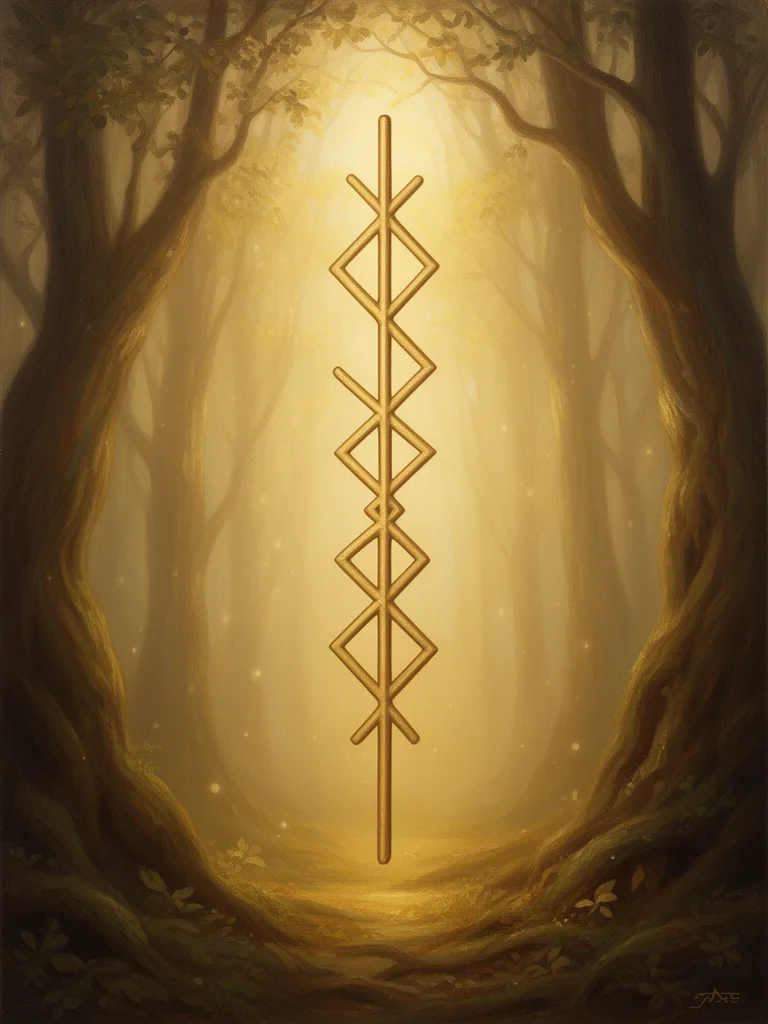
Ogham is an ancient alphabet, primarily associated with Old Irish, used for inscriptions on stone monuments. It consists of lines and notches representing phonetic sounds, often linked to trees and natural elements in Celtic traditions.
Where the word comes from
The origin of "Ogham" is uncertain, but it is believed to derive from the Old Irish word ogham, potentially related to og meaning "point" or "edge," referencing the linear nature of the script. It first appeared in inscriptions dating from the 4th century CE.
In depth
A mystery lanjriiafre l)elon<;inf? to the early Celtic laeis. and used by the Druids. One form of tliis lan«;uage consisted in the association of the leav»'S of certain trees witli the letters, this was called lirth-liiis-nioti Offfuini, and to form words and senti-nces the leaves were strung on a cord in the proper order. Godfrey Iliggins suggests that to complete the mystification certain otlier leaves which meant jiotliing were interspersed, [w.w.w.] Ogir or Ilhr (Scdnd.). A chief of the giants in the Edda and the .illy of tlie gods. The highest of the Water-gods, and the same as the (ini'k Okeanos. Ogmius. The god of wisdom and eloquence of the Di'uids. hence llri-mt's in a sense. 0§7&i3' (('f'-)An ancient sid)merged island known as the isle of < alypso, and identified by some with Atlantis. This is in a certain sense correct. But then what portion of Atlantis, since the latter was a continent rather than an "enormous" island! Oitzoe (P(rs.). The invisible goddess whose voice spoke through the rocks, and whom, according to Pliny, the Magi had to consult for the f'lection of their kings.
What it means today
The Ogham script, with its stark, linear forms, offers a fascinating entry point into the pre-Christian Celtic mind. Unlike the flowing scripts of the East or the more ornate alphabets of the Mediterranean, Ogham is elemental, almost architectural in its construction. Mircea Eliade, in his exploration of archaic techniques of ecstasy, often points to the power of symbolic systems to bridge the mundane and the sacred. The Ogham, with its rumored connections to trees and their inherent properties, could be seen as such a bridge, a way of inscribing the very energies of the natural world onto stone.
The association of Ogham letters with specific trees, a practice known as beth-luis-nion (after the first three letters derived from tree names: beith for birch, luis for rowan, nin for ash), suggests a deeply animistic understanding of the cosmos. Each tree was not merely a plant but a repository of spirit, a living symbol whose essence could be invoked through its corresponding letter. This is not dissimilar to the symbolic correspondences found in Hermeticism or the seed syllables (bijas) in Tantric Buddhism, where sound and form are imbued with potent spiritual force. The act of carving Ogham, therefore, was not simply writing but an act of invocation, a way of grounding abstract concepts or names into the enduring substance of the earth.
While Blavatsky's definition touches upon the leaves being strung on a cord, a more common understanding points to inscriptions on standing stones, often marking boundaries or the graves of chieftains. This physical presence, the script etched into rock, lends it a permanence that echoes the enduring power of the natural world it purportedly represents. It invites contemplation of a time when the world was perceived as a text, and the wise could read its divine inscriptions. It reminds us that meaning can be found not only in elaborate narratives but in the stark, deliberate arrangement of simple lines.
RELATED_TERMS: Runes, Cuneiform, Hieroglyphs, Glyphs, Symbolism, Animism, Celtic Mythology
Related esoteric terms
Books on this concept







No reflections yet. Be the first.
Share your interpretation, experience, or question.
