Nine
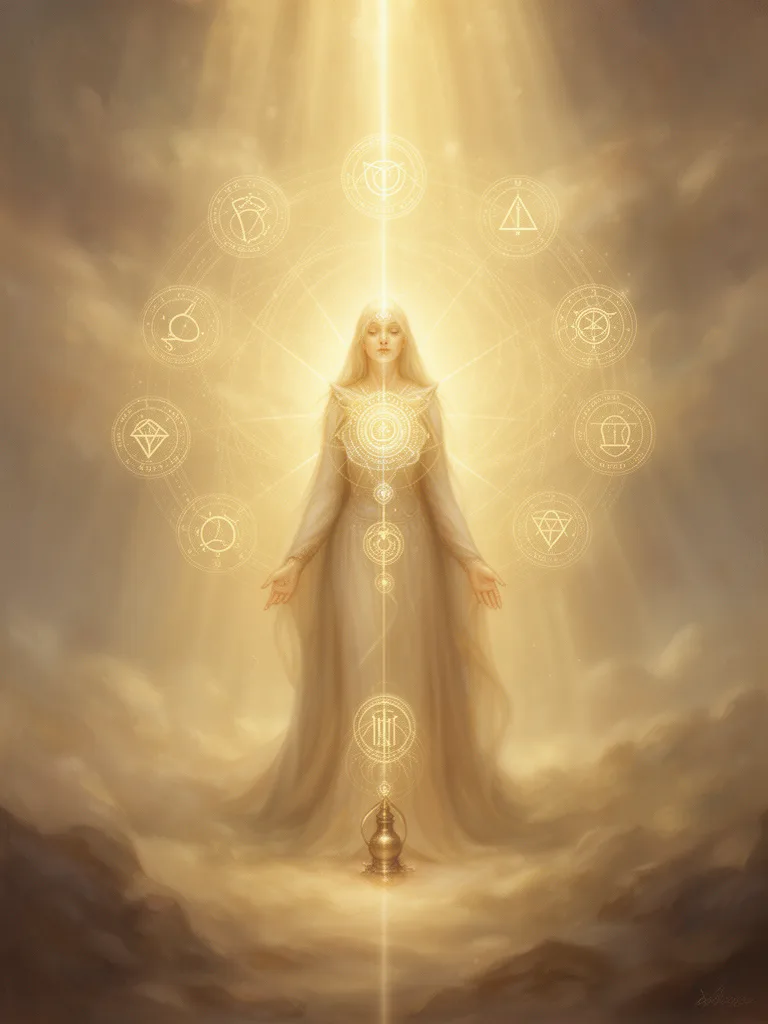
The number nine, in esoteric traditions, often symbolizes completion, cosmic order, and divine totality. It represents the culmination of a cycle, bridging the earthly and the divine, and is frequently associated with spiritual attainment and hidden knowledge.
Where the word comes from
The word "nine" derives from the Proto-Germanic newun, ultimately tracing back to the Proto-Indo-European root h₁néwn̥, meaning "nine." This ancient root is shared across many Indo-European languages, indicating its fundamental place in early human enumeration and conceptualization.
In depth
The "Kahl)alah of the Nine Chamhers" is a form of secret \viitin<; in ei[)her, which orijrinated witli tlie Hebrew Rabbis, and has bt-en used by several societies for pur])0Ses of concealment : notably some grrades of the Freemasons have ado])ted it. A iigfure is drawn of two horizontal parallel lines and two vertical parallel lines across them, this process forms nine chambers, the centre one a simple square, the others beinp: either two or three sided ligures, these are allotted to the several letters in any order that is ajrreed upon. There is also a Kabbalistic atttribution of the ten Sephiroth to these nine chambers, but this is not published, [w.w.w.]
How different paths see it
What it means today
The number nine, a seemingly simple integer, resonates with a profound sense of fullness and completion across diverse esoteric currents. In the ancient world, where numbers were not merely quantitative but qualitative, nine stood as a potent symbol. It is the square of three, the number of the divine trinity, thus amplifying its sacred resonance. For thinkers like Pythagoras, numbers were the very essence of reality, and nine, as the last single digit before the return to unity in ten, held a special place, signifying the culmination of a grand cycle.
Mircea Eliade, in his seminal works on the history of religions, often highlighted how cyclical time, marked by completion, was central to ancient cosmologies. The number nine, by representing the end of one sequence and the precipice of another, embodies this cyclical understanding. It is the number of planets in some astrological systems, the nine months of gestation, the nine Muses of inspiration. In the Kabbalistic context mentioned by Blavatsky, even if the "nine chambers" are a less common attribution, the idea of partitioning divine emanations or stages of consciousness into a specific numerical pattern underscores the human impulse to map the ineffable.
This impulse is mirrored in the Sufi tradition, where the journey of the soul towards God, the sayr ilallah, can be understood as a progression through stages, each representing a deepening of spiritual realization. While not always explicitly numbered nine, the concept of a completed path, a state of spiritual maturity, is akin to the symbolic fullness that nine represents. Similarly, in Buddhist thought, the path to enlightenment involves overcoming a series of obstacles or mental states. The attainment of Nirvana, the ultimate liberation, can be seen as the completion of this arduous journey, a state of profound peace and wholeness.
The modern seeker, often adrift in a sea of information and fragmented experiences, can find in the symbolism of nine a call to integrate and synthesize. It suggests that true understanding is not merely about accumulating knowledge but about reaching a point of completion, a state where disparate elements coalesce into a meaningful whole. This number invites contemplation on the cycles of life, the culmination of efforts, and the potential for a new, more profound beginning that emerges from that completion. It is a reminder that endings are often the most fertile ground for new creation.
RELATED_TERMS: Trinity, Octave, Completion, Cycle, Totality, Sephiroth, Stages of Consciousness, Divine Manifestation
Related esoteric terms
Books on this concept








No reflections yet. Be the first.
Share your interpretation, experience, or question.
