Mot
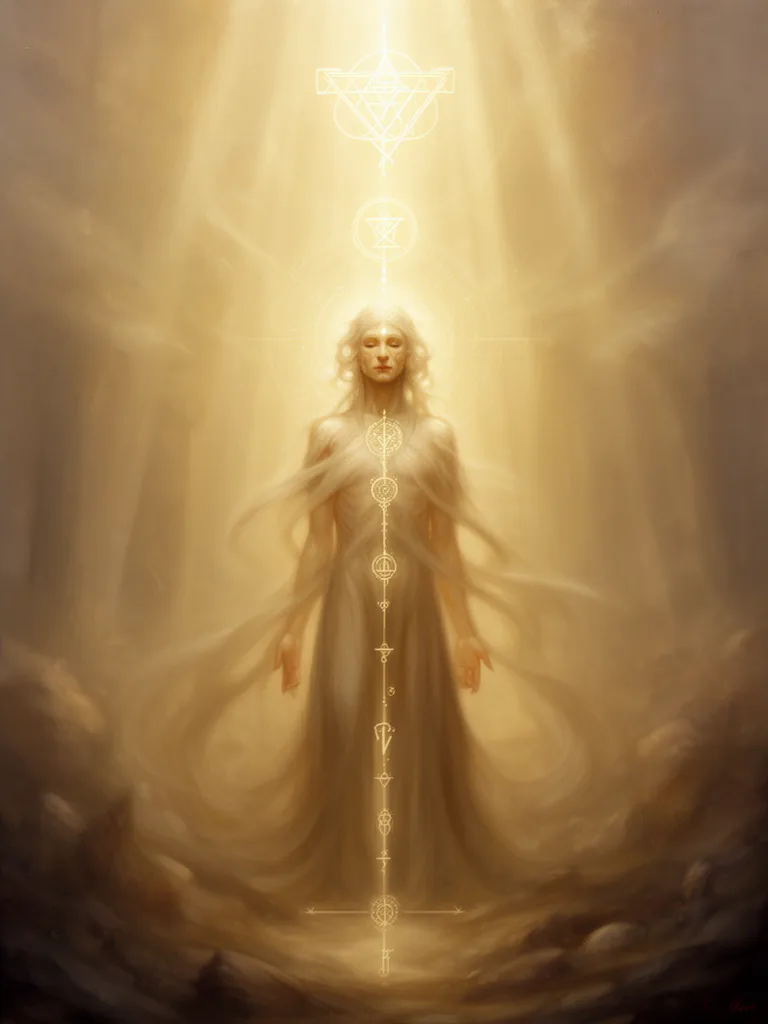
Mot signifies primordial chaos, the undifferentiated source from which all creation emerges, akin to a cosmic mother or the moon. It represents the primal substance of existence before form, a concept found in ancient cosmogonies.
Where the word comes from
The term "Mot" is not directly traceable to a single ancient language in a universally accepted scholarly form. Blavatsky associates it with "Mooth" from the Tyrrhenian Cosmogony and Egyptian "Mout," suggesting a root related to "mother" or "primordial substance." Its appearance is linked to speculative interpretations of ancient mythologies.
In depth
The same as ilus, mud, primordial ehaos; a Avord used in the Tyrrhenian Cosmogony (See "Suidas"). Mout or Mooth (Eg.). The mother goddess; primordial goddesses, for "all the gods are born from Mooth", it is said. Astronomically, the moon.
How different paths see it
What it means today
Blavatsky's inclusion of "Mot" in her lexicon, drawing from the obscure Tyrrhenian Cosmogony and linking it to Egyptian "Mout," invites a contemplation of the primordial feminine principle as the very fount of existence. This is not merely a linguistic curiosity; it is an invitation to revisit the deep, often submerged, archetypes that inform our understanding of creation. Mircea Eliade, in his explorations of archaic cosmogonies, consistently highlights the role of a primordial, undifferentiated state—a chaos or a watery abyss—as the necessary prelude to ordered existence. This "chaos" is not necessarily negative, but rather pregnant with possibility, a fertile void.
The association with the moon, a celestial body often linked to cyclical processes, feminine energies, and the subconscious, further enriches the term's resonance. In many traditions, the moon governs the ebb and flow of tides, the rhythms of nature, and even the fluctuations of the human psyche. It represents a more passive, receptive, and cyclical aspect of divinity, contrasted with the active, solar principle. The idea that "all the gods are born from Mooth" suggests a matriarchal or at least a primordial feminine sovereignty at the heart of the cosmos, a concept that can be understood through the lens of Carl Jung's anima archetype or the more abstract notion of Sophia in Gnostic traditions.
For the modern seeker, "Mot" serves as a powerful counterpoint to narratives of creation that emphasize a singular, masculine, transcendent deity. It points towards an immanent, generative force, a cosmic womb from which all manifest reality, including our own consciousness, emerges. It encourages a reverence for the unformed, the potential, the silent, pregnant darkness that precedes the brilliant dawn of awareness. This concept prompts us to look not only to the heavens for origins but also to the deep, primal waters within ourselves and the universe, recognizing the mothering force that sustains all being.
Related esoteric terms
Books on this concept






No reflections yet. Be the first.
Share your interpretation, experience, or question.
