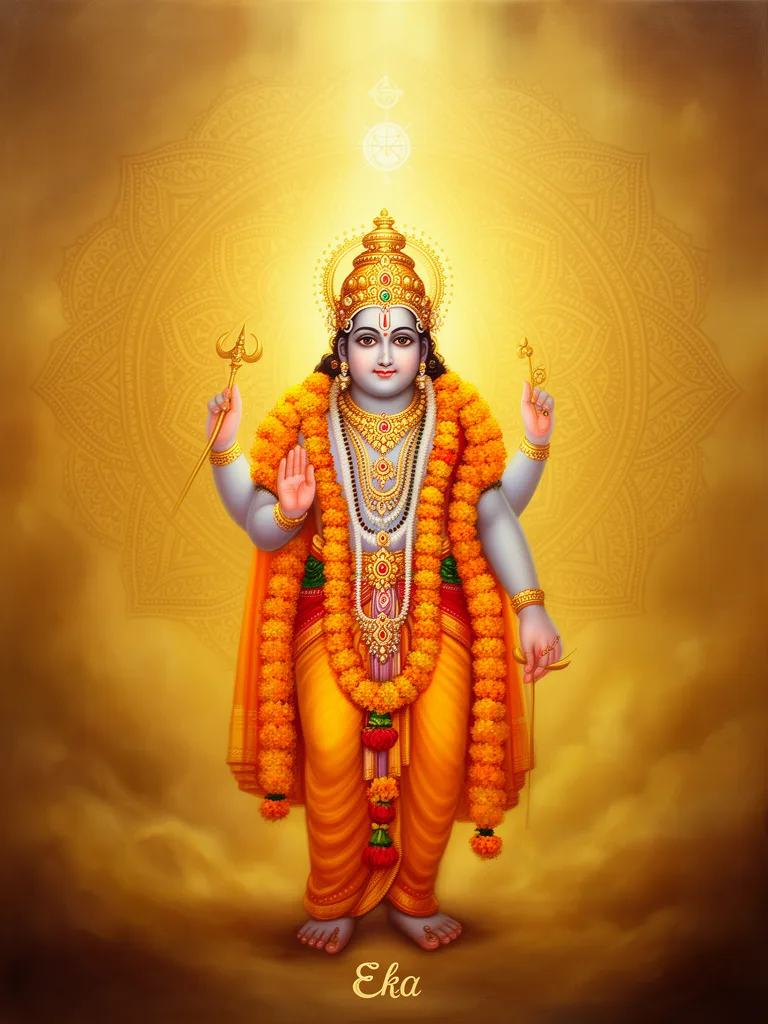
Eka
Eka signifies "one" or "single" in Sanskrit, representing unity, singularity, and the primordial oneness from which all existence arises. It is often synonymous with Mahat, the Universal Mind, embodying the principle of cosmic intelligence and the singular source of all phenomena.
Where the word comes from
The term "Eka" originates from Sanskrit, derived from the Proto-Indo-European root *oinos, meaning "one." It is the foundational numeral for singularity and uniqueness, appearing in numerous philosophical and religious contexts to denote an undivided, ultimate reality or principle.
In depth
"One"; also a synonym of Mahat, the Liiirtrsal Miml. as the principle of Intelligence.
How different paths see it
What it means today
The Sanskrit word "Eka," meaning "one," carries a weight far beyond simple enumeration. It is a conceptual anchor, a whisper of the primordial unity that precedes all distinction. In the Hindu tradition, Eka is not merely a number but an ontological statement, pointing to the singular, undifferentiated absolute, Brahman, from which the cosmos unfurls. Blavatsky’s association of Eka with Mahat, the Universal Mind, further illuminates its role as the principle of intelligence, the singular consciousness that animates the manifold.
This concept resonates deeply with the modern seeker grappling with the overwhelming complexity of existence. In a world saturated with information and perceived divisions, Eka offers a potent reminder of underlying coherence. Mircea Eliade, in his explorations of the sacred, often highlighted humanity's perennial search for a unified center, a point of origin or ultimate reality that can orient experience. Eka serves precisely this function, grounding the observer in the singular truth of being. It is the stillness from which all movement arises, the silence that contains all sound.
The pursuit of Eka is not an intellectual exercise alone but a contemplative practice. It mirrors the insights of mystics across traditions who speak of a return to the source, a dissolution of the egoic self into a larger, singular awareness. This is not a loss of individuality in a nihilistic sense, but a realization of one's true nature as inseparable from the whole. The challenge lies in perceiving this singularity not as an abstract concept, but as the living, breathing reality of every moment, the subtle hum beneath the cacophony of the everyday. Eka is the fundamental truth that the many are, in essence, one, a realization that can profoundly alter one's perception of self and the world. It invites us to see the universe not as a collection of separate objects, but as a single, indivisible expression of ultimate reality.
RELATED_TERMS: Brahman, Atman, Mahat, Unity, Monism, Consciousness, Being, Oneness
Related esoteric terms
Books on this concept







No reflections yet. Be the first.
Share your interpretation, experience, or question.
