Chaos
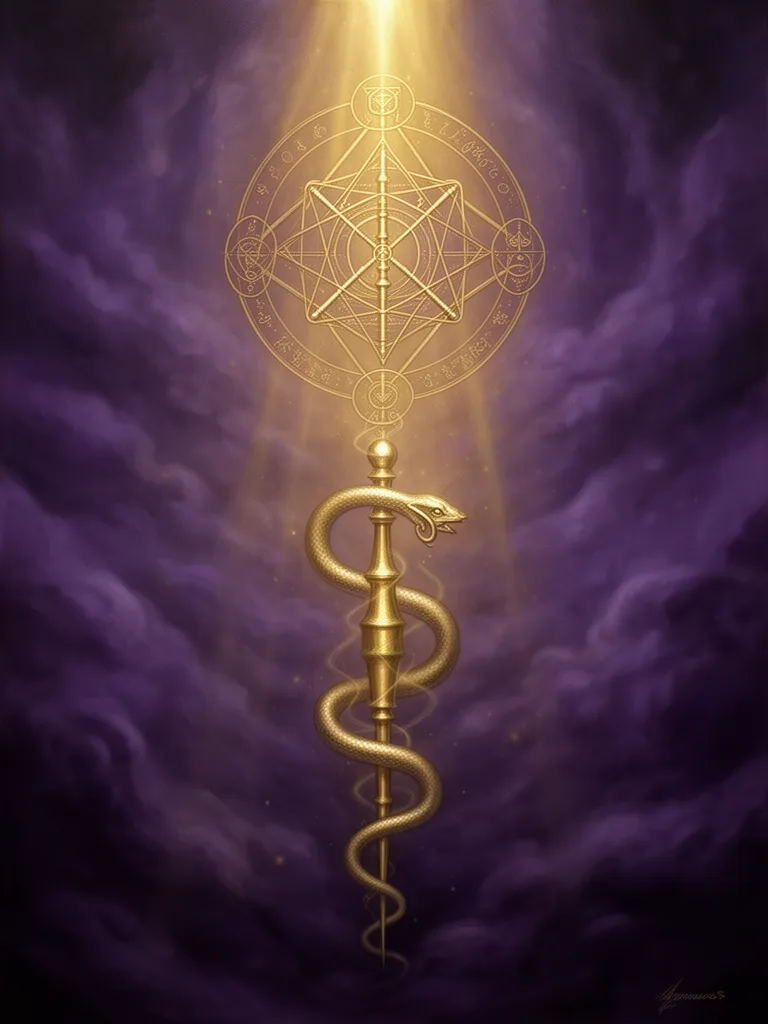
Chaos refers to the primordial, unmanifest state of existence before creation. It is the boundless, undifferentiated potential from which all form and order emerge, often personified as a divine, fertile abyss.
Where the word comes from
The term "Chaos" originates from the ancient Greek word "khaos" (χάος), meaning "yawning gap" or "abyss." In Hesiod's Theogony, it describes the primordial void from which the cosmos sprang, a concept predating the written word and later adopted into various philosophical and mystical traditions.
In depth
The Aby.ss the '"Great Deep". It was personified in Egj'pt by the Goddess Neith, anterior to all gods. As Deveria says, "the only God. without form and sex, who gave birth to itself, and without fecundation, is adored under the form of a Virgin Mother". She is the vulture-lu'aded Goddess found in the oldest period of Abydos, who belongs, accordingly to Mariette Bey. to the lirst Dynasty, which would make her, even on the confession of the time-dwarfing Orientalists, about 7.000 years old. As ]\Ir. Bonwick tells us in his excellent work on Egyptian belief — "Neith, Nut, Nepte, Nuk (her names as variously read!) i? a philosophical conception worthy of the nineteenth century after the Christian era, rather than the thirty-ninth before it or earlier than that". And he adds: "Neith or Nout is neither more nor less than the Great Mother , and yet the Immaculate Virgin, or female God from whom all things proceeded". Neith is the "Father-Mother" of the Stanzas of the Secret Doctrine, the Swahhdvat of the Northern Buddhists, the immaculate Mother indeed, the prototype of the latest "Virgin" of all : for. as Sharpe says, "the Feast of Candlemas — in honour of the goddess Ne'ith — is ytt inarkctl in our Alinaimes as Candlenuis tlay. or the Purification of the \'irf;in Mary"; and Beaun-pard tells us of "the lininaeulati' Conception of the Virj^in, wlio can hcnci'forth, as well as the Hj,'yptian Mim-rva. tlic mysterious Neith, boast of havinj: come from hersi'lf. and of havinjr piven birth to God". He who would deny the working; of cycles and the recurrence of events, let him read what Xeith was 7.000 years n^o, in the conception of the Egyptian Initiates, trying to popularize a philosophy too abstract for the ma.s.se8; and then remend)er the subjects of disjiute at the Council of Kphesus in 4'M, wlien Mary was (h'clared Mother of God; and her immaculate Concejjtion forced on the World as by command of God, by Pojx' and Council in lSr)8, Ni'i'th is Swabhavat and also the Vedic A
How different paths see it
What it means today
The concept of Chaos, as understood in Hermetic thought and echoed in other traditions, offers a profound counterpoint to our modern inclination towards order and predictability. It is not the nihilistic void of popular imagination, but rather the fertile, pregnant abyss from which all existence unfolds. Mircea Eliade, in his seminal work "The Myth of the Eternal Return," explores how ancient cosmogonies often depict creation as an emergence from a primordial watery chaos, a state of undifferentiation that is both terrifying and generative. This primordial state is not an absence of being, but a superabundance of potential, a boundless sea of possibilities before the divine intellect imposes form and distinction.
Blavatsky's reference to the Egyptian goddess Neith, described as the "Father-Mother," "Immaculate Virgin," and "Great Mother," beautifully illustrates this concept. Neith is anterior to all gods, embodying a primal, self-generating essence from which everything proceeds. This resonates with the Gnostic concept of the Pleroma, the fullness of the Godhead, from which emanations arise. In Hermeticism, Chaos is the prima materia, the raw, unformed substance that the divine craftsman, the Demiurge, shapes into the cosmos. It is the unmanifest potential that awaits the divine spark of organization. For the modern seeker, understanding Chaos is to embrace the mystery of beginnings, to recognize that true innovation and transformation often arise from a period of dissolution, a willingness to enter the "unformed" space before a new structure emerges. It is a call to confront the unknown, not with fear, but with the understanding that within this boundless abyss lies the seed of all that is yet to be.
RELATED_TERMS: Prima Materia, Void, Unmanifest, Brahman, Pleroma, Akasha, Nun, Great Mother
Related esoteric terms
Books on this concept





No reflections yet. Be the first.
Share your interpretation, experience, or question.
