Minos
Minos is a legendary figure from Greek mythology, primarily known as the king of Crete and a wise lawgiver. In later esoteric traditions, he became associated with the underworld and the judgment of souls, symbolizing divine justice and the ordering of cosmic principles.
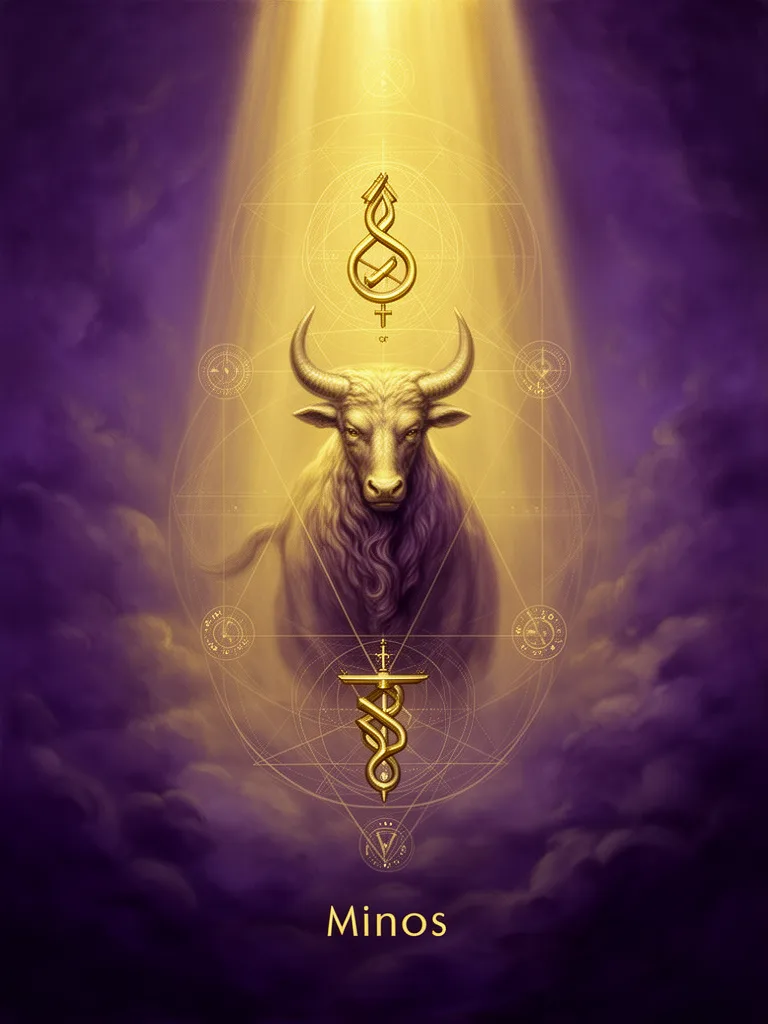
Where the word comes from
The name Minos derives from the Greek word "Mīnos" (Μίνως). Its precise etymological roots are debated, but some scholars suggest a possible connection to Minoan civilization, named after him, or even to pre-Greek linguistic strata, hinting at an ancient, foundational authority.
In depth
Tiie great Judge in Iladcs. An ancient King of Crete.
How different paths see it
What it means today
The figure of Minos, as he appears in the ancient Greek myths and is subsequently reinterpreted in esoteric traditions, offers a profound lens through which to examine the nature of judgment and cosmic law. Initially, he is the wise king of Crete, a legislator whose laws were so revered they were said to have been dictated by Zeus himself. This establishes him as an embodiment of earthly order, a ruler who brought justice and civilization to his people. However, it is his later role, particularly as depicted in the underworld, that truly animates his esoteric significance.
In Hades, Minos becomes one of the three judges of the dead, alongside Rhadamanthus and Aeacus. This transition from earthly ruler to celestial arbiter signifies a movement from the temporal to the eternal, from the governance of mortals to the reckoning of souls. Mircea Eliade, in his studies of comparative religion, often highlights how figures who bridge the earthly and divine realms serve as conduits for sacred power and cosmic wisdom. Minos, in this context, represents the impartial, divine justice that operates beyond human fallibility. He is the embodiment of the principle that actions have consequences, a universal law that even the departed must face.
For the Hermetic tradition, which seeks to understand the underlying principles of the cosmos, Minos embodies the concept of divine law or the Logos. His judgment is not arbitrary but a reflection of the inherent order of the universe. This resonates with the Hermetic axiom "As above, so below," suggesting that the principles governing the cosmos are mirrored in the human soul and in the processes of life and death. The judgment of Minos, therefore, is not merely punitive but a process of recognition and alignment with these fundamental truths. It speaks to the idea that the soul, upon shedding its physical form, must confront its own actions and their place within the grander scheme.
The psychological dimension of Minos is also compelling. Carl Jung's exploration of archetypes reveals how figures like the wise old man or the divine judge represent profound aspects of the human psyche. Minos can be seen as the archetype of the inner judge, the faculty within us that assesses our choices and guides us towards a more integrated self. His presence in the underworld can be interpreted as the soul’s encounter with its own conscience, its own deepest truths, stripped bare of earthly pretenses. This internal reckoning is a crucial step in any path of spiritual development, a necessary purification before any ascent. The precise, unyielding nature of his judgment underscores the importance of ethical conduct and the integrity of one's intentions, not just for societal harmony but for the soul's own liberation. The enduring myth of Minos reminds us that justice is not merely a human construct but a cosmic imperative, a force that shapes existence itself.
Related esoteric terms
Books on this concept








No reflections yet. Be the first.
Share your interpretation, experience, or question.
