Manus
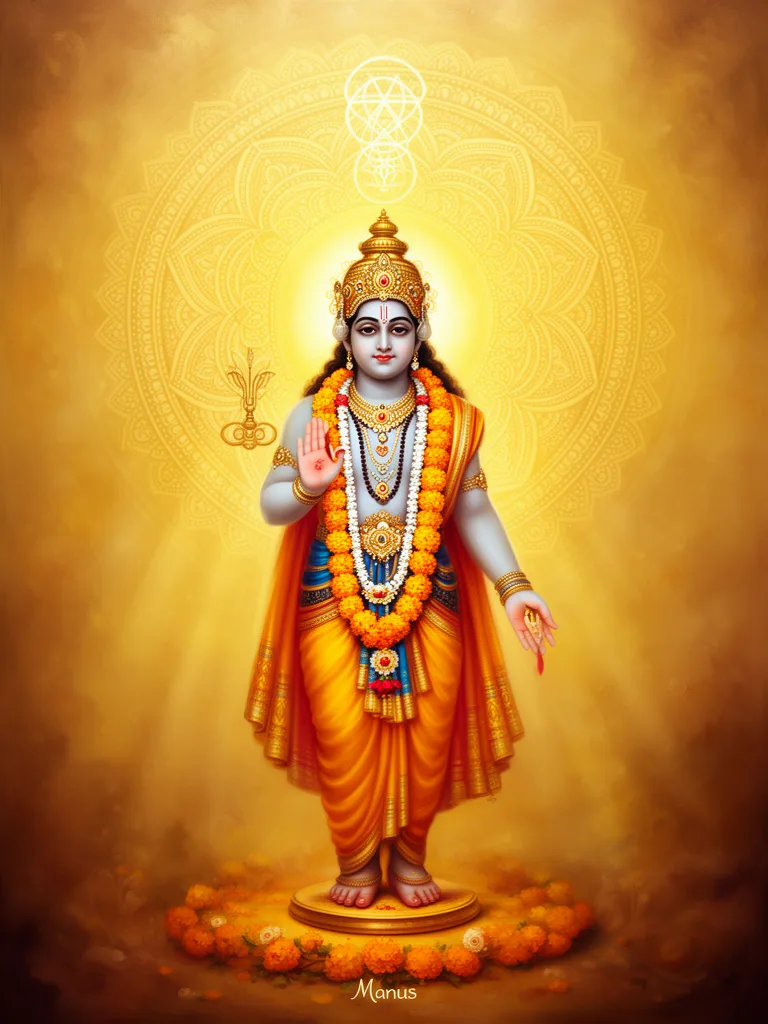
Manus are progenitor figures in Hindu cosmology, each presiding over a cosmic epoch (Manvantara) and the lineage of humanity within that era. They are seen as divine lawgivers and progenitors, shaping the course of creation and human development across vast cycles of time.
Where the word comes from
The Sanskrit term "Manu" (मनु) derives from the root "man," meaning "to think" or "to measure." It signifies the primordial man, the first ancestor, and the lawgiver. In Vedic and Puranic traditions, Manu is the archetypal human from whom all humanity descends, establishing the foundational laws and social structures.
In depth
The fourteen Manus are tlie })atrons or guardians of the race cycles in a ]\Ianvantara, or Day of Brahma. The primeval Manus are seven, they become fourteen in the Piirdnas. Manushi or Mamishi Biiddhas (Sk.). Human Buddhas. Bodhi.sattvas. or incarnated Dyhan Chohans.
How different paths see it
What it means today
In the grand, sweeping narratives of Hindu cosmology, the Manus emerge as figures of immense, almost geological significance. They are not merely ancestors in the human sense, but the very architects of successive epochs of existence. Helena Blavatsky, in her ambitious synthesis, notes their role as patrons and guardians of "race cycles," a concept that resonates with the modern understanding of distinct historical periods, each with its own unique character and developmental trajectory. The fourteen Manus, as delineated in the Puranas, suggest a recurring pattern of creation, governance, and eventual dissolution, only to be followed by a new genesis under a new Manu. This echoes Mircea Eliade's observations on the cyclical nature of time in archaic societies, where the repetition of primordial acts, often initiated by divine beings or culture heroes, serves to renew the world and restore order. The root "man," meaning to think, imbues Manu with the quality of intellect and foresight, positioning him not just as a progenitor but as a cosmic lawgiver, establishing the principles of Dharma that guide human conduct. This is not a static blueprint but a dynamic unfolding, where each Manu initiates a new phase in the grand cosmic drama. The idea of "human Buddhas" or "Manushi Buddhas" mentioned by Blavatsky, while specific to a Buddhist interpretation, hints at a universal archetype of enlightened beings who guide humanity, a concept that finds a parallel in the Manu's role as a divinely appointed leader. The Manus, therefore, offer a framework for understanding history not as a linear progression, but as a series of grand cycles, each initiated and overseen by a primal intelligence, reminding us that the ordering of the world is an ongoing, divinely orchestrated process.
RELATED_TERMS: Brahma, Kalpa, Manvantara, Yuga, Dharma, Progenitor, Archetype, Cosmic Cycle
Related esoteric terms
Books on this concept







No reflections yet. Be the first.
Share your interpretation, experience, or question.
