Lares
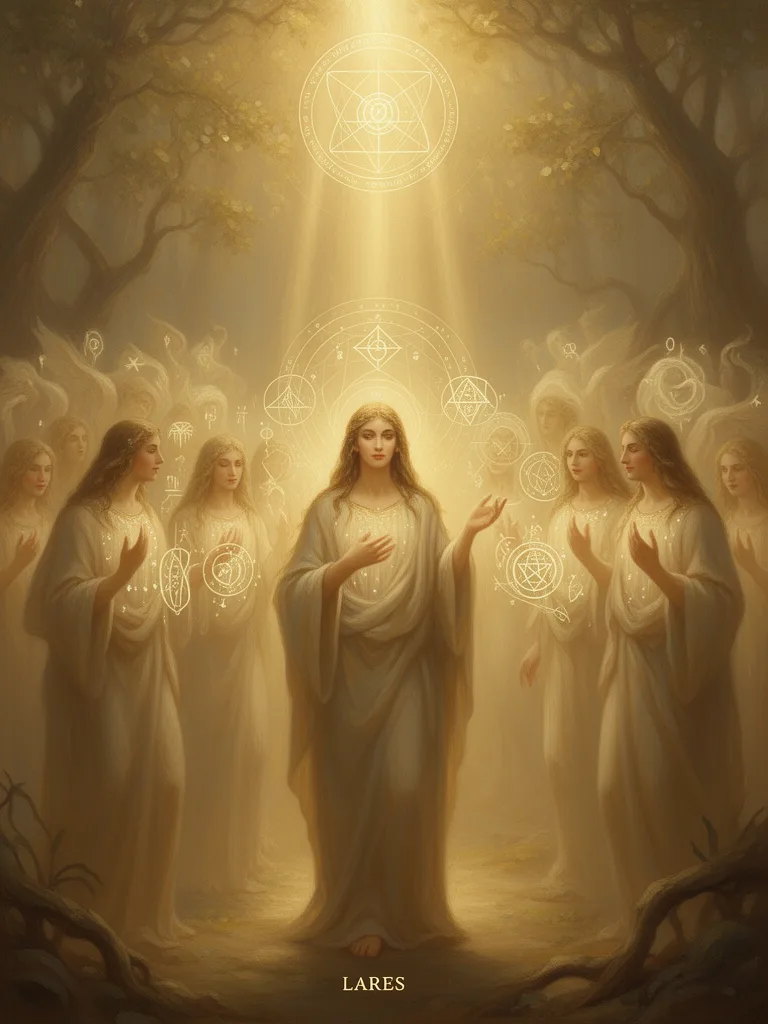
Lares were ancestral spirits venerated in ancient Roman religion, believed to protect households, families, and communities. They represented the deified dead, serving as guardians of domestic life and public spaces.
Where the word comes from
The term "Lares" is of uncertain origin, possibly Etruscan. It is associated with Roman household deities, first appearing in historical records during the Roman Republic. The plural form likely derives from an ancestral or protective spirit concept.
In depth
These were of three kinds: Laris famHiarcs. the guardians and invisible presidents of the family circle; Lares j)arvi, small idols used for divinations and augury: and Lares prastites, which were supposed to maintain order among the others. The Lares are the manes or ghosts of disembodied people. Apuleius says that the turaulary inscription. To the gods manes who lived, meant that the Soul had been transformed in a Lcmurc; and adds that though "the human Soul is a demon that our languages may name genius", and "is an immortal god thougli in a certain .sr».se she is horn at the same time as the man in whom she is, yet we may say that she dies in the same way that she is born''. Which means in plainer language that Lares and Lemures are simply the shells cast off by the Ego, the high spiritual and immortal Soul, whose shell, and also its astral reflection, the animol Soul, die, whereas the higher Soul prevails throughout eternity.
How different paths see it
What it means today
Blavatsky's definition, though couched in the complex, sometimes opaque language of late 19th-century occultism, points to a fascinating aspect of ancient Roman belief: the Lares as more than mere idols or superstitions. They represent a deeply ingrained understanding of the continuity of consciousness and the spiritual resonance of place. Mircea Eliade, in his studies of religion, often highlighted how archaic societies perceived the sacred as immanent, an active force within the world, not separate from it. The Lares are a prime example of this immanence, embodying the idea that the spirits of those who lived within a home continue to exert a protective influence over it, a concept echoed in the Hindu veneration of Pitrs, or ancestral spirits.
The notion that Lares are "shells cast off by the Ego" suggests a precursor to Jungian ideas of the collective unconscious and archetypes, or perhaps even a more literal interpretation of the astral body's separation from the physical at death. Apuleius's quote, as interpreted by Blavatsky, speaks to the soul's transformative journey, its "birth" and "death" in relation to the physical form, yet its ultimate enduring nature. This resonates with the perennial philosophy's emphasis on the immortal soul and the transient nature of its material coverings. For the modern seeker, the concept of Lares offers a potent reminder that our environments are not merely inert spaces but can be imbued with spiritual significance and ancestral memory. It encourages a mindful relationship with our homes, seeing them not just as shelters but as sacred spaces, animated by the echoes of those who came before and the protective energies they may still embody. This perspective invites a re-enchantment of the domestic sphere, transforming it into a locus of spiritual connection and continuity.
Related esoteric terms
Books on this concept








No reflections yet. Be the first.
Share your interpretation, experience, or question.
