Kamadeva
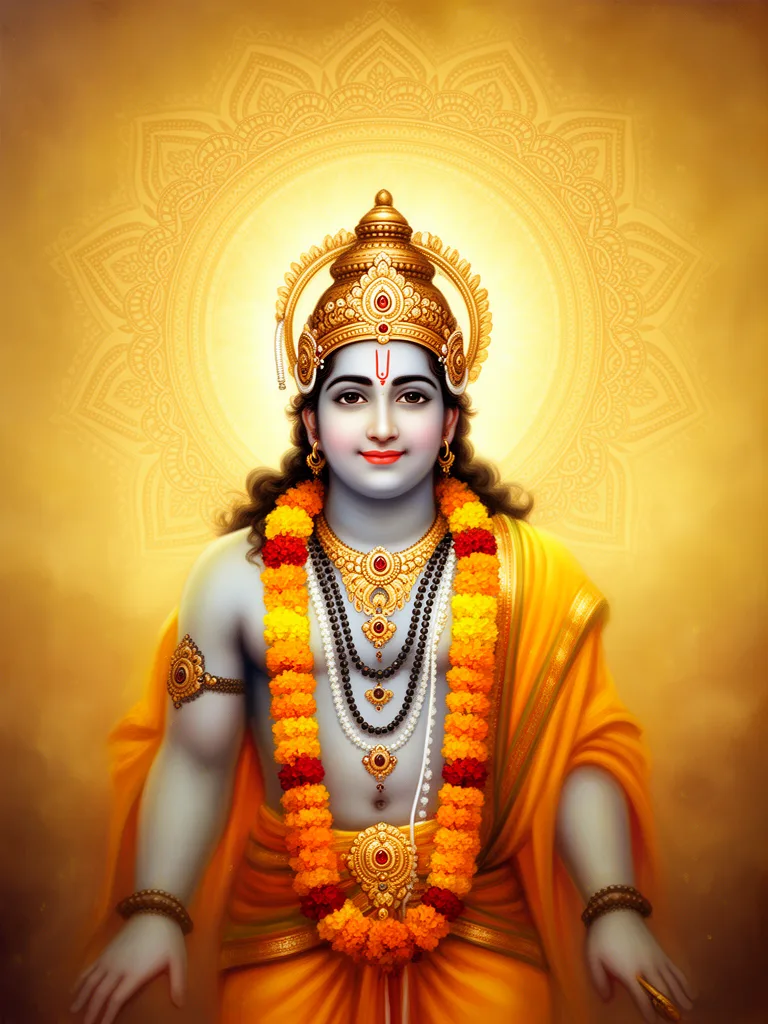
Kamadeva is the Hindu god of love, desire, and longing, often depicted as a youthful deity with a bow of sugarcane and arrows of flowers. He embodies the creative impulse and the universal attraction that animates existence, transcending mere physical passion.
Where the word comes from
The Sanskrit term "Kamadeva" (कामदेव) literally translates to "god of desire" or "deity of love." It is derived from "kama" (काम), meaning desire, longing, or love, and "deva" (देव), meaning god or deity. The concept predates the Puranic era, with roots in Vedic literature.
In depth
In the popular notions the god of love, a Visvadeva, in the Hindu Pantheon. As the Eros of Hesiod, degraded into Cupid by exoteric law, and still more degraded by a later popular sense attributed to the term, so is Kama a most mysterious and metaphysical subject. The earlier Vedic description of Kama alone gives the key-note to what he emblematizes. Kama is the first conscious, all enibracing desire for universal good, love, and for all that lives and feels, needs help and kindness, the first feeling of infinite tender compassion and mercy that arose in the consciousness of the creative One Force, as soon as it came into life and being as a ray from the Absolute. Says the Rig Veda, "Desire first arose in It, which was the primal germ of mind, and which Sages, searching with their intellect, have discovered in their heart to be the bond which connects Entity with non-Entity'', or Manas with pure Atma-Buddhi. There is no idea of sexual love in the conception. Kama is pre-eminently the divine desire of creating happiness and love ; and it is only ages later, as mankind began to materialize by anthropomorphization its grandest ideals into cut and dried dogmas, that Kama became the power that gratifies desire on the animal plane. This is shown by what every Veda and some Brahmanas say. In the Atharva Ved^, Kama is represented as the Supreme Deity and Creator. In the Taitar'iya Brahmann, he is the child of Dliarnia. the god of Law and Justice, of Sraddha and faith. In another account he springs from the heart of Brahmji. Others show him born from water i.e., from primordial chaos, or the "Deep". Hence one of his many names, Ird-ja, "the waterborn"; and Aja, "unborn"; and Atmahhu or "Self-existent". Because of the sign of Mnl-ara (Capricornus) on his banner, he is also called "Makara Ketu". Tlie allegory about Siva, the "Great Yogin", reducing Kama to ashes by the fire from his central (or third) Eife, for inspiring the Mahadeva with thoughts of his wife, while he was at h
How different paths see it
What it means today
In the grand theater of Hindu cosmology, Kamadeva, the god of love and desire, is far more than a mere Cupid figure. Blavatsky, in her insightful, if sometimes dense, exegesis, points to the Vedic roots of the concept, where Kama is not the debased, sensual passion of later anthropomorphism, but the primordial urge, the "first conscious, all embracing desire for universal good, love." This is a crucial distinction. It positions Kama not as an agent of fleeting pleasure, but as the very engine of existence, the cosmic longing that arises from the Absolute, the "primal germ of mind."
Mircea Eliade, in his exploration of the sacred and the profane, often highlighted how ancient cultures perceived fundamental forces of nature and human experience as divine. Desire, in this context, is not merely a personal emotion but a universal principle, a force that animates the cosmos. It is the attractive power that draws atoms together, that makes stars ignite, and that compels life to perpetuate itself. The Rig Veda's description of desire as the "bond which connects Entity with non-Entity" resonates with mystical traditions that speak of the divine spark within all things, a yearning to return to its source or to express itself fully in manifestation.
The imagery of Kamadeva’s bow of sugarcane and arrows of flowers, while seemingly lighthearted, speaks to the potent, yet often ephemeral, nature of desire. Sugarcane, sweet and life-giving, represents the allure of the world, while flower-tipped arrows suggest the swift, sometimes intoxicating, effect of longing. Yet, the deeper meaning, as Blavatsky suggests, lies in the recognition of this desire as a fundamental aspect of consciousness itself, a creative force that, when understood and directed, can lead to profound spiritual realization rather than mere worldly attachment. It is the echo of the divine impulse to create, to love, and to connect, a whisper from the heart of the universe.
RELATED_TERMS: Desire, Love, Creation, Longing, Shakti, Prana, Eros, Attraction
Related esoteric terms
No reflections yet. Be the first.
Share your interpretation, experience, or question.
