Hakim
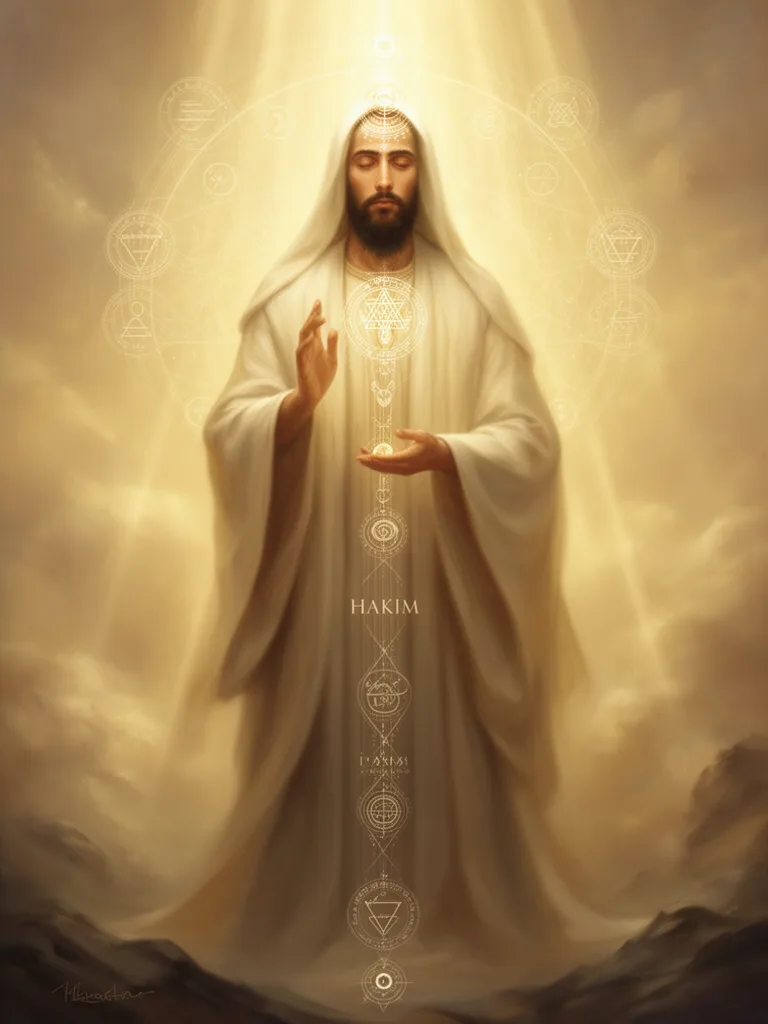
A wise physician or sage, the term Hakim denotes one who possesses profound knowledge of both physical healing and spiritual wisdom. Beyond mere medical skill, a Hakim offers guidance for the soul, embodying a holistic understanding of well-being that integrates body, mind, and spirit.
Where the word comes from
The word Hakim derives from the Arabic root ḥ-k-m, meaning "to be wise" or "to govern." It entered Persian, Urdu, and other languages of the Islamic world. The concept of the wise healer or physician is ancient, appearing in various forms across cultures, but Hakim specifically signifies this dual mastery within Islamic and related traditions.
In depth
A doctor, in all the Eastern countries, from Asia .Miiioito India.
How different paths see it
What it means today
Blavatsky's definition, though brief and geographically focused, captures a kernel of truth: the Hakim is a doctor, yes, but one whose practice extends far beyond the scalpel or the prescription pad. In the rich tapestry of Eastern thought, particularly within the Sufi tradition, the Hakim is a figure of profound spiritual authority. Mircea Eliade, in his explorations of shamanism and archaic techniques of ecstasy, often touches upon the healer as a mediator between worlds, one who understands the invisible forces that govern health and illness. The Hakim embodies this ancient role, a physician of the soul as much as the body.
This is not a mere academic pursuit; the Hakim's wisdom is lived, embodied. It is the understanding that a fever might be a manifestation of a deeper spiritual imbalance, or that a troubled heart can manifest as physical malaise. Think of the Persian poet Rumi, himself a mystic and spiritual guide, whose verses often speak of the spiritual physician who prescribes contemplation, devotion, or detachment as remedies for the soul's afflictions. The Hakim’s practice, therefore, involves a deep listening, not just to the patient's symptoms, but to the silent language of their being.
The term speaks to a holistic worldview, one that predates and, in many ways, surpasses our contemporary fragmented approaches to well-being. It suggests that true healing is not merely the absence of disease, but the presence of a vibrant, integrated life force, a harmony between the individual and the cosmos. This resonates deeply with modern explorations of psychosomatic medicine and the growing recognition of the mind-body connection, but the Hakim’s perspective is rooted in a spiritual cosmology, a recognition of divine order and purpose. As Henry Corbin might suggest, the Hakim is a figure who bridges the imaginal and the material, understanding that the soul's landscape directly influences the body's terrain. The practice of the Hakim, therefore, is an art of profound empathy and spiritual discernment, a gentle guiding hand towards wholeness.
RELATED_TERMS: Sage, Physician, Guru, Yogi, Adept, Mystic, Healer, Ascetic
Related esoteric terms
Books on this concept





No reflections yet. Be the first.
Share your interpretation, experience, or question.
