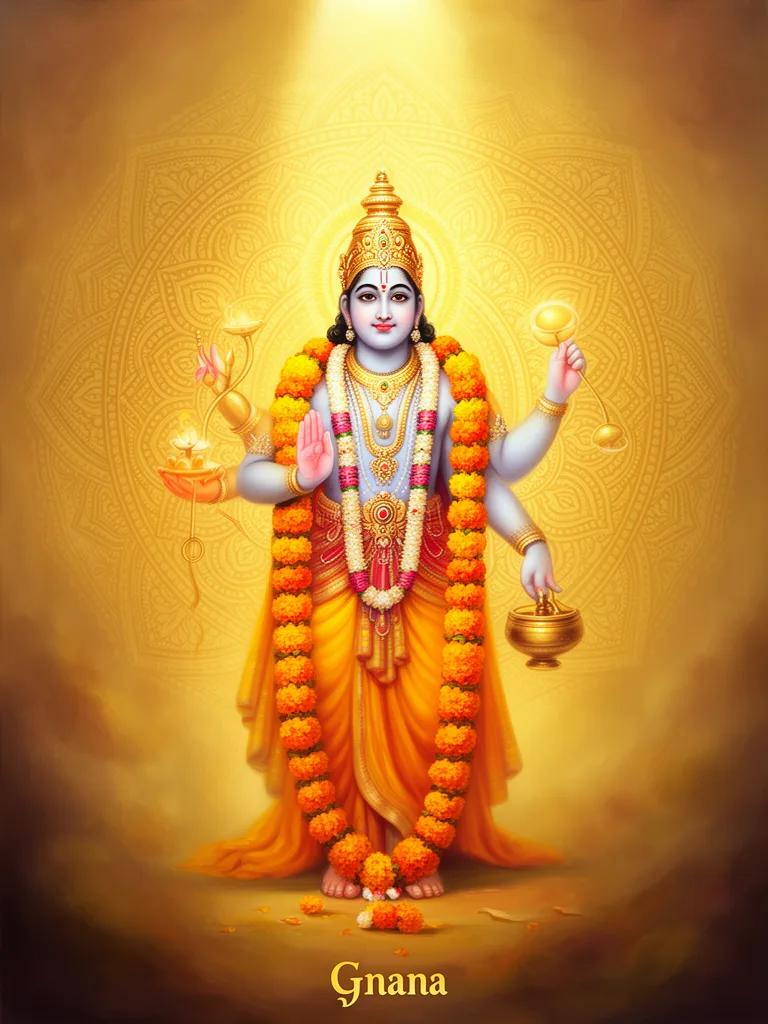
Gnana
Gnana refers to spiritual knowledge, distinct from mere intellectual understanding. It is wisdom attained through direct experience and spiritual realization, leading to liberation from ignorance and suffering in Hindu philosophy.
Where the word comes from
Derived from the Sanskrit root 'jñā' meaning "to know." It signifies knowledge, wisdom, and insight. The concept is central to Vedic and Upanishadic thought, appearing in early Sanskrit texts and evolving through various philosophical schools.
In depth
Knowledge as applied to tiie esoteric .sciences.
How different paths see it
What it means today
Blavatsky's definition, "Knowledge as applied to the esoteric sciences," hints at a specialized form of knowing, a gnosis that transcends the ordinary. In the grand architecture of Hindu thought, Gnana is more than mere information; it is the illuminating wisdom that arises from direct, experiential realization of ultimate truth. Mircea Eliade, in his seminal works on comparative religion, often spoke of the distinction between profane knowledge and sacred knowledge, a chasm that Gnana seeks to bridge. It is the knowledge that liberates, not by adding to one's intellectual storehouse, but by fundamentally reorienting one's perception of reality.
This is the wisdom that sees through the veils of maya, the cosmic illusion that binds us to the cycle of birth and death. It is the discernment, the Viveka, that separates the eternal Atman from the ephemeral phenomena of the material world. The Upanishads, those ancient dialogues of seekers and sages, are replete with passages expounding this path of knowledge. It is not a path for the faint of heart, nor for the purely academic mind. As Carl Jung observed in his explorations of the psyche, true transformation often requires a confrontation with the unconscious, a descent into the depths of one's own being to unearth profound truths. Gnana is that luminous ascent, the dawning realization that the Knower, the Known, and the act of knowing are ultimately one. It is the quiet understanding that settles in the soul when the incessant chatter of the ego finally subsides, leaving only the pure, unadulterated awareness of being. This is the knowledge that, as the Bhagavad Gita suggests, burns away the karma of past actions, leading to the cessation of suffering.
RELATED_TERMS: Jnana Yoga, Moksha, Atman, Brahman, Maya, Viveka, Avidya, Gnosis
Related esoteric terms
Books on this concept




No reflections yet. Be the first.
Share your interpretation, experience, or question.
