Fire
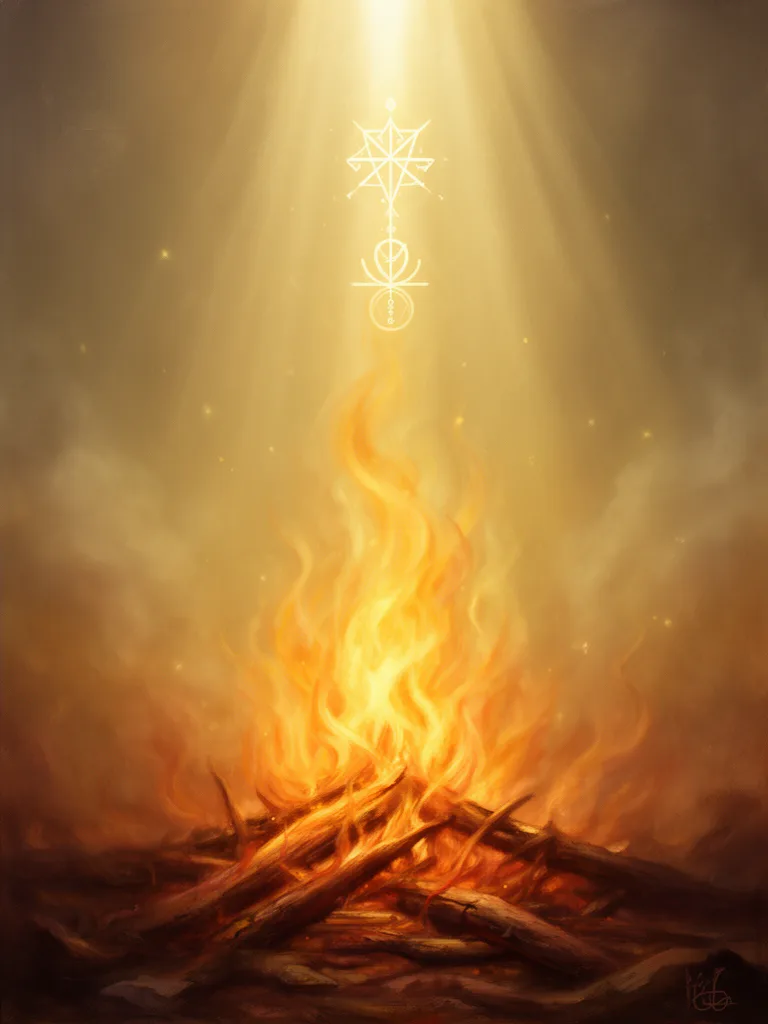
Fire, in esoteric traditions, symbolizes divine energy, life force, and transformative power. It represents the animating principle of the cosmos, the source of consciousness, and the catalyst for spiritual illumination and transmutation. It is often associated with the sun and viewed as a fundamental element in both material and spiritual realms.
Where the word comes from
The English word "fire" derives from Old English "fȳr," ultimately tracing back to Proto-Germanic "*fōr." Its Indo-European root is less clear but may be linked to words for "to burn" or "to shine." Across cultures, fire is a universal symbol, appearing in ancient Greek "pyr," Sanskrit "agni," and Latin "ignis."
In depth
A figure of speech to denote deity, the "One" life. A theurgic term, used later by the Rosicrucians. The symbol of the living fire is the sun, certain of whose rays develop the fire of life in a diseased body, impart the knowledge of the future to the sluggish mind, and stimulate to active function a certain psychic and generally dormant faculty in man. The meaning is very occult. Fire-Philosophers. The name given to the Hermetists and Alcliemists of the Middle Ages, and also to the Rosicrucians. The latter,, the successors of the Theurgists, regarded fire as the symbol of Deity. It was the source, not only of material atoms, but the container of the spiritual and psychic Forces energizing them. Broadly analyzed, fire is a triple principle ; esoterically, a septenary, as are all the rest of the Elements. As man is composed of Spirit, Soul and Body, plus a fourfold aspect: so is Fire. As in the works of Robert Fludd (de Fluctibus) one of the famous Rosicrucians, Fire contains (1) a visible flame (Body) ; (2) an invisible, astral fire (Soul) ; and (3) Spirit. The four aspects are heat (life), light (mind), electricity (Kamic, or molecular powers) and the Synthetic Essence, beyond Spirit, or the radical cause of its existence and manifestation. For the Hermetist or Rosicrucian, when a flame? is extinct on the objective plane it has only passed from the seen world unto the unseen, from the knowable into the unknowable. Fifty Gates of Wisdom (Kah.). The number is a blind, and there are really 49 prates, for Moses, than whom the Jewish world has no higher adept, reached, according to the Kab])alas. and passed only the 49th. These "gates" typify tiie different planes of Being or Ens. They are thus the "gates" of Life and the "gates" of understanding or degrees of occult knowledge. Tliese 49 (or 50) gates correspond to the seven gates in the seven caves of Initiation into the ]\Iysteries of Mithra (see Celsus and Kircher). The division of the 50 gates into five chief gates,
How different paths see it
What it means today
The elemental force of fire, so primal and potent in our physical experience, resonates deeply within the esoteric traditions as a potent symbol of the divine. Blavatsky's definition points to fire as a figure of speech for "deity," for the "One" life, a concept echoed in the Vedic god Agni, the divine messenger that bridges the earthly and celestial realms. This is not the destructive fire of an uncontrolled conflagration, but the controlled, purposeful flame of transformation.
Mircea Eliade, in his seminal work "The Myth of the Eternal Return," illuminates how fire serves as a symbol of the sacred, a force that renews and regenerates, constantly bringing the world back to its pristine, primordial state. The alchemists, referred to by Blavatsky as "Fire-Philosophers," understood this deeply. For them, fire was not just a tool for physical transmutation but the very engine of spiritual evolution, the catalyst for turning leaden ignorance into the golden wisdom of enlightenment. Robert Fludd's conception of fire as a triple principle—visible flame, invisible astral fire, and spirit—mirrors the alchemical understanding of matter, soul, and spirit, a unified whole energized by divine force.
In Sufism, the fire is the passionate love of God, the burning desire that purifies the heart, consuming all attachments to the self and the world, leading to a state of ecstatic union. This is the fire of the mystic's heart, an internal inferno that purifies the soul, much like the alchemist's furnace refines base metals. The Rosicrucians, inheritors of the theurgic arts, saw fire as the symbol of Deity itself, the source of all energy, both material and spiritual. It is the animating principle, the breath of life, and the light of consciousness.
For the modern seeker, fire offers a powerful metaphor for the inner work. It calls us to embrace the transformative heat of self-inquiry, to allow the flames of awareness to burn away the dross of egoic conditioning and illusion. It is the spark of divine potential within each of us, waiting to be fanned into the brilliant luminescence of awakened consciousness. To truly understand fire is to understand the dynamic, incandescent nature of reality itself.
Related esoteric terms
Books on this concept





No reflections yet. Be the first.
Share your interpretation, experience, or question.
