Emerald Tablet
The Emerald Tablet is a concise, cryptic text of Hermetic philosophy, traditionally attributed to Hermes Trismegistus. It contains a foundational principle of alchemy and Western esotericism: "As above, so below," summarizing the interconnectedness of the macrocosm and microcosm.
Where the word comes from
The name "Emerald Tablet" originates from its purported inscription on a green stone. Its earliest known forms appear in Arabic alchemical texts between the 8th and 10th centuries CE, notably in "The Secret of Creation." The Latin translation, "Tabula Smaragdina," became widely influential in medieval Europe.
In depth
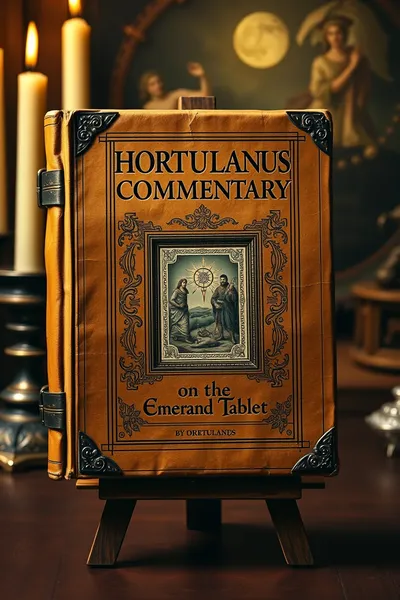
The Emerald Tablet, also known as the Smaragdine Table or the Tabula Smaragdina, is a compact and cryptic text traditionally attributed to the legendary Hellenistic figure Hermes Trismegistus. The earliest known versions are four Arabic recensions preserved in mystical and alchemical treatises between the 8th and 10th centuries CE—chiefly the Secret of Creation (Arabic: سر الخليقة, romanized: Sirr al-Khalīqa) and the Secret of Secrets (سرّ الأسرار, Sirr al-Asrār). It was often accompanied by a frame...
How different paths see it
What it means today
The Emerald Tablet, a text so compact it could be etched onto a jewel, offers a distillation of wisdom that has echoed through centuries of Western esoteric thought. Its brevity belies its profound implications, a quality that has drawn thinkers from alchemists seeking material transformation to mystics contemplating spiritual unity. The famous dictum, "As above, so below," is not merely a poetic observation but a foundational axiom. It suggests a cosmic resonance, a mirroring between the vastness of the heavens and the intricate workings of the human psyche. This principle, as Mircea Eliade noted in his studies of shamanism and archaic techniques of ecstasy, is a recurring motif across diverse spiritual traditions, reflecting a deep-seated human intuition of interconnectedness.
For the alchemist, this meant that the transmutation of base metals was a symbolic representation of the purification and elevation of the soul. The laboratory became a sacred space, the crucible a metaphor for the trials of spiritual development. Carl Jung, in his explorations of alchemy, recognized this psychotherapeutic dimension, seeing alchemical symbolism as a projection of the unconscious mind’s striving for wholeness. The tablet, therefore, becomes an invitation to a holistic understanding of existence, where the external world is not separate from the internal, and the pursuit of knowledge is a journey inward as much as outward. It teaches that the secrets of the universe are not hidden in some distant, inaccessible realm but are reflected in the very fabric of our being and the world around us, awaiting recognition. The challenge lies not in discovery, but in perception.
RELATED_TERMS: Hermeticism, Alchemy, Correspondence, Macrocosm, Microcosm, Hermes Trismegistus, As Above So Below
Related esoteric terms
Books on this concept






No reflections yet. Be the first.
Share your interpretation, experience, or question.
