Dabar
Dabar, a Hebrew term, signifies "word" or "thing." In Kabbalistic thought, it represents divine utterance, creative speech, and the manifestation of God's will, linking the ineffable divine realm to the phenomenal world. It embodies both spoken word and tangible reality.
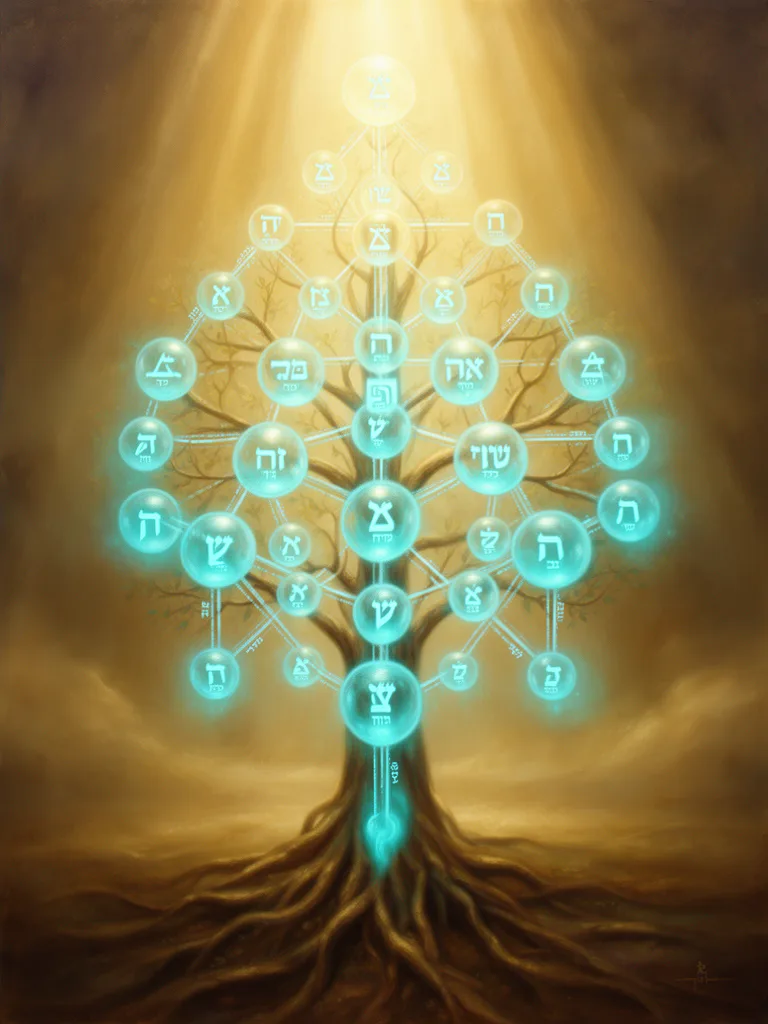
Where the word comes from
Dabar originates from the Hebrew root דבר (d-b-r), meaning "to speak" or "to say." It first appeared in ancient Hebrew texts, notably the Torah. The term encompasses both "word" and "deed" or "thing," suggesting that divine speech is inherently creative and manifest.
In depth
D (a) B (a) R (im), meaninjjr tli.-Word", and the "Words" in the Chaldean Kabbala, Dahar and Logoi. (See See. Doct., I. p. 350, and "Logos", or "Word"). Dabistan (I'rrs.). The land of Iran; ancient Persia. Dache-Dachus Chald.). The dual emanation of Moymis, the progeny of tlie dual or androgynous World-Principle, the male Apason and female Tauthe. Like all theocratic luitions possessing Temple mysteries, the Babylonians never mentioned the "One" Principle of the Universe, nor did they give it a name. This made Damascius {Thcogonies) remark that like the rest of "barbarians" the Babylonians passed it over in silence. Tauthe was the mother of the gods, while Apason was her self-generating male power, Moymis,the ideal universe, being her only-begotten son, and emanating in his turn Dache-Dachus,, and at last Belus, the Demiurge of the objective Universe.
How different paths see it
What it means today
The Hebrew Dabar, meaning "word" or "thing," offers a profound lens through which to consider the nature of creation and divine immanence. In the intricate tapestry of Kabbalistic thought, Dabar is not simply a linguistic unit but the very instrument of divine will, the utterance that brings worlds into existence. It echoes the Genesis account, where God speaks and it is so, suggesting that the primordial act of creation was an act of divine speech. This imbues the concept of language with a cosmic significance, elevating it beyond mere communication to a fundamental principle of being.
Mircea Eliade, in his explorations of the sacred and the profane, often highlighted the power attributed to the word in ancient cultures. The Dabar can be seen as a manifestation of this primal power, a divine decree that shapes reality. It implies a universe that is inherently communicative, a cosmic conversation in which human language, when aligned with divine intention, can participate. This resonates with the Hermetic principle, "As above, so below," suggesting that the Dabar, as the divine word, has its echo in human expression and understanding.
For the modern seeker, contemplating Dabar invites a re-evaluation of the power of our own words and intentions. If the universe is, in a sense, a manifestation of divine utterance, then our own speech, our thoughts, and our actions carry a creative weight. It encourages a mindful engagement with language, recognizing its potential to shape our inner and outer worlds. The Dabar serves as a reminder that the ineffable divine is not entirely removed from us, but is intimately connected through the very act of expression, a bridge between the silent void and the resounding cosmos. To grasp the Dabar is to glimpse the divine artisan at work, speaking reality into being, and to consider the profound implications for our own role as co-creators.
RELATED_TERMS: Logos, Shekhinah, Ein Sof, Sephirot, Creation, Divine Will, Revelation, Word of God
Related esoteric terms
No reflections yet. Be the first.
Share your interpretation, experience, or question.
