Bal
Bal, a Hebrew term, signifies "Lord" and, in Kabbalistic thought, represents divine authority and the active principle of God. It is also associated with the Chaldean deity Bel and the Canaanite god Baal, often depicted as an idol, highlighting a complex history of religious interpretation and syncretism.
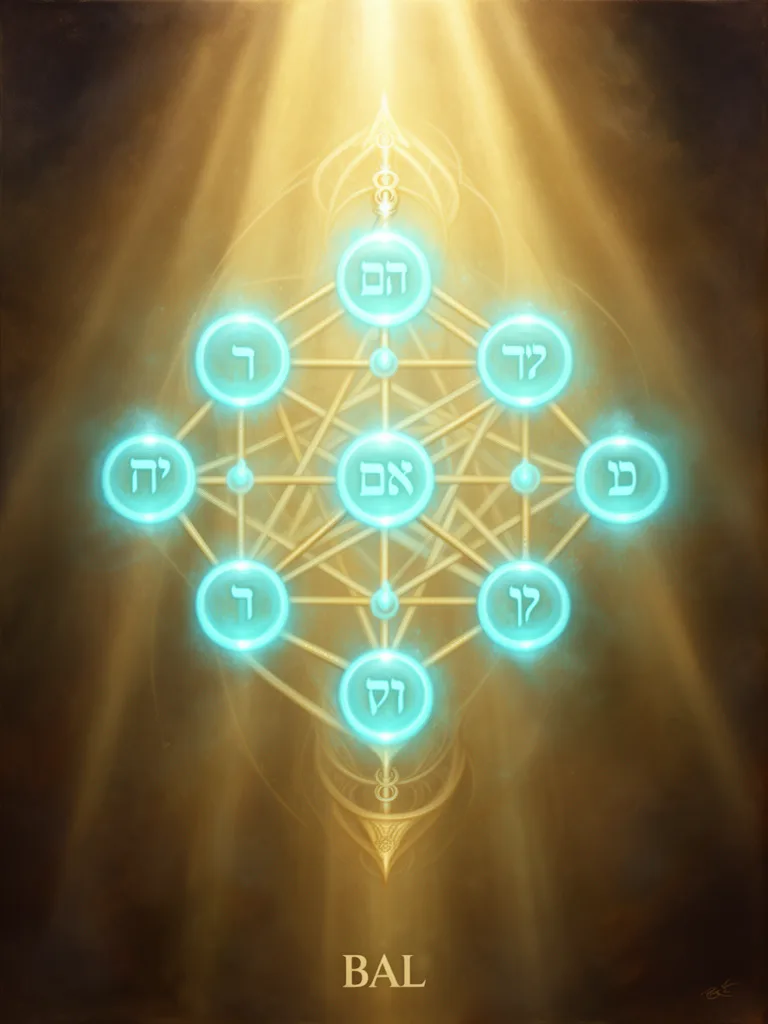
Where the word comes from
The Hebrew word 'bal' (בַּל) derives from an ancient Semitic root meaning "lord" or "master." It appears in various Semitic languages, including Akkadian 'bēlu' and Ugaritic 'bl,' signifying dominion. In its Kabbalistic context, it retains this sense of sovereignty and active divine presence.
In depth
Commonly translated "Lord", but also Bel, the Chaldean god, and Baal, an "idol". Bala (Sk.), or Panchahalani. The "five powers" to be acquired in Yoga practice ; full trust or faith ; energy ; memory ; meditation ; wisdom.
How different paths see it
What it means today
The term "Bal," as presented in Blavatsky's definition, offers a fascinating prism through which to view the ancient world's wrestling with the concept of ultimate power. While its Hebrew root signifies "Lord," its echo in Chaldean "Bel" and Canaanite "Baal" invites us to consider the fraught history of religious nomenclature. The very name of the divine, when encountered across cultural boundaries, can transform from a sacred invocation into a marker of the "other," an idol to be repudiated by the ascendant faith. This linguistic and theological friction is not merely academic; it reflects a deeply human impulse to define the ineffable, often by contrasting it with what is deemed profane or alien.
Blavatsky's inclusion of the Sanskrit "Bala" and its interpretation as "five powers" in Yoga practice – faith, energy, memory, meditation, wisdom – adds another layer of complexity. This connection, though linguistically distant, speaks to a cross-cultural search for the attributes or faculties that enable one to grasp or embody a higher principle. The "lordship" implied by Bal, whether divine or personal, requires a cultivation of inner strength and discernment. The energy to act, the memory to learn from the past, the focused stillness of meditation, and the clarity of wisdom are, in a sense, the tools by which the spiritual aspirant asserts their own dominion over the chaotic forces of existence, or aligns themselves with the divine order. It suggests that the external assertion of lordship, whether by a deity or a conqueror, has its internal counterpart in the disciplined mastery of the self. The journey from the external "Lord" to the internal cultivation of powers mirrors the perennial quest for self-knowledge as the path to cosmic understanding.
RELATED_TERMS: Adonai, Elohim, Shekhinah, Tetragrammaton, Logos, Divine Will, Self-Mastery
Related esoteric terms
Books on this concept






No reflections yet. Be the first.
Share your interpretation, experience, or question.
