Cube
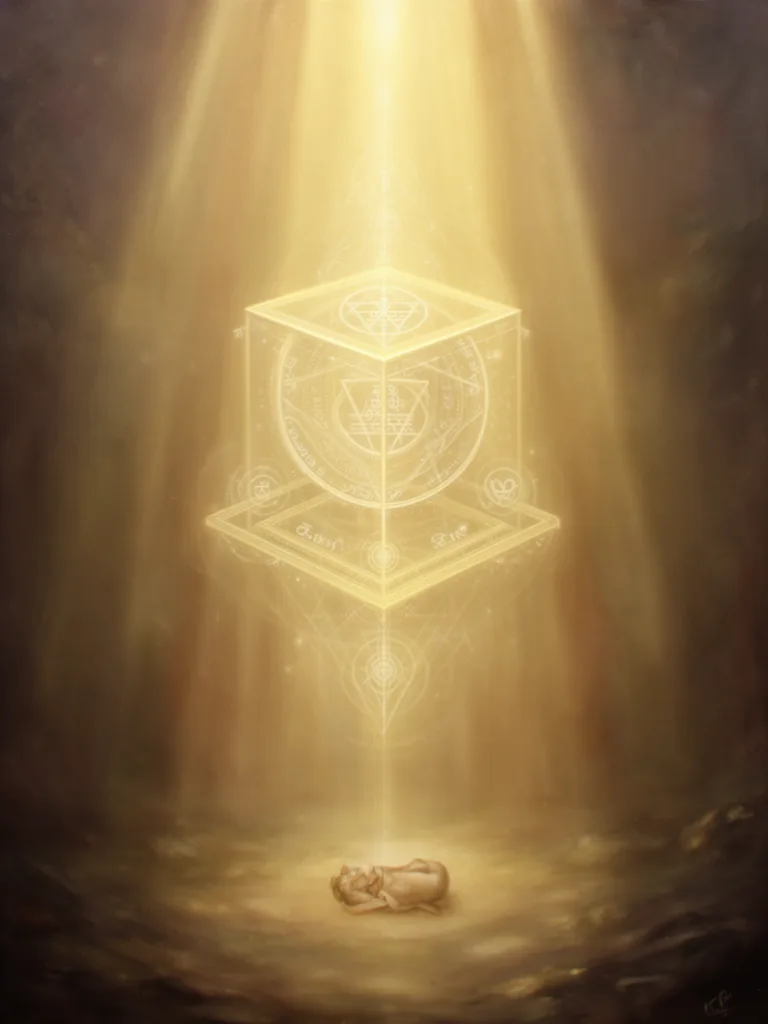
The cube is a fundamental geometric solid with six equal square faces, twelve equal edges, and eight vertices. It represents stability, order, and the material world in various symbolic systems, embodying a balanced and contained form.
Where the word comes from
The English word "cube" derives from the Latin "cubus," which itself comes from the Greek "kybos," meaning dice or cube. The term's usage in geometry dates back to ancient Greek mathematicians, signifying a regular hexahedron.
In depth
A cube is a three-dimensional solid object in geometry. It has eight vertices and twelve straight edges of the same length, so that these edges form six square faces of the same size. It is an example of a polyhedron. It is a special case of a cuboid, a parallelepiped, and a rhombohedron in which all six quadrilateral faces are squares. It is a three-dimensional hypercube, a family of polytopes that also includes the two-dimensional square and four-dimensional tesseract. The cube is found in many...
How different paths see it
What it means today
The cube, a form so commonplace it often escapes notice, is a silent, geometric oracle. Its six perfect squares, meeting at right angles with unwavering precision, speak a language of order, stability, and material manifestation. Mircea Eliade, in his exploration of sacred space, noted how geometric forms often serve as anchors for the divine, creating a microcosm of cosmic order within the chaos of the profane. The cube, with its inherent symmetry and balanced proportions, embodies this principle of earthly stability, a solid ground upon which the ephemeral can be apprehended.
In the Hermetic tradition, the cube is often linked to the element of Earth, the most dense and tangible of the four. It represents the material plane, the realm of form and substance, but also the foundation from which spiritual ascent can begin. Similarly, in Hindu thought, it can represent the physical universe, a divinely constructed edifice. The symmetry of the cube mirrors the underlying order of Brahman, the ultimate reality, suggesting that even in the densest materiality, there is a divine blueprint.
The Kabbalistic understanding of the cube, with its six faces representing the six directions of space, further emphasizes its role as a symbol of cosmic totality. It encompasses all that can be perceived and experienced within the manifest universe, a contained yet complete representation of creation. This completeness within a defined form is what makes it so potent.
For the modern seeker, the cube serves as a powerful counterpoint to the boundless and often overwhelming nature of spiritual inquiry. It is a reminder that the divine can be found not only in the vastness of the infinite but also in the precise, contained beauty of the finite. The perfect form of the cube, when contemplated, can paradoxically lead to an understanding of the formless, by highlighting the nature of form itself as a temporary arrangement. It invites us to see the underlying perfection in the seemingly mundane, the cosmic architecture within the everyday. It is in the very solidity and constraint of the cube that we may glimpse the infinite possibilities of existence.
Related esoteric terms
Books on this concept








No reflections yet. Be the first.
Share your interpretation, experience, or question.
