Boaz
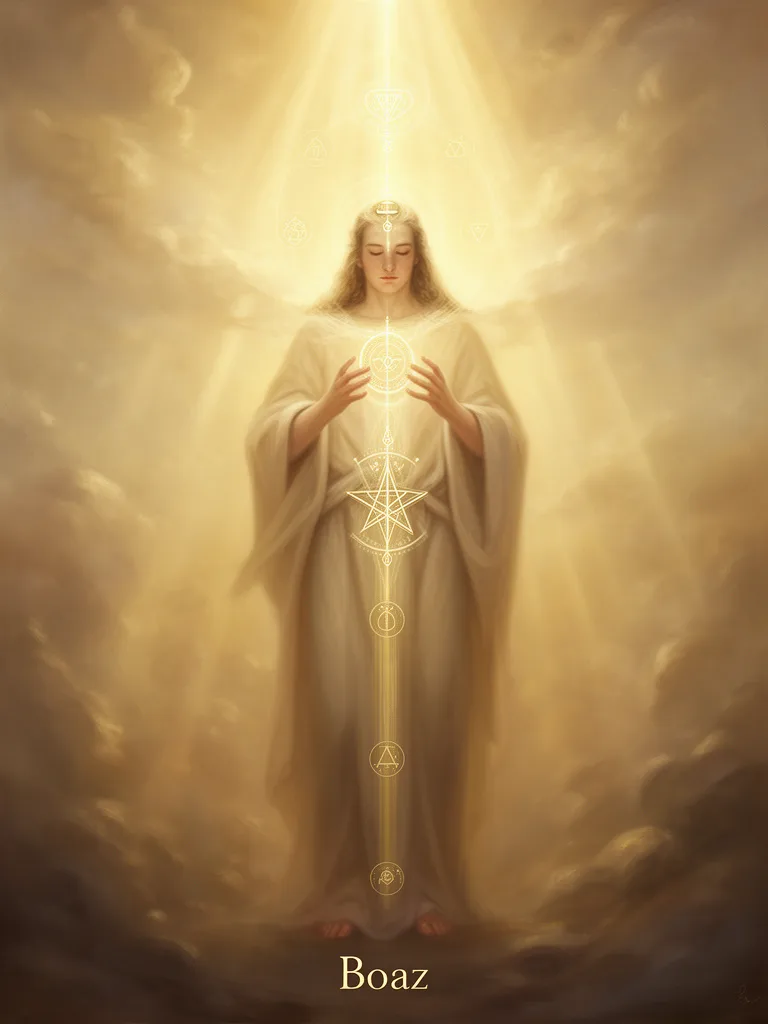
Boaz signifies "strength in" or "strength within," a symbolic name associated with one of the two great pillars at the entrance of Solomon's Temple. This name represents foundational strength and the divine presence that guards sacred thresholds.
Where the word comes from
The name Boaz originates from Hebrew, likely derived from the roots "bō" (בֹּא), meaning "in" or "to enter," and "ʿōz" (עֹז), meaning "strength" or "might." It first appears in the biblical narrative of the Book of Ruth and later in the genealogies of King David.
In depth
Tiie great-grandfather of David. The word is from B, meaning "in", and oz "strength", a symbolic name of one of the pillars at the porch of King Solomon's temple, [w.w.w.]
How different paths see it
What it means today
The figure of Boaz, as rendered in the biblical text and later interpreted through esoteric lenses, offers a profound meditation on strength not as brute force, but as an intrinsic quality, a divine indwelling that underpins existence. Blavatsky's succinct definition, connecting the name to "strength in" and the Temple pillars, points to a fundamental esoteric principle: that true power resides within, a foundational presence that stabilizes and protects.
Mircea Eliade, in his studies of sacred space, illuminates how temples are not just buildings but cosmograms, points where the terrestrial is connected to the celestial. The entrance, guarded by such symbolic pillars, becomes a liminal zone, a passage that requires a specific disposition, a cultivated inner strength, to cross. The name Boaz, meaning "strength in," suggests that this necessary strength is not an acquired attribute but a latent potential, an inherent divine spark that must be recognized and activated.
In Kabbalistic tradition, the pillars Jachin and Boaz represent the dual aspects of divine manifestation, often understood as mercy and judgment, or expansion and contraction. Boaz, associated with strength, can be seen as the pillar that grounds, that provides the firm foundation upon which the edifice of creation is built. It speaks to the immutability of divine law and the inherent resilience of the spiritual order. This concept resonates with Carl Jung's exploration of archetypes, where foundational symbols like pillars represent enduring structures of the collective unconscious, essential for psychic integrity.
The symbolic resonance of Boaz extends to the idea of a spiritual gateway. To enter the sacred, one must possess a certain inner fortitude, a moral and spiritual strength that aligns with the principles represented by the pillar itself. This is not a passive reception of power but an active engagement with one's own inner resources, a recognition of the divine "strength in" that allows for passage. It is a reminder that the most profound journeys begin with acknowledging the foundational strength that already resides within us, a strength that, like the pillar, stands firm against the winds of change and doubt.
This understanding of Boaz invites us to consider the thresholds in our own lives—moments of transition, periods of challenge, or opportunities for spiritual growth—as sacred spaces. The strength required to face them is not external, but an echo of that primal, indwelling power symbolized by the ancient pillar.
RELATED_TERMS: Jachin, Solomon's Temple, threshold, divine presence, sacred space, inner strength, duality ---
Related esoteric terms
Books on this concept








No reflections yet. Be the first.
Share your interpretation, experience, or question.
