Ayin
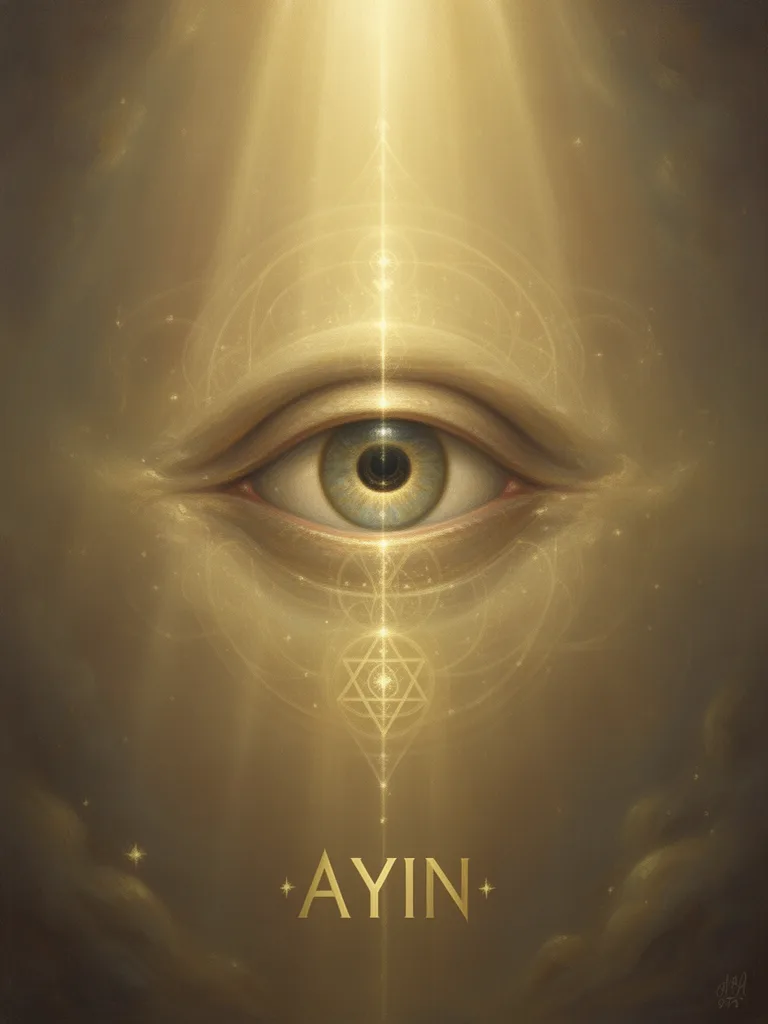
Ayin, meaning "nothing" or "eye" in Hebrew, represents the primordial void or unmanifest potential from which all existence arises in Kabbalistic thought. It signifies a state of absolute non-being, a divine emptiness that precedes creation, and can also be understood as the divine gaze or awareness.
Where the word comes from
The Hebrew word "ayin" (עין) primarily means "eye" but also carries the connotation of "nothingness" or "void." This dual meaning is central to its Kabbalistic interpretation, suggesting a divine awareness that is simultaneously boundless and empty of form. The term's roots are ancient, deeply embedded in Semitic linguistic traditions.
In depth
Lit., "Nothing", whence the name of Ain-So])li. (See "Ain"). Aymar, Jacques. A famous Frenchman who had great success in the use of the Divining Rod al)Out the end of the 17th century ; he was often employed in detecting criminals; two M.D.'s of the University of Paris, Chauvin and Garnier reported on the reality of his powers. See Colquhoun on Magic [w.w.w.]
How different paths see it
What it means today
In the grand lexicon of the esoteric, few terms possess the profound, almost vertiginous, emptiness of Ayin. Blavatsky's inclusion, though brief and referencing a somewhat tangential historical figure, points to a core concept within Kabbalah, the mystical tradition of Judaism. Ayin, in its most potent sense, signifies not mere absence, but a divine nothingness, a primordial void that is the very womb of creation. It is the unmanifest potential, the absolute negation of all defined existence that precedes the unfolding of the cosmos.
This concept echoes across various spiritual traditions, though often under different guises. Mircea Eliade, in his extensive studies of comparative religion, often highlighted the significance of primordial waters or cosmic eggs as symbols of this unformed, generative potential. In a more psychological vein, Carl Jung's exploration of the archetype of the Self hints at a similar boundless, unconditioned center that underlies our conscious experience. The Sufis, too, speak of the fana, annihilation of the ego in the divine, a state that approaches a form of divine emptiness, though often framed within the context of ecstatic union rather than primordial void.
The challenge for the modern seeker lies in grappling with a concept that defies easy intellectualization. Ayin is not a thing to be grasped, but a state to be approached, perhaps through contemplative practices that quiet the mind's incessant demand for definition and form. It invites a surrender to the unknowable, a recognition that ultimate reality may reside not in what is perceived, but in the infinite space that allows perception itself to occur. It is the divine silence before the first word, the unwritten page upon which all stories are inscribed. To contemplate Ayin is to confront the ultimate mystery of being, a mystery that is not a problem to be solved but a reality to be experienced in its profound, ungraspable essence.
RELATED_TERMS: Ein Sof, Keter, Shekhinah, Brahman, Shunyata, Tao, The Absolute, Ground of Being
Related esoteric terms
Books on this concept








No reflections yet. Be the first.
Share your interpretation, experience, or question.
