Asia
Asia is not an esoteric term but a geographical designation. Blavatsky's use of "Asia" in her 1892 work appears to be a geographical reference point, not an esoteric concept with a defined spiritual meaning within her system. It likely grounds the discussion of various traditions within a continental context.
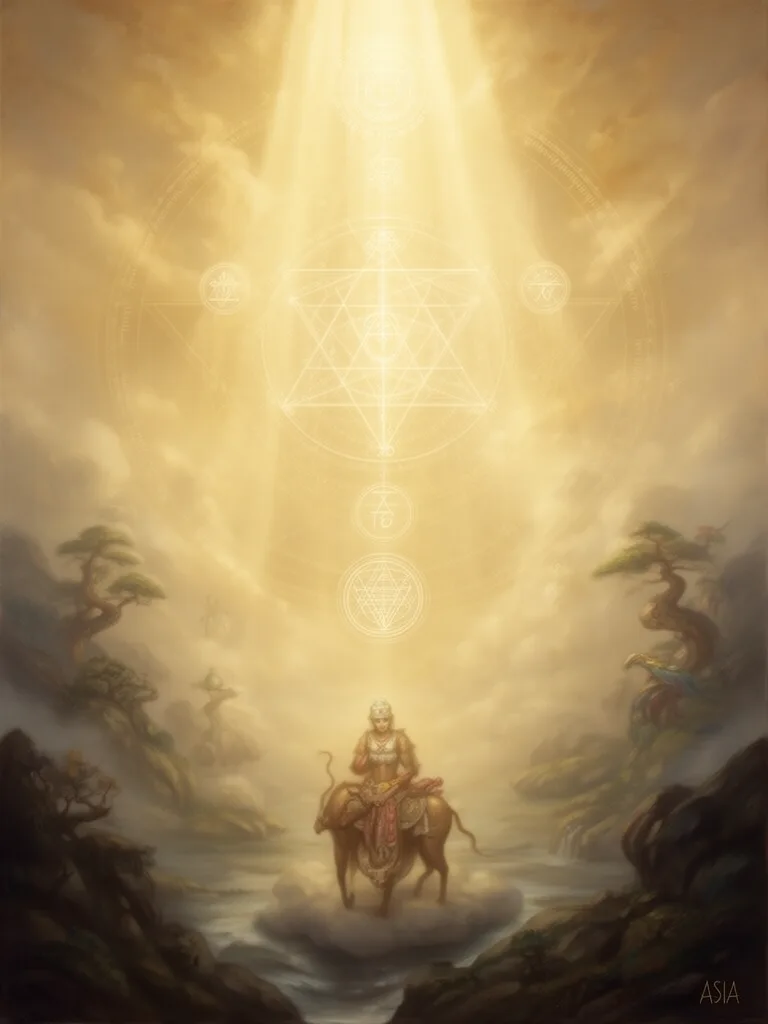
Where the word comes from
The term "Asia" originates from ancient Greek, likely derived from an Assyrian or Hittite word such as "Assu" or "Asu," meaning "east" or "rising." It was first used by the Greeks to denote the region east of the Aegean Sea, gradually expanding its scope to encompass the entire continent.
In depth
Moreover, as his mother, who is represented as Queen of Heaven standing on the crescent, is identified in Gnostic pliilosophy, and also in the esoteric system, with the Moon her.self, like all the other lunar goddesses such as Isis, Diana. Astarte and others — motliers of tlie Logoi, so Christ is called repeatedly in the Roman Catholic Church, the SunChrist, the Christ-Sol( it and so on. If the latter is a nievaphor so also is the earlier. Chantong (Tib.). "He of the 1.000 Eyes', a name of Padmaj^ani or Chenresi (Avalokitesvara).
How different paths see it
What it means today
In the grand cartography of human consciousness, "Asia" functions less as a destination and more as a vast, fertile ground from which countless spiritual seeds were sown. It is the continent that cradles the ancient rivers of wisdom, the mountain ranges where ascetics sought solitude, and the bustling cities where philosophies were debated and disseminated. When Helena Blavatsky, or any scholar of esoteric traditions, refers to Asia, they are not invoking a mystical entity but acknowledging the geographical matrix that birthed and nurtured the very systems of thought and practice that fascinate us.
Mircea Eliade, in his profound explorations of the sacred and the profane, often highlighted how geographical locations become imbued with spiritual significance, acting as cosmic centers or points of access to the divine. Asia, in this context, becomes synonymous with the very source code of many world religions and mystical paths. From the Vedic hymns echoing in the Ganges plains to the Zen koans contemplated in Japanese gardens, the continent is a living repository of spiritual inquiry.
The term itself, with its hazy etymological roots pointing eastward, mirrors the outward expansion of spiritual exploration. It is the direction from which the sun rises, symbolizing illumination and the dawn of knowledge. For the modern seeker, encountering "Asia" in an esoteric text is an invitation to recognize the interconnectedness of these diverse traditions, to see them not as isolated phenomena but as branches of a common, ancient tree of human spiritual yearning, its roots sunk deep in this singular, expansive landmass. It reminds us that the search for meaning is a global endeavor, historically rooted in shared human experiences across a continent teeming with spiritual innovation. The continent itself becomes a metaphor for the vastness of the human spirit's quest.
Related esoteric terms
Books on this concept







No reflections yet. Be the first.
Share your interpretation, experience, or question.
