Ares
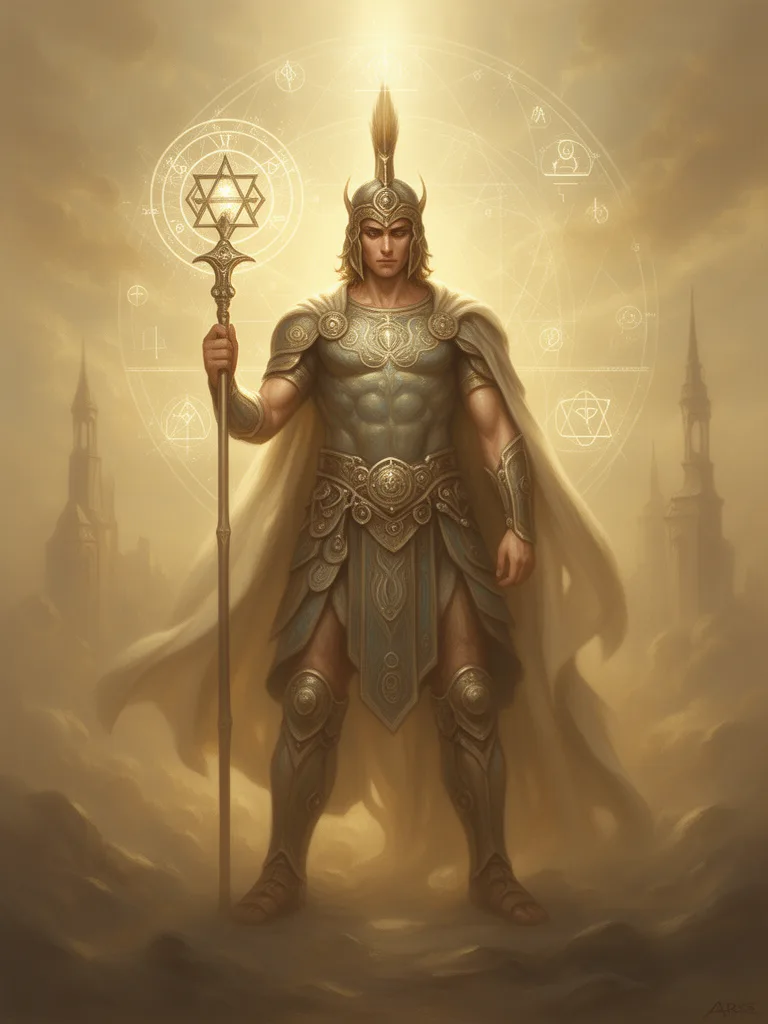
Ares is the Greek god of war, embodying the brutal, chaotic, and often destructive aspects of conflict and primal energy. He represents the untamed force that drives aggression and battle, a primal aspect of existence often viewed with both fear and a grim fascination.
Where the word comes from
The name "Ares" likely derives from the ancient Greek word "aras," meaning "bane" or "curse," reflecting the destructive nature associated with the god. Some scholars suggest a possible pre-Greek origin, hinting at an older, more elemental concept of strife. Its etymological roots are debated but consistently point to notions of ruin and contest.
In depth
The Greekname for ^Mars, god of war ; also a term used by Paracelsus, the differentiated Force in Cosmos.
How different paths see it
What it means today
The name Ares, echoing with the ancient Greek "aras," or bane, immediately conjures a potent, almost elemental force. Blavatsky's linkage to Mars, the Roman god of war, is apt, but her inclusion of Paracelsus's "differentiated Force in Cosmos" offers a more profound esoteric dimension. This isn't simply about the clash of armies; it's about the fundamental energies that drive conflict and change throughout existence. In the alchemical tradition, this fiery, disruptive principle is vital. As Mircea Eliade observed in his studies of religion, the sacred often manifests through terrifying, awe-inspiring forces, and Ares, in his raw power, certainly fits this description. He represents the primal, often violent, impulse that can lead to both destruction and, paradoxically, the clearing of ground for new growth. This is not a gentle force; it is the stark reality of struggle, the necessary friction that can forge strength or shatter all. To engage with the concept of Ares is to acknowledge the shadow aspect of creation, the wild, untamed energy that lies beneath the veneer of order. It is to understand that growth often emerges from the crucible of conflict, a truth mirrored in the cyclical nature of both the cosmos and the human psyche. The god of war, then, becomes a symbol of the unavoidable challenges that test and refine, a reminder that even in ruin, the potential for transformation resides.
Related esoteric terms
Books on this concept








No reflections yet. Be the first.
Share your interpretation, experience, or question.
