Apava
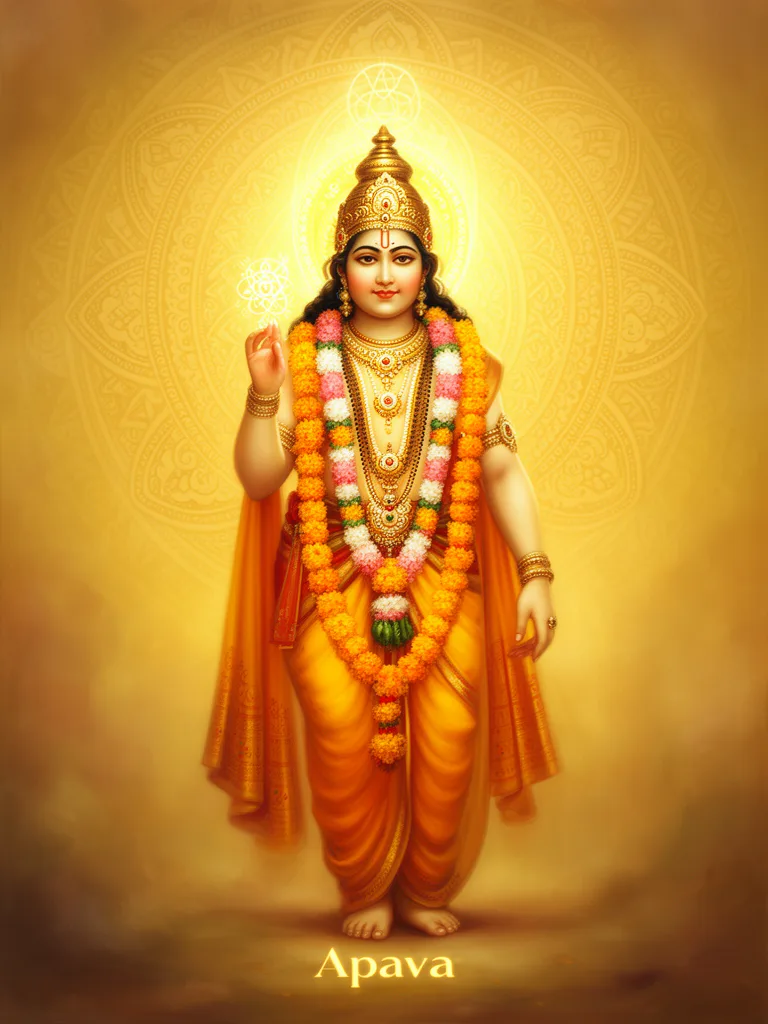
Apava is a Sanskrit term referring to a divine being, often associated with Vishnu or Brahma, who is depicted as "sporting in water." This concept signifies a primordial, creative force that manifests through divine play and duality, leading to the generation of the cosmos.
Where the word comes from
Apava originates from the Sanskrit word "ap," meaning "water," and "vava," suggesting "play" or "sport." It describes a divine entity that engages in playful creation within the primordial waters, a recurring motif in ancient cosmogonies. The term evokes a sense of unburdened, joyous activity at the genesis of existence.
In depth
Lit., "He who sports in tli<Water". Another a.spect of Xarayana or Vishnu and of Brahmii combined, for Apava. like the latter, divides himself into two parts, male and female, and creates Vishiui, who cn-ates Viraj. who cn-att s Mann. The name is explained aTid interpreted in various ways in Brahmanical literature.
How different paths see it
What it means today
The term Apava, with its evocative image of divine "sporting in water," offers a profound counterpoint to more austere or grim cosmogonies. It suggests that the very act of existence, the unfolding of the universe, is rooted in a form of cosmic play, a divine exuberance that precedes the strictures of causality and obligation. Mircea Eliade, in his exploration of eternal return, often highlighted the cyclical and playful nature of creation myths, where divine beings engage in activities that are both generative and seemingly effortless, like a child's game.
This concept resonates with the idea of the divine as an unfettered source of being, akin to a musician improvising a melody or a dancer lost in the rhythm. The water, itself a symbol of fluidity, potentiality, and the unconscious, becomes the stage for this primordial performance. It is within this boundless, yielding medium that the divine spirit, in its playful aspect, initiates the differentiation of forms, the emergence of order from chaos.
The duality inherent in Apava, often described as dividing into male and female principles to create further manifestations, speaks to a fundamental aspect of existence: the necessity of polarity for generation. This is not a conflict but a harmonious interplay, a necessary dance of opposites that fuels the ongoing process of becoming. The creation of Vishnu, who in turn creates Viraj and Manu, illustrates a cascading series of divine emanations, each step imbued with the initial spirit of playful creation. It suggests that the universe, in its deepest essence, is not a machine but a living, breathing, and perhaps even laughing, entity.
Understanding Apava encourages a shift in perspective, inviting us to see the world not as a burden to be carried but as a grand, unfolding spectacle, a divine improvisation that continues to play out in every moment. It asks us to consider the possibility that the ultimate reality is not one of grim necessity but of boundless, creative joy.
Related esoteric terms
Books on this concept



No reflections yet. Be the first.
Share your interpretation, experience, or question.
