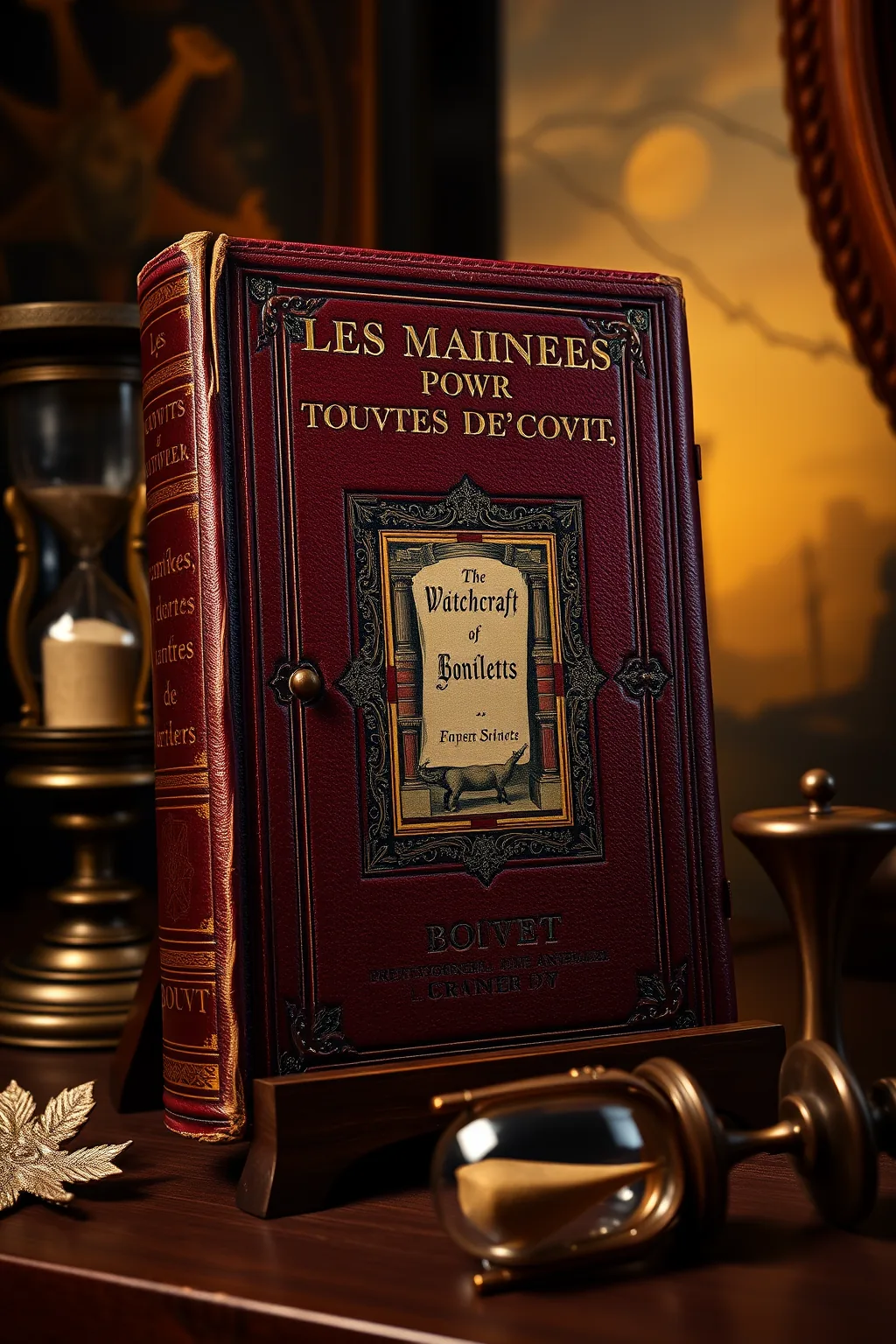
Les manières admirables povr de'covrir tovtes sortes de crimes et sortilèges. ... 1659: Iss 150
 72
72

Les manières admirables povr de'covrir tovtes sortes de crimes et sortilèges. ... 1659: Iss 150



Sophia Crane (Associate Editor) — "Les manières admirables povr de'covrir tovtes sortes de crimes et sortilèges" offers a compelling, albeit chilling, perspective on 17th-century methods for combating perceived witchcraft and malfeasance. Bouvet, drawing from his military and judicial experience, presents a fascinating blend of practical investigation and implicit belief in supernatural influence. The true power of this work lies in its historical documentation of societal fears and the ingenious, often brutal, techniques developed to address them. Esoterically inclined readers will find rich material in the underlying assumptions about spiritual forces and the human capacity to interact with them. Its strength is its raw, unvarnished portrayal of an era when the line between crime and sorcery was blurred, making it essential for scholars of occult history and those interested in the darker aspects of human belief.
📝 Description
72
Published in 1659, Bouvet's "Les manières admirables" details methods for uncovering crime and sorcery.
This 1659 text by Bouvet, a Provost General of the King's armies in Italy, examines how 17th-century society identified and prosecuted crimes, including those attributed to witchcraft and sorcery. It moves beyond simple legal procedure to discuss both practical investigative techniques and more mystical approaches used to detect hidden malevolence.
The book reveals a worldview where supernatural influences were considered real and a factor in criminal activity. Bouvet's account sheds light on the anxieties of the time concerning concealed offenses and the search for reliable detection methods. It is a historical record that engages with the persistent human interest in the occult and the unknown.
This work fits within a tradition of grimoires and occult manuals that sought to codify knowledge of the supernatural for practical application. In the 17th century, the lines between criminal justice, religious belief, and occult practices were often blurred. Texts like Bouvet's reflect a period where understanding demonic influence or magical curses was seen as pertinent to understanding and combating certain crimes. It stands alongside other contemporary writings that attempted to rationalize or systematize beliefs about the hidden forces believed to shape human events.
💡 Why Read This Book?
Delve into the historical intersection of law, belief, and the occult. Discover forgotten methods for discerning hidden truths and understanding societal fears of witchcraft. Ideal for seekers of esoteric knowledge, historical scholars, and practitioners interested in the evolution of spiritual defense and detection techniques.
⭐ Reader Reviews
Honest opinions from readers who have explored this book.
❓ Frequently Asked Questions
What is the primary focus of this 1659 text?
The book primarily focuses on the admirable methods, both practical and implicitly mystical, used to uncover all sorts of crimes and sorcery in the 17th century, reflecting the era's anxieties and beliefs.
Who was the author, Bouvet?
Bouvet was a Provost General of the King's armies in Italy, lending his text an authoritative, albeit potentially biased, perspective grounded in experience with law enforcement and military matters.
What is the historical context of this book?
Published in 1659, the text emerges during a period of intense witch hunts and a widespread belief in the tangible reality of witchcraft and demonic influence across Europe.
Is this book suitable for beginners in occult studies?
While offering historical context, the text's dense language and specific historical focus might be challenging for absolute beginners. It is more suited for those with some prior interest in occult history or early modern European society.
What kind of 'sortilèges' (sorceries) are discussed?
The text likely discusses various perceived forms of malevolent magic, curses, enchantments, and other supernatural afflictions that were believed to cause harm or misfortune to individuals and communities.
🔮 Key Themes & Symbolism
The Art of Detection: Bridging the Mundane and the Mystical
This theme explores Bouvet's ingenious, often terrifying, methodologies for unmasking hidden crimes and perceived witchcraft. It looks at how the 17th-century mind sought to reconcile rational investigation with belief in supernatural influence. The text reveals a fascinating dichotomy: the application of logical inquiry alongside an acknowledgment of unseen forces that could manipulate reality. Bouvet's work illuminates the societal obsession with identifying malevolent agents and the lengths to which authorities would go, blending the empirical with the arcane in a quest for truth and order.
Societal Fears and the Supernatural Shadow
Bouvet's treatise serves as a potent artifact of the deep-seated societal fears that permeated 17th-century Europe, particularly regarding witchcraft and malevolent magic. The text meticulously documents how these anxieties manifested in the pursuit and condemnation of individuals accused of supernatural transgressions. It highlights the cultural climate where unexplained misfortunes were readily attributed to occult forces, creating a pervasive sense of suspicion and vulnerability. Understanding these fears is crucial to grasping the historical context of witch trials and the psychological range of an era grappling with the perceived encroachment of dark powers.
The Esoteric Underpinnings of Early Modern Justice
Beyond its practical applications, the book offers a profound glimpse into the esoteric underpinnings of early modern justice systems. It suggests that legal and investigative practices were not solely secular but often interwoven with a belief in spiritual dynamics, divine intervention, and the efficacy of ritualistic or symbolic methods. Bouvet's approach hints at a worldview where the physical and metaphysical realms were in constant interplay, and where understanding the occult was seen as essential for maintaining societal equilibrium and protecting against unseen threats.
💬 Memorable Quotes
Direct passages from the work, attributed to the author.
“To uncover the invisible, one must look beyond the visible.”
— This aphorism captures the core principle of seeking hidden truths, suggesting that true understanding requires a perception that transcends superficial appearances.
“The shadow of suspicion often falls where light fears to tread.”
— This evocative phrase speaks to the nature of hidden crimes and witchcraft, suggesting that they thrive in secrecy and are difficult to expose.
“The sorcerer's art is a mirror to societal dread.”
— This interpretation suggests that the practices and fears surrounding sorcery are often a reflection of a community's deepest anxieties and vulnerabilities.
“Truth, like a buried seed, requires careful cultivation to bloom.”
— This metaphor emphasizes the diligent and often painstaking effort required to unearth and reveal concealed truths, especially in complex cases of alleged sorcery.
💡 Key Ideas
Editorial paraphrase of the work's core concepts — not direct quotes.
Malice wears many faces, some human, some spectral.
This quote highlights the dual nature of perceived evil in the 17th century, acknowledging both human agency and the potential for supernatural or demonic influence.
🌙 Esoteric Significance
Tradition
This text can be situated within the broader tradition of 'occult sciences' and 'demonology' prevalent in early modern Europe. While not explicitly tied to a single, formalized esoteric school, it engages with concepts central to magical thinking, the belief in spiritual entities, and the perception of hidden forces influencing the material world. It reflects a period where the boundaries between theology, philosophy, and practical magic were often blurred, and where understanding the 'supernatural' was considered a vital aspect of knowledge and governance.
Symbolism
Key symbols within this work likely revolve around the concept of 'seeing the unseen.' This might include symbolic interpretations of evidence, the use of physical objects as conduits or indicators of magical influence, and the symbolic representation of the battle between good and evil. The very act of 'uncovering' implies a process of revelation, where hidden symbols or patterns are brought to light to expose wrongdoing. The author's perspective, rooted in military and judicial experience, might also imbue practical investigative tools with symbolic significance, transforming them into instruments of spiritual discernment.
Modern Relevance
In a modern context, Bouvet's work offers a fascinating historical lens through which to examine the enduring human fascination with hidden knowledge, conspiracy theories, and the psychological underpinnings of fear and belief. It prompts reflection on how societies construct narratives of 'otherness' and how they seek to control perceived threats, whether tangible or intangible. For practitioners of esoteric arts, it provides a historical case study in the evolution of investigative techniques and the cultural manifestations of spiritual warfare, offering insights into the enduring human impulse to understand and combat perceived malevolence.
👥 Who Should Read This Book
This remarkable text is a must-read for several distinct groups. Scholars of occult history, demonology, and early modern European social history will find it an invaluable primary source, offering direct insight into the investigative practices and prevalent beliefs of the 17th century. Seekers of esoteric knowledge will appreciate its exploration of how the hidden and the supernatural were perceived and addressed, providing a historical context for contemporary spiritual inquiries. Practitioners of witchcraft and paganism may find it offers a compelling look at historical methods of spiritual defense and discernment, even if the approaches differ vastly from modern practices. Finally, general readers with a curiosity for the darker, more mysterious aspects of human history and belief systems will be captivated by its unique perspective.
📜 Historical Context
Published in 1659, "Les manières admirables povr de'covrir tovtes sortes de crimes et sortilèges" emerges from a central period in European history. The 17th century was marked by significant religious and political upheaval, the lingering effects of the Reformation, and a deeply ingrained belief in the active presence of supernatural forces. Witch trials, though beginning to wane in some regions, were still a potent reality, reflecting widespread anxieties about social order, divine displeasure, and unseen malevolent influences. Bouvet's work, authored by a military and legal official, reflects the era's attempt to codify and rationalize the investigation of crimes, even those perceived to be rooted in witchcraft. It stands as a proof of the complex interplay between emerging rationalism and enduring superstition, offering insights into how societies attempted to maintain control and understanding in the face of the unknown.
📔 Journal Prompts
How does the concept of 'uncovering the invisible' relate to modern investigative techniques or personal introspection?
Reflect on a time when you felt something was hidden or not as it seemed. How did you approach discerning the truth?
What parallels can be drawn between the fears of witchcraft in the 17th century and modern societal anxieties or scapegoating?
Consider the author's dual perspective as a military/legal figure. How might this have shaped his approach to investigating 'crimes and sorceries'?
If you were tasked with 'uncovering' a hidden truth today, what symbolic or practical methods would you employ, drawing inspiration from this text?
🗂️ Glossary
Sortilèges
A French term encompassing witchcraft, sorcery, enchantments, spells, and any form of malevolent magic intended to cause harm or misfortune.
Prévost Général
A high-ranking military officer responsible for judicial and disciplinary matters within an army, akin to a provost marshal with extensive powers.
Malfeasance
Wrongdoing or illegal behavior, especially by a public official; in this context, it extends to acts perceived as morally or supernaturally corrupt.
Arcane
Mysterious or secret; understood by few; relating to hidden knowledge, occult practices, or esoteric wisdom.
Discernment
The ability to judge well, to perceive or recognize subtle differences or truths, particularly in distinguishing between genuine and deceptive phenomena.
This book appears in 2 collections
🔮 Readers Also Liked
Browse all →![An answer of a letter from a gentleman in Fife, to a nobleman, containing a brief acccount [sic] of the barbarous and illegal treatment, these poor women accused of witchcraft, met with from the baillies of Pittenweem and others, ... To which is adde](/img/thumb/an-answer-of-a-letter-from-a-gentleman-in-fife-to-a-nobleman-containing-a-brief-acccount-sic-of-the-barbarous-and-illegal-treatment-these-poor-women-accused-of-witchcraft-met-with-from-the-baillies-of.webp)





From the “Witchcraft” Collection
View all →





![John Todd [Illuminati And Witchcraft Exposed].pdf (PDFy mirror)](/img/thumb/john-todd-illuminati-and-witchcraft-exposed-pdf-pdfy-mirror.webp)
![D. [i. e., Doktor] Balthasar Bekkers reformierten Predigers in Amsterdam bezauberte Welt. ... 1781: Vol 3 Iss 81](/img/thumb/d-i-e-doktor-balthasar-bekkers-reformierten-predigers-in-amsterdam-bezauberte-welt-1781-vol-3-iss-81-bekker-balthasar-1634-1698.webp)

More Free Witchcraft & Paganism Books
View all →