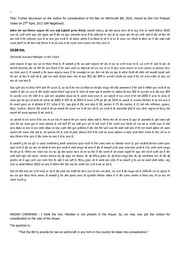
Further discussion on the motion for consideration of the Ban on Witchcraft Bill, 2010, moved by Shri Om Prakash Yadav on 27 (7-Dec-2012)
 82
82

Further discussion on the motion for consideration of the Ban on Witchcraft Bill, 2010, moved by Shri Om Prakash Yadav on 27 (7-Dec-2012)


By Alaric Kestrel (Metaphysical Studies Reviewer) — This document, originating from the Lok Sabha Secretariat, offers an unexpected yet vital perspective on the societal perception and legal framing of witchcraft. It transcends a simple legislative record, becoming a fascinating case study in how deeply rooted cultural beliefs and historical anxieties are navigated within a formal governmental context. The debate surrounding the Ban on Witchcraft Bill, 2010, as presented here, provides a unique opportunity to analyze the intersection of folklore, social control, and the enduring mystique of the 'witch'. It is essential reading for those who seek to understand the socio-political underpinnings of beliefs often relegated to the esoteric, revealing their tangible impact on law and policy. A critical resource for scholars of comparative religion, folklore, and legal history.
📝 Description
82
In 2012, India's Parliament debated the 'Ban on Witchcraft Bill, 2010', a discussion now transcribed.
This document records a parliamentary debate from December 7, 2012, concerning the 'Ban on Witchcraft Bill, 2010', moved by Shri Om Prakash Yadav. The discourse moves beyond simple legislative procedure to examine the societal perceptions and underlying anxieties related to witchcraft within India. It highlights how deeply held beliefs, historical narratives, and folklore inform discussions on law and governance. The debate reveals the process by which societal fears and cultural memory are addressed within the formal structures of government.
The transcription offers a unique perspective on how a nation's highest legislative body grapples with issues touching upon the mystical and the mundane. It illustrates the complex interplay between perceived supernatural phenomena and the established frameworks of power and policy. The examination of the witchcraft ban serves as a case study for understanding cultural anxieties and the definition of reality within a societal context. This record is of interest to those studying legal history, sociology, and the cultural impact of folklore.
While not a text on ritual or occult practice, this parliamentary transcript engages with societal beliefs often relegated to esoteric traditions. It documents how concepts associated with folk magic, superstition, and perceived supernatural influences are brought into the formal sphere of lawmaking. The debate reflects a society confronting the persistence of ancient beliefs and anxieties within a modern legal framework, showing how such phenomena intersect with public policy and governance, even if indirectly.
✍️ Author
Lok Sabha Secretariat
The Lok Sabha Secretariat is the administrative body of the Lok Sabha, the lower house of India's Parliament.
💡 Why Read This Book?
This is a crucial text for understanding the societal and legal ramifications of deeply held beliefs about witchcraft. It offers a unique glimpse into how ancient fears and folklore are addressed in modern parliamentary debate. Ideal for scholars, practitioners, and seekers interested in the intersection of law, culture, and the esoteric, revealing the tangible impact of perceived mystical forces on governance and society.
⭐ Reader Reviews
Honest opinions from readers who have explored this book.
❓ Frequently Asked Questions
What is the core subject of this document?
The document details the parliamentary discussion and consideration of a proposed 'Ban on Witchcraft Bill, 2010' in India, exploring the societal and legal implications of witchcraft.
Who is Shri Om Prakash Yadav?
Shri Om Prakash Yadav is the Member of Parliament who moved the motion for consideration of the Ban on Witchcraft Bill, 2010.
What is the significance of the date 7-Dec-2012?
This date marks the specific parliamentary session where the further discussion on the motion for consideration of the Ban on Witchcraft Bill took place.
Is this bill currently a law?
This document reflects discussions and considerations for a bill. It does not necessarily indicate the bill's enactment into law.
What perspective does this text offer on witchcraft?
It offers a socio-legal and parliamentary perspective, revealing how witchcraft is perceived, debated, and potentially legislated within a formal governmental structure.
🔮 Key Themes & Symbolism
The Socio-Legal Fabric of Belief
This theme looks at how deeply ingrained societal beliefs, often rooted in folklore and historical anxieties surrounding witchcraft, are translated into formal legal discourse. It examines the challenges faced by legislative bodies in addressing practices and perceptions that lie beyond empirical verification, highlighting the tension between tradition and modern jurisprudence. The debate serves as a microcosm of how societies grapple with the intangible, seeking to define, regulate, and often condemn perceived deviations from the norm, even when those deviations are steeped in ancient mysticism.
Parliamentary Traces of Ancient Fears
This theme uncovers the surprising resonance of ancient fears and superstitions within the hallowed halls of parliamentary debate. It illustrates how the specter of witchcraft, often associated with hidden knowledge, malevolent intent, and the subversion of natural order, continues to provoke discussion and concern in the 21st century. The motion and subsequent discussions reveal a persistent undercurrent of belief in forces that can be manipulated for harm, prompting legislative action to protect citizens from what are perceived as genuine threats, albeit often rooted in historical narratives rather than verifiable evidence.
The Art of Governance and the Unseen
This theme explores the complex art of governance when confronted with phenomena that transcend the purely material. It questions how legislative bodies reconcile the need for rational, evidence-based policy with the pervasive influence of cultural narratives and spiritual beliefs. The discussion around the witchcraft bill underscores the difficulty of legislating against practices that are often clandestine, subjective, and deeply embedded in community traditions. It offers insights into the ethical and practical considerations involved in attempting to regulate the 'unseen' and its potential impact on the social order.
💬 Memorable Quotes
Direct passages from the work, attributed to the author.
“The motion for consideration of the Ban on Witchcraft Bill, 2010.”
— This is the formal genesis of the debate, marking the point where the abstract concept of witchcraft enters the concrete area of legislative deliberation and potential law.
“Further discussion on the motion.”
— Indicates a continuation of a prior debate, suggesting that the issues surrounding witchcraft and its potential prohibition are complex and require sustained attention.
“Moved by Shri Om Prakash Yadav.”
— Highlights the individual initiative and responsibility taken by a Member of Parliament to bring this significant, often sensitive, topic to the forefront of national discussion.
“On 27 (7-Dec-2012).”
— Pinpoints the exact temporal locus of this specific parliamentary engagement, grounding the abstract discussion in a concrete moment of historical record.
“From the Parliament Digital Library.”
— Signifies the preservation and accessibility of this discourse, making it a valuable resource for historical, legal, and cultural study, ensuring its legacy endures.
🌙 Esoteric Significance
Tradition
While not explicitly tied to a single esoteric tradition, this document indirectly engages with the broader spectrum of folk magic, shamanism, and animistic beliefs that have historically been labeled as 'witchcraft'. It touches upon the societal perception of individuals who might be seen as channeling or manipulating unseen energies, often for perceived harm or benefit, a theme common across many indigenous and pre-modern spiritual systems.
Symbolism
The 'witch' itself is a potent symbol within numerous cultural and esoteric traditions, often representing the untamed feminine, forbidden knowledge, rebellion against societal norms, or the power to influence natural and human affairs through non-conventional means. The 'ban' symbolizes the societal attempt to control or eradicate these perceived forces, reflecting a deep-seated fear of the unknown and the desire for order over chaos.
Modern Relevance
In an era increasingly dominated by scientific rationalism, discussions about witchcraft highlight the persistent human need for meaning, agency, and explanations for suffering that extend beyond the purely material. This document's relevance lies in demonstrating how deeply ingrained these beliefs remain, influencing social dynamics, legal challenges, and the very definition of acceptable societal practices, even in the face of widespread education and technological advancement.
👥 Who Should Read This Book
This document is useful for a diverse audience. **Scholars of law and governance** will find it a critical case study in legislative response to cultural phenomena. **Anthropologists and sociologists** will appreciate its insights into the persistence of folklore and social control mechanisms. **Students of religion and comparative mythology** will gain a unique perspective on how 'witchcraft' is perceived and debated beyond academic texts. **Esoteric practitioners and seekers** interested in the societal impact and legal history of such beliefs will find a rare, real-world connection to their studies, understanding the tangible consequences of how these traditions are viewed and legislated.
📜 Historical Context
The early 21st century in India was a period of rapid modernization and globalization, yet it also saw a strong resurgence and continued adherence to traditional beliefs and practices. Discussions surrounding issues like witchcraft often reflected a complex societal landscape where ancient folklore and superstitions coexisted with scientific advancements and evolving legal frameworks. The 'Ban on Witchcraft Bill, 2010' motion emerged within this context, likely fueled by persistent reports of witch hunts, social injustices, and the need for legal recourse in regions where such beliefs held significant sway. The parliamentary debate, therefore, is not just about a piece of legislation, but a reflection of the ongoing dialogue between tradition and modernity, and the state's role in reading through the often-sensitive intersection of belief systems and public welfare. It speaks to the enduring influence of historical narratives and cultural anxieties on contemporary societal issues.
📔 Journal Prompts
Reflect on the societal fears that might have led to the proposal of a 'Ban on Witchcraft Bill'.
How do modern legal systems attempt to address beliefs and practices that are not empirically verifiable?
Consider the historical evolution of the perception of 'witchcraft' and its impact on societal narratives.
What are the ethical considerations for a government when legislating on matters of belief and tradition?
Explore the symbolic meaning of 'witchcraft' in different cultures and how that symbolism might influence public policy.
🗂️ Glossary
Motion for Consideration
A formal proposal made in a legislative assembly to begin the process of debating and potentially voting on a proposed bill or resolution.
Lok Sabha
The lower house of India's Parliament, representing the people directly. Its proceedings are central to national legislative activity.
Bill
A proposed law presented to a legislature for approval. If passed by both houses and assented to by the head of state, it becomes an Act.
Witchcraft
A broad term encompassing practices believed to involve supernatural powers, often associated with magic, sorcery, and the invocation of spirits, historically subject to fear and persecution.
Parliamentary Discourse
The formal discussions, debates, and arguments that take place within a parliament regarding legislative matters and public policy.
This book appears in 2 collections
🔮 Readers Also Liked
Browse all →


More by Lok Sabha Secretariat
All books →





From the “Witchcraft” Collection
View all →





More Free Witchcraft & Paganism Books
View all →