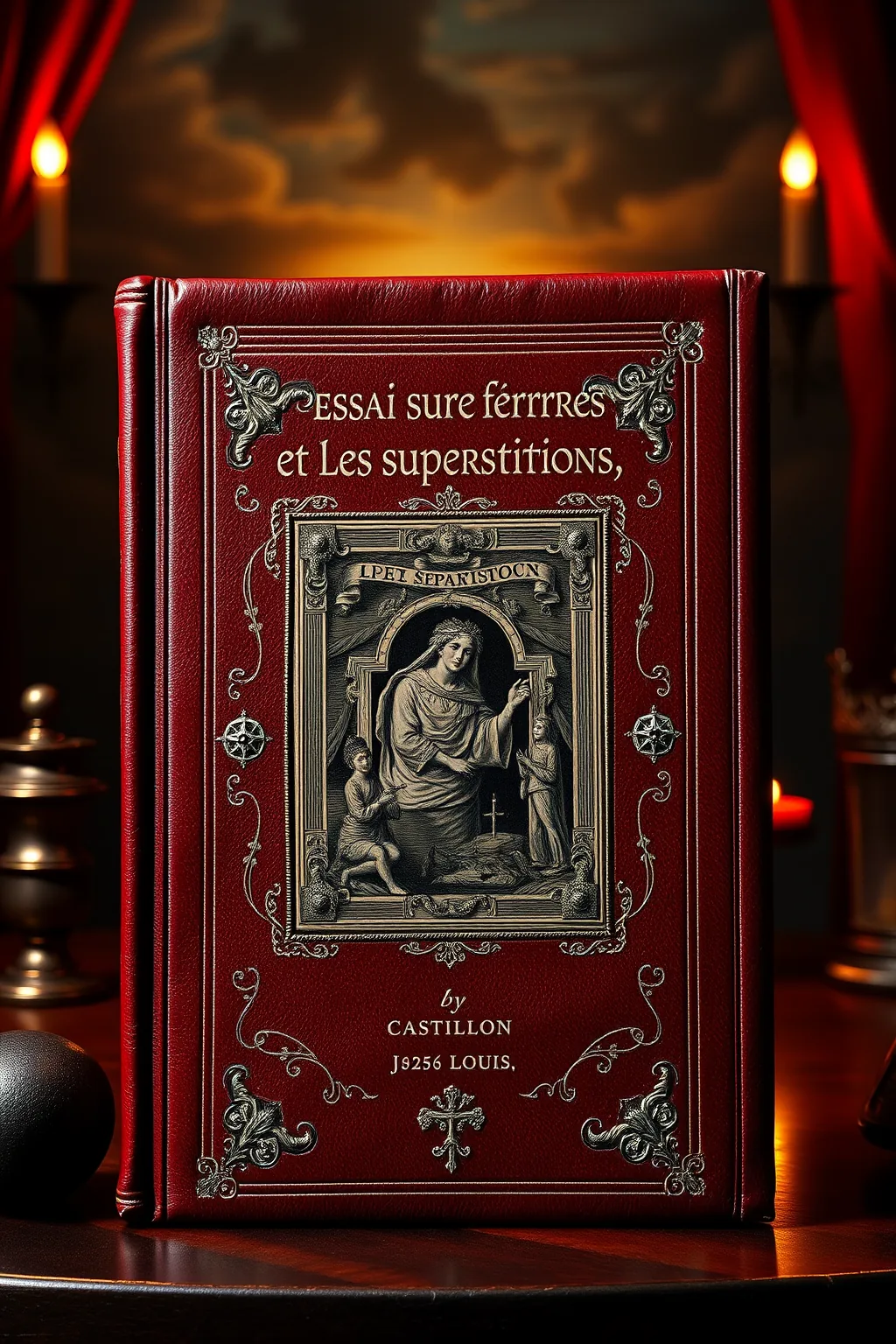
Essai sur les erreurs et les superstitions. ... 1765: Iss 204
 76
76

Essai sur les erreurs et les superstitions. ... 1765: Iss 204



Cassian Rothmann (Senior Critic, Ancient Wisdom) — In "Essai sur les erreurs et les superstitions," Jean Louis Castillon offers a prescient examination of the psychological underpinnings of belief. Far from a dry philosophical tract, this work delves into the very essence of how societies and individuals fall prey to unfounded notions, a theme resonating deeply with esoteric traditions. Castillon's strength lies in his analytical clarity, dissecting the roots of superstition with a detached yet empathetic gaze. He provides invaluable insights for scholars of occult history and practitioners seeking to understand the shadow side of spiritual exploration. This "Essai" is a vital precursor to modern critical thinking, urging readers to discern truth from illusion, a timeless pursuit for the earnest seeker.
📝 Description
76
Published in 1765, Jean Louis Castillon's "Essai sur les erreurs et les superstitions" dissects the roots of human credulity.
Jean Louis Castillon's 1765 "Essai sur les erreurs et les superstitions" examines how people fall prey to illusion and unfounded beliefs. Castillon scrutinizes the human mind's vulnerability to dogma and unsubstantiated claims about the unknown. He distinguishes between sincere spiritual inquiry and the allure of baseless convictions.
The author analyzes the origins of superstition and its widespread effects on both societies and individual minds. This work investigates the nature of gullibility, detailing how fear, desire, and the need for assurance distort perception. This distortion, Castillon argues, leads to the spread of myths and the acceptance of irrational ideas. The "Essai" encourages readers to hone their critical thinking skills and differentiate between fleeting superstitious notions and genuine knowledge.
Castillon's work engages with Enlightenment critiques of popular belief and superstition, which was a significant undercurrent in esoteric thought of the period. While not overtly mystical, it addresses the psychological mechanisms that underpin belief systems, including those that might be considered esoteric. The text's focus on distinguishing true knowledge from error and illusion aligns with the alchemical and hermetic traditions' emphasis on discernment and the pursuit of authentic understanding, often framed against a backdrop of societal ignorance or 'darkness'.
💡 Why Read This Book?
Unravel the historical roots of widespread misconceptions and their influence on belief systems. This "Essai" equips seekers and scholars with the tools to critically assess superstitions, enhancing their understanding of human psychology and the discernment of genuine esoteric knowledge from mere folklore. It's an essential read for anyone dedicated to intellectual rigor and the pursuit of truth.
⭐ Reader Reviews
Honest opinions from readers who have explored this book.
❓ Frequently Asked Questions
What is the primary focus of Castillon's "Essai sur les erreurs et les superstitions"?
The primary focus is a critical examination of the origins, nature, and pervasive influence of human errors and superstitions across society and individual belief systems.
What is the historical period this book addresses?
The book was written and published in 1765, placing it within the Enlightenment era, a period characterized by a strong emphasis on reason and skepticism.
Who would benefit most from reading this work?
Historians of ideas, philosophers, students of psychology, and individuals interested in the history of witchcraft, paganism, and the discernment of truth from falsehood will find this work highly beneficial.
Does this book offer practical advice for combating superstition?
While not a prescriptive self-help guide, the book's analytical approach implicitly encourages critical thinking and reasoned skepticism as antidotes to superstition.
Is this a religious text or a critique of religion?
It is primarily a philosophical and psychological critique of erroneous beliefs and superstitions, which can encompass religious or quasi-religious phenomena, rather than a theological text itself.
🔮 Key Themes & Symbolism
The Psychology of Belief and Delusion
This theme looks at the inherent human tendencies that foster erroneous beliefs and superstitions. Castillon dissects the psychological mechanisms—fear, desire, the yearning for certainty, and the influence of social conditioning—that make individuals susceptible to accepting unfounded ideas. It explores how these psychological vulnerabilities are exploited or inadvertently amplified, leading to the widespread acceptance of myths, magical thinking, and irrational practices. The text serves as an early exploration into the cognitive biases that shape our perception of reality, prompting readers to consider the internal landscapes that give rise to external phenomena of superstition.
Societal Constructs of Error and Truth
Castillon examines how errors and superstitions are not merely individual failings but are often embedded within and perpetuated by societal structures, traditions, and institutions. He scrutinizes how collective narratives, cultural norms, and authoritative pronouncements can solidify false beliefs, making them appear as immutable truths. This theme considers the historical evolution of superstitions and their role in maintaining social order or fostering collective anxieties. It prompts reflection on the power dynamics involved in defining what is considered 'true' and how dissenting or rational viewpoints might be suppressed or marginalized within a given cultural context.
The Distinction Between Genuine Mysticism and Superstitious Practice
A crucial element of Castillon's "Essai" is the delicate yet vital distinction he draws between authentic spiritual or mystical experiences and the superficial, often fear-driven, manifestations of superstition. He implicitly argues that true esoteric understanding arises from inner cultivation and reasoned inquiry, whereas superstition often stems from external pronouncements, unverified claims, and a reliance on magical thinking for immediate solutions. This theme encourages a discerning approach to the occult and metaphysical, urging readers to differentiate between profound wisdom and the mere accumulation of unexamined folk beliefs or rituals devoid of deeper meaning.
💬 Memorable Quotes
Direct passages from the work, attributed to the author.
“Where fear resides, reason often flees.”
— This speaks to how primal emotions, particularly fear, can override logical thought processes, making individuals more susceptible to irrational beliefs and superstitions.
“Tradition, a sturdy vine, can choke the bloom of inquiry.”
— This poignant metaphor suggests that unquestioning adherence to established customs or beliefs can stifle intellectual curiosity and the pursuit of new knowledge.
“The unexamined belief is a seed for future delusion.”
— This emphasizes the importance of critical self-reflection and questioning one's own convictions to prevent the perpetuation of errors and superstitions.
“We build altars to our own ignorance.”
— This powerful statement critiques the act of venerating or solidifying one's lack of understanding, often through the adoption of baseless beliefs or superstitions.
💡 Key Ideas
Editorial paraphrase of the work's core concepts — not direct quotes.
The mind, eager for clarity, often grasps at shadows.
This quote highlights the human tendency to seek quick answers, sometimes settling for illusory explanations rather than confronting complex truths or uncertainties.
🌙 Esoteric Significance
Tradition
This work aligns with the philosophical and rationalist currents of esoteric thought that emerged during the Enlightenment. It doesn't belong to a specific mystical lineage like Kabbalah or Hermeticism but rather provides a critical framework for understanding the *misapplication* of spiritual or metaphysical impulses. Its significance lies in its contribution to the tradition of critical inquiry within esoteric studies, encouraging practitioners and scholars to rigorously examine the roots of belief and to distinguish genuine inner wisdom from external, often fear-based, superstitions.
Symbolism
While not overtly symbolic in its language, the "Essai" uses the 'errors' and 'superstitions' themselves as potent symbols. They represent the veils that obscure truth, the shadows cast by ignorance, and the illusions that bind the human mind. Castillon's dissection of these phenomena can be seen as a symbolic act of dispelling darkness, a metaphorical unmasking of hidden falsehoods. The reader's journey through his analysis is a symbolic ascent from the mire of credulity towards the clear light of reason and discernment, a fundamental process in many esoteric paths.
Modern Relevance
In an age saturated with misinformation, conspiracy theories, and the rapid spread of unverified claims via digital channels, Castillon's "Essai" offers timeless insights. His analysis of the psychological and societal drivers of superstition remains acutely relevant for understanding contemporary phenomena. For those engaged with esoteric traditions, it provides a crucial lens for self-scrutiny, helping to differentiate authentic spiritual development from the allure of simplistic, unexamined beliefs or the sensationalism often found in fringe communities. It is a foundational text for cultivating intellectual fortitude in the pursuit of esoteric knowledge.
👥 Who Should Read This Book
This "Essai" is indispensable for the discerning reader. Scholars of intellectual history, philosophy, and the history of witchcraft and paganism will find a rich source for understanding the Enlightenment's critique of irrationality. Esoteric practitioners and seekers will benefit immensely from Castillon's dissection of belief systems, aiding them in distinguishing genuine spiritual insight from pervasive superstition and fostering a more rigorous approach to their path. Beginners exploring the foundations of critical thinking in relation to belief will find a clear and compelling argument. Ultimately, anyone dedicated to the pursuit of truth and the cultivation of intellectual clarity will find this work a valuable, thought-provoking companion.
📜 Historical Context
Penned in 1765, Jean Louis Castillon's "Essai sur les erreurs et les superstitions" emerges from the heart of the European Enlightenment. This era was characterized by a fervent embrace of reason, scientific inquiry, and a critical re-evaluation of traditional authorities, including religious dogma and long-held superstitions. The intellectual climate was one of skepticism towards the supernatural and a desire to understand the world through empirical observation and logical deduction. Castillon's work stands as a proof of this philosophical current, dissecting the mechanisms of irrationality at a time when philosophers like Voltaire and Diderot were actively challenging established falsehoods. His "Essai" contributes to a broader discourse on human nature, the formation of belief systems, and the persistent struggle between enlightenment and the lingering shadows of the past, making it a significant artifact of 18th-century intellectual history and its engagement with the occult and the mundane.
📔 Journal Prompts
Reflect on a personal superstition you once held. What were its roots, and how did you overcome it?
Analyze how societal or cultural influences contribute to the spread of a particular modern-day 'superstition' or unfounded belief.
Consider the difference between a deeply held, yet unsubstantiated, belief and a genuine, intuitive spiritual insight. How can one discern between the two?
How does the 'Essai's' critique of fear-based beliefs apply to contemporary anxieties or societal panics?
Imagine you are advising a contemporary individual who is deeply entrenched in a superstitious belief system. What principles from Castillon's work would you emphasize?
🗂️ Glossary
Superstition
A belief or practice resulting from ignorance, fear of the unknown, trust in magic or chance, or a false conception of causation. It often involves attributing undue significance to omens or irrational connections.
Credulity
A tendency to be too ready to believe that something is real or true; gullibility. It is the state of being easily persuaded or deceived.
Dogma
A principle or set of principles laid down by an authority as incontrovertibly true. In this context, it refers to beliefs that are accepted without question, often hindering critical inquiry.
Gnosis
In esoteric traditions, gnosis refers to spiritual or intuitive knowledge, often considered a direct apprehension of truth or divine reality, as opposed to intellectual understanding.
Enlightenment
An 18th-century intellectual and cultural movement emphasizing reason, individualism, skepticism, and science as the primary sources of authority and legitimacy, challenging traditional religious and political structures.
This book appears in 2 collections
🔮 Readers Also Liked
Browse all →






From the “Witchcraft” Collection
View all →







More Free Witchcraft & Paganism Books
View all →