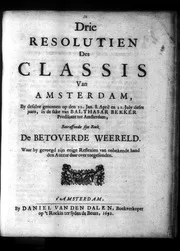
Drie resolutien des Classis van Amsterdam, by deselve genomen op den 22. Jan. 8. April en 21. July deses jaars, ... 1692: Vol 3 Iss 82
 72
72

Drie resolutien des Classis van Amsterdam, by deselve genomen op den 22. Jan. 8. April en 21. July deses jaars, ... 1692: Vol 3 Iss 82



Cassian Rothmann (Senior Critic, Ancient Wisdom) — Balthasar Bekker’s 'Drie resolutien' offers an incisive look into the theological battles of 1692 Amsterdam. This issue, Volume 3, Issue 82, meticulously documents the Classis's resolutions, revealing the intellectual rigor and underlying anxieties concerning witchcraft and religious orthodoxy. Bekker's influence is palpable, guiding the reader through complex arguments that question established demonological doctrines. The work serves as a vital primary source for understanding the transition from fervent superstition to nascent rationalism in religious thought. Its strength lies in its direct presentation of these critical debates, providing fertile ground for scholars and practitioners interested in the historical evolution of esoteric beliefs and their intersection with organized religion. A compelling, albeit dense, exploration of a transformative period.
📝 Description
72
In 1692, the Amsterdam Classis passed three resolutions concerning theological matters.
This volume, 'Drie resolutien des Classis van Amsterdam,' contains the official records from three meetings of the Amsterdam Classis held on January 22nd, April 8th, and July 21st, 1692. While appearing as simple church minutes, these resolutions touch upon the era's engagement with themes of the occult and demonology. Balthasar Bekker, a theologian known for questioning established religious doctrines, frames these discussions. The text allows readers to see how rational thought and existing beliefs in supernatural forces interacted during a time of significant intellectual change. It is suitable for those interested in how witchcraft beliefs developed, how theological ideas shifted, and how societal fears influenced intellectual discourse.
The book offers insight into the historical foundations of skepticism and the persistent human interest in the unexplained, viewed through the historical religious structures of the time. It provides a direct look at the concerns and decisions made by a prominent religious body during a period of intense spiritual and philosophical debate.
Published in 1692, this work emerges from a period where theological debates often intersected with popular and learned beliefs about the supernatural. The Amsterdam Classis, as a body representing a significant branch of Calvinist thought, would have been grappling with issues that touched upon the boundaries of accepted spiritual understanding. Bekker's involvement suggests an engagement with, or critique of, prevailing views on witchcraft and demonology, placing these resolutions within a broader context of intellectual currents that questioned or reinforced traditional eschatological and cosmological frameworks. The text reflects a moment where established religious authority was being tested by both internal theological scrutiny and external societal anxieties.
💡 Why Read This Book?
Uncover the historical genesis of witchcraft discourse and the clash between superstition and emerging reason. Explore theological debates from a pivotal era, offering profound insights into societal fears and intellectual evolution. Ideal for scholars of religious history, occult studies, and anyone seeking to understand the foundations of modern skepticism through a primary lens.
⭐ Reader Reviews
Honest opinions from readers who have explored this book.
❓ Frequently Asked Questions
What is the primary focus of this 1692 publication?
This publication centers on three official resolutions passed by the Classis of Amsterdam on specific dates in 1692, concerning matters debated within the religious and intellectual context of the era.
Who was Balthasar Bekker and what is his connection to this text?
Balthasar Bekker (1634-1698) was a prominent Dutch theologian and philosopher whose works often challenged prevailing beliefs, including those surrounding witchcraft. While not the direct author of these resolutions, his intellectual milieu and potential influence are implicit in the context of such theological discussions.
What historical period does this document represent?
This document represents the late 17th century (specifically 1692), a period marked by significant intellectual shifts, the waning of intense witch hunts in some regions, and ongoing theological debates about the nature of good, evil, and the divine.
What is the significance of the 'Classis of Amsterdam'?
The Classis of Amsterdam was a regional governing body of the Dutch Reformed Church. Their resolutions held significant weight in theological and ecclesiastical matters, reflecting the prevailing doctrines and controversies of the time.
Is this a primary source for studying witchcraft beliefs?
Yes, this publication is a valuable primary source. It offers direct insight into the official deliberations and theological reasoning surrounding potentially controversial topics, including those related to witchcraft, from the perspective of a significant religious authority of the period.
🔮 Key Themes & Symbolism
Theological Scrutiny and Spiritual Authority
This volume examines the rigorous theological examinations conducted by the Amsterdam Classis, showcasing their role as arbiters of religious doctrine and practice in the late 17th century. It reveals the intricate processes by which spiritual authorities grappled with complex issues, seeking to reconcile faith with reason and maintain societal order. The resolutions reflect a period where religious institutions held immense sway, and their pronouncements carried significant weight in shaping public understanding of the divine, the diabolical, and the permissible boundaries of belief. Readers will gain an appreciation for the intellectual range of ecclesiastical governance and the mechanisms through which theological consensus, or dissent, was forged.
The Lingering Shadow of Witchcraft Beliefs
While the intensity of witch trials had begun to wane in many parts of Europe by 1692, the underlying beliefs and societal anxieties surrounding witchcraft remained a potent force. This collection of resolutions offers a window into how these fears were addressed, debated, and perhaps reinterpreted by religious leaders. It illuminates the subtle shifts in perspective, the enduring influence of demonological lore, and the theological arguments employed to read through the perceived threat of malevolent supernatural forces. For those interested in the history of magic, folklore, and the psychology of belief, these documents provide crucial insights into the evolving discourse surrounding the occult during a transitional historical epoch.
Intellectual Transition and Emerging Rationalism
The late 17th century was a period of profound intellectual ferment, witnessing the rise of scientific inquiry and a burgeoning spirit of rationalism that began to challenge traditional dogma. Within this context, the resolutions of the Amsterdam Classis, especially when viewed through the lens of thinkers like Balthasar Bekker, can be seen as reflecting this tension between entrenched beliefs and emerging modes of thought. The debates captured here hint at the slow but steady erosion of unquestioned acceptance of supernatural explanations, paving the way for more empirical and philosophical approaches to understanding the world. This volume serves as a evidence of the gradual reorientation of thought during a central era.
💬 Memorable Quotes
Direct passages from the work, attributed to the author.
“Resolutions of the Classis of Amsterdam, 1692.”
— A direct identifier, signaling official pronouncements from a significant religious body during a critical historical juncture.
“Taken on the 22nd of January, 8th of April, and 21st of July.”
— Highlights the specific timeline of these important deliberations, grounding the text in concrete historical moments.
“Volume 3, Issue 82.”
— Indicates its place within a larger series, suggesting a continuation of discourse and a systematic approach to record-keeping.
“Digitized from IA40330315-11.”
— A technical note detailing the origin of the digital copy, crucial for archival and research purposes.
“Previous issue: per_witchcraft-in-europe-and-america_d-i-e-doktor-balth_bekker-balthasar-1634_1781_3_81.”
— Establishes a clear link to preceding content, facilitating a chronological understanding of related materials and the flow of intellectual discourse.
🌙 Esoteric Significance
Tradition
While not overtly a text of ritual or spellcraft, this work is deeply embedded within the broader tradition of Western esotericism by virtue of its engagement with the historical context of witchcraft beliefs and demonology. It represents the 'perennial philosophy' in its historical theological manifestation – how established religious frameworks grappled with the unseen and the 'occult' in the human experience. It speaks to the esoteric concern with hidden knowledge, the nature of spiritual warfare, and the interpretation of divine will, albeit from a position of institutional authority rather than direct mystical practice.
Symbolism
The 'resolutions' themselves act as symbolic articulations of societal control and theological interpretation. The dates and specific wording of these resolutions carry symbolic weight, representing the formalization of belief systems and the containment of perceived threats. The very act of the Classis convening and deliberating symbolizes the attempt to impose order and divine sanction upon chaotic or feared elements of existence, particularly those associated with the diabolical or the 'unnatural' forces believed to drive witchcraft.
Modern Relevance
In an age increasingly reliant on scientific explanation, understanding the historical debates surrounding witchcraft and religious authority offers a crucial perspective on the evolution of human belief systems. This text illuminates the psychological and societal roots of fear, the power of narrative in shaping perception, and the enduring human quest to comprehend forces beyond immediate understanding. It provides context for contemporary discussions on critical thinking, the influence of ideology, and the historical construction of 'the other,' demonstrating how deeply ingrained beliefs, even those now considered superstitious, shaped societies and influenced intellectual progress.
👥 Who Should Read This Book
This volume is essential for academic scholars of religious history, theology, and the history of witchcraft and magic. It will greatly appeal to occult practitioners and students of esoteric traditions who seek to understand the historical roots and societal context of beliefs surrounding the supernatural. Furthermore, general readers with a keen interest in intellectual history, the evolution of skepticism, and the cultural underpinnings of religious thought will find these resolutions a fascinating and clear primary source.
📜 Historical Context
The year 1692 falls within the late Baroque period, a time of profound societal and intellectual transformation in Europe. While the fervor of the major witch hunts had begun to subside in many regions, anxieties about the supernatural, demonology, and the perceived influence of witchcraft persisted. This era witnessed the rise of Enlightenment ideals, emphasizing reason, empirical observation, and a questioning of traditional authorities. The Dutch Republic, particularly Amsterdam, was a hub of intellectual activity, printing, and religious discourse, often characterized by a degree of religious tolerance and scholarly debate. Figures like Balthasar Bekker challenged deeply ingrained beliefs, particularly concerning the active role of the Devil and the nature of miracles, contributing to a gradual shift in theological and philosophical thought. This volume, recording the resolutions of the Amsterdam Classis, captures a snapshot of these evolving debates, offering insight into how established religious institutions navigated the complex interplay between faith, superstition, and the dawning of a more rational worldview.
📔 Journal Prompts
Reflect on the power dynamics between religious authority and the perception of the 'occult' in 1692. How might these resolutions have impacted individuals accused or suspected of witchcraft?
Consider the arguments that might have been debated within the Classis regarding the nature of evidence for witchcraft. How does this compare to modern methods of verification?
Bekker's era saw a burgeoning interest in rationalism. How do the resolutions presented here reflect or resist this intellectual current?
Imagine you are a member of the Amsterdam community in 1692. How would the pronouncements of the Classis on these matters influence your daily life and beliefs?
Explore the concept of 'hidden knowledge' within the context of religious doctrine. What was considered 'revealed truth' versus 'esoteric' or forbidden knowledge during this period?
🗂️ Glossary
Classis
In the context of the Dutch Reformed Church, a 'Classis' was a regional governing body composed of ministers and elders, responsible for overseeing churches within a specific geographical area and handling matters of doctrine and discipline.
Resolutions
Formal decisions or decrees made by an assembly or council, in this case, the Amsterdam Classis, addressing specific issues debated and voted upon by its members.
Demonology
The theological study of demons and evil spirits, their nature, hierarchy, and influence on the human world, a significant topic within religious discourse of the 17th century.
Theological
Relating to the study of the nature of God and religious belief. In this context, it refers to the doctrines and discussions within the Christian church.
Occult
Relating to supernatural, mystical, or magical powers, practices, or phenomena. In the 17th century, this often intersected with beliefs about witchcraft and unseen spiritual forces.
This book appears in 2 collections
🔮 Readers Also Liked
Browse all →



More by BEKKER, Balthasar 1634-1698.
All books →
From the “Witchcraft” Collection
View all →





More Free Witchcraft & Paganism Books
View all →