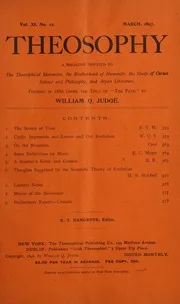
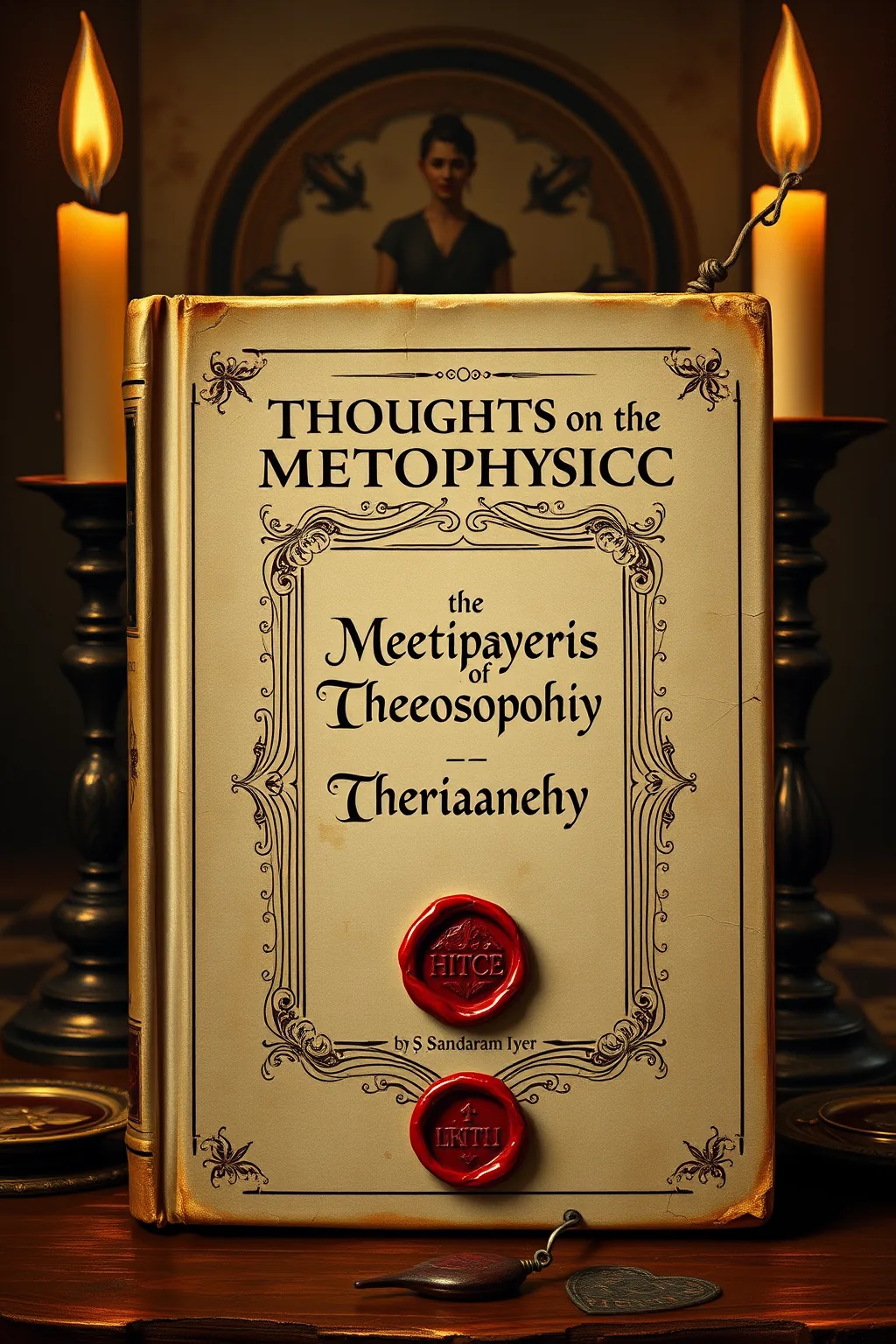
Thoughts on the Metaphysics of Theosophy
 72
72

Thoughts on the Metaphysics of Theosophy


Review by Ophelia Vance (Mystical Literature Reviewer) — 'Thoughts on the Metaphysics of Theosophy' by S. Sandaram Iyer is a luminous exploration of the spiritual cosmos. Iyer's prose, though rooted in a specific tradition, possesses a universal resonance, offering clear insights into complex metaphysical concepts like reincarnation, karma, and the nature of the divine monad. He artfully bridges the gap between abstract philosophy and practical spiritual application, making the esoteric accessible without sacrificing its profundity. This work is particularly compelling for its systematic exposition of Theosophical principles, providing a robust framework for understanding the interconnectedness of the material and spiritual realms. Highly recommended for serious students of esoteric philosophy and seekers of ultimate truths.
📝 Description
72
S. Sandaram Iyer's 1910 work examines the metaphysical underpinnings of Theosophy.
Published in 1910, S. Sandaram Iyer's 'Thoughts on the Metaphysics of Theosophy' addresses the philosophical structure of the Theosophical movement. Iyer focuses on explaining key concepts like the interconnectedness of all things, the idea of recurring cycles in time, and the operations of non-physical dimensions. The text aims to clarify the spiritual science that Theosophy represents.
This book invites readers to consider the soul's progression, the law of karma, and the intelligent force guiding the universe. It is written for those interested in moving beyond ordinary understanding to grasp the spiritual realities underlying existence. The work seeks to guide the mind toward a deeper apprehension of the metaphysical basis for spiritual development.
This book sits within the broader context of early 20th-century Theosophy, a movement that sought to synthesize Eastern and Western esoteric traditions. It engages with ideas prevalent in spiritualist and occult circles of the time, attempting to provide a philosophical framework for concepts such as reincarnation, karma, and the existence of unseen spiritual hierarchies. Theosophy itself drew heavily on Hindu, Buddhist, and Gnostic thought, aiming to present a unified view of spiritual evolution accessible to a Western audience.
💡 Why Read This Book?
Embark on a profound intellectual and spiritual journey. This book offers a rare glimpse into the foundational metaphysics of Theosophy, revealing the hidden connections between the seen and unseen worlds. It's ideal for seekers, scholars, and practitioners of esoteric disciplines who wish to deepen their understanding of consciousness, karma, and the soul's evolution. Uncover timeless wisdom that can illuminate your path.
⭐ Reader Reviews
Honest opinions from readers who have explored this book.
❓ Frequently Asked Questions
What is the primary focus of this book?
The primary focus is on the metaphysical underpinnings of Theosophy, exploring concepts such as the nature of reality, consciousness, reincarnation, karma, and the spiritual evolution of humanity.
Who is the intended audience for this work?
This book is intended for individuals interested in esoteric philosophy, spiritual seekers, students of Theosophy and related traditions, and scholars of comparative religion and metaphysics.
Does the book offer practical guidance for spiritual practice?
While primarily a philosophical exploration, the book's insights into the laws of the cosmos and the nature of the self can inform and deepen one's spiritual practice and understanding.
What is the historical significance of this book?
It represents a significant contribution to the early dissemination and intellectual development of Theosophical thought, offering a structured approach to its complex doctrines during a pivotal era for Western esotericism.
Is prior knowledge of Theosophy required to understand this book?
While some familiarity with spiritual concepts is beneficial, Iyer's clear exposition makes the book accessible to dedicated newcomers willing to engage with its profound ideas.
🔮 Key Themes & Symbolism
The Nature of Consciousness and Reality
Iyer explores the multi-faceted nature of consciousness, postulating that it is not merely a product of the physical brain but a fundamental aspect of the cosmos, permeating all existence. He explores the idea of a universal consciousness from which individual minds arise and to which they ultimately return. The book meticulously dissects the relationship between the perceived material world and the subtler, energetic planes, suggesting a holographic or interconnected reality where thought and intention play a significant role in shaping our experiences. This theme encourages a shift in thinking, moving beyond materialistic viewpoints to embrace a more holistic and spiritually informed understanding of existence.
The Law of Karma and Reincarnation
Central to Iyer's discourse is the profound and intricate law of Karma, understood not as arbitrary fate but as a cosmic principle of cause and effect. The book elucidates how actions, thoughts, and intentions sown in this life, and indeed across numerous lifetimes, inevitably bear fruit. Reincarnation is presented as the natural mechanism through which the soul progresses, learning lessons and working out karmic debts, thereby achieving spiritual evolution. This theme emphasizes personal responsibility, the interconnectedness of all beings through shared karmic threads, and the ultimate purpose of suffering and joy as catalysts for growth.
The Hierarchical Structure of the Cosmos
Iyer paints a picture of a divinely ordered universe, characterized by a complex hierarchy of intelligences and planes of existence, stretching from the most rarefied spiritual realms down to the densest physical matter. This 'Great Chain of Being' is not static but dynamic, with each level playing a vital role in the grand cosmic scheme. The book explores the concept of spiritual evolution, where humanity occupies a unique position, capable of ascending through these planes by understanding and aligning with universal laws. This theme offers a sense of cosmic purpose and an understanding of our place within a vast, intelligent, and purposeful creation.
💬 Memorable Quotes
Direct passages from the work, attributed to the author.
“Karma is not punishment, but the cosmic law of equilibrium.”
— This clarifies the nature of karma, moving beyond a punitive interpretation to emphasize its role as a natural, impersonal force that maintains balance and order throughout the cosmos.
“The outer form is but a shadow of the inner reality.”
— This highlights the esoteric principle of looking beyond the superficial appearances of the material world to perceive the deeper, spiritual truths that lie beneath.
“Each soul is on a journey of self-discovery, guided by the light within.”
— This speaks to the individual path of spiritual growth and enlightenment, emphasizing the inherent divine spark within each being and the innate drive towards self-realization.
“To know oneself is to know the divine.”
— This profound statement links self-awareness with spiritual realization, suggesting that by understanding the depths of our own being, we touch upon the universal and the divine.
💡 Key Ideas
Editorial paraphrase of the work's core concepts — not direct quotes.
The universe is a living organism, and we are its cells.
This quote captures the core Theosophical idea of unity and interconnectedness, suggesting that all phenomena are part of a singular, conscious entity, and that our individual existence is inseparable from the whole.
🌙 Esoteric Significance
Tradition
This work is deeply embedded within the Theosophical tradition, which itself draws heavily from ancient Indian philosophies (Vedanta, Yoga) and Neoplatonism, blended with elements of Western esotericism. It presents a systematic, albeit simplified, interpretation of complex metaphysical doctrines intended to reveal the underlying unity of all religions and sciences, offering a framework for understanding the universe as a manifestation of divine consciousness.
Symbolism
The book implicitly uses strong symbolism inherent in Theosophical teachings, such as the 'Great Chain of Being,' the 'Seven Principles of Man,' and the cyclical nature of time (Yugas). These symbols are not merely decorative but represent profound metaphysical concepts: the hierarchical structure of existence, the multi-layered human constitution, and the eternal dance of creation and dissolution, all pointing towards an underlying spiritual order.
Modern Relevance
In an age often characterized by materialism and existential fragmentation, Iyer's work offers a compelling counter-narrative of interconnectedness, spiritual purpose, and the inherent divinity within each individual. Its emphasis on ethical conduct, the law of karma, and the continuous evolution of consciousness speaks to contemporary discussions on mindfulness, personal responsibility, and the search for meaning beyond material pursuits, providing timeless wisdom for working through the complexities of modern life.
👥 Who Should Read This Book
This book is a rich source for the dedicated seeker of spiritual truths and the serious student of esoteric philosophy. Beginners in Theosophy will find it an excellent primer, offering clarity on foundational concepts. Scholars of comparative religion and metaphysics will appreciate its thoughtful synthesis of Eastern and Western thought. Practitioners of spiritual disciplines can glean clear insights that will deepen their understanding of the underlying principles guiding their path. Ultimately, anyone yearning to explore the deeper mysteries of existence, consciousness, and the soul's journey will find 'Thoughts on the Metaphysics of Theosophy' an invaluable companion.
📜 Historical Context
Written during the burgeoning interest in Eastern philosophies and spiritualism in the late 19th and early 20th centuries, 'Thoughts on the Metaphysics of Theosophy' emerges from a fertile period of intellectual and spiritual cross-pollination. Theosophy, as popularized by Helena Blavatsky, sought to synthesize ancient wisdom traditions with modern scientific and philosophical thought. S. Sandaram Iyer, an Indian scholar deeply immersed in both Eastern Vedantic thought and Western esoteric currents, offers a unique perspective. This era saw a questioning of established religious dogma and a widespread search for deeper, often hidden, truths about existence, consciousness, and humanity's place in the universe. Iyer's work contributed to this intellectual milieu, providing a structured and accessible exposition of Theosophical tenets, influencing subsequent generations of spiritual seekers and philosophers.
📔 Journal Prompts
Reflect on a personal experience that demonstrates the principle of cause and effect (karma) in your life. How did your actions lead to specific outcomes?
Consider the concept of 'universal consciousness.' How does this idea challenge or affirm your current understanding of your own consciousness and its connection to the world?
Identify one aspect of the 'hierarchical structure of the cosmos' as described in Theosophy that resonates most with you. Explore why this particular concept feels significant.
Meditate on the idea that 'the outer form is but a shadow of the inner reality.' What 'inner realities' do you perceive in your daily life, and how do they manifest outwardly?
How can the principle of 'spiritual evolution' be applied to your personal growth and development? What steps can you take to consciously participate in your own evolution?
🗂️ Glossary
Theosophy
A spiritual philosophy that seeks to synthesize ancient wisdom traditions with modern science and philosophy, emphasizing the underlying unity of all religions and the spiritual evolution of humanity.
Metaphysics
The branch of philosophy that deals with the first principles of things, including abstract concepts such as being, knowing, substance, cause, identity, time, and space, often exploring the fundamental nature of reality.
Karma
In Eastern traditions, the principle of cause and effect where intent and actions of an individual influence their future, often understood as a cosmic law of equilibrium and consequence.
Reincarnation
The philosophical or religious concept that the non-physical essence of a living being starts a new life in a different physical form or body after biological death.
Monad
In Theosophy and other esoteric systems, the divine spark or spiritual principle within an individual, often seen as an eternal, unchanging core of being.
This book appears in 2 collections
🔮 Readers Also Liked
Browse all →








More by S. Sandaram Iyer
All books →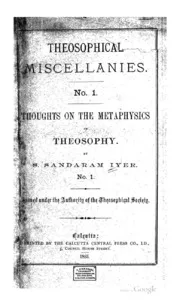
From the “Theosophy” Collection
View all →






More Free Theosophy & Anthroposophy Books
View all →