The Key to Theosophy
 80
80

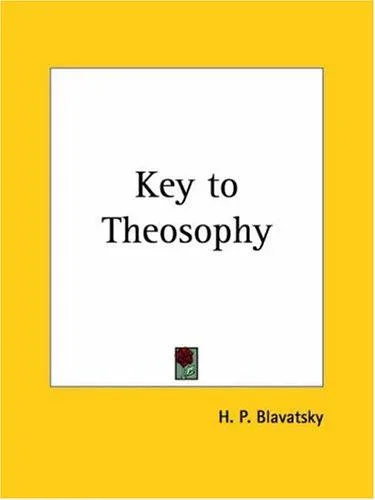
The Key to Theosophy
Helena Blavatsky's "The Key to Theosophy" functions as an essential, if dense, exposition of the foundational ideas she championed. Unlike many spiritual texts, it adopts a Q&A format, directly confronting potential reader queries and objections. This method, while effective for clarity, can sometimes lead to a somewhat dry, encyclopedic feel. The strength lies in its comprehensive attempt to systematize complex metaphysical concepts – the interplay of karma, reincarnation, and the evolution of consciousness, for instance, is laid out with a logical, if esoteric, framework. A limitation is its inherent reliance on a specific esoteric vocabulary that requires significant prior or concurrent study to fully grasp. The discussion of the Seven Principles of Man, a core Theosophical doctrine, exemplifies both the book's thoroughness and its demanding nature for the uninitiated. For serious students of esoteric thought, it remains a pivotal, albeit challenging, primary source.
📝 Description
80
The Key to Theosophy, first published in 1930, explains the core principles of the Theosophical Society.
This book is a systematic explanation of Theosophical principles, intended to clarify the movement's main ideas for a wider readership. It addresses common questions and misunderstandings about Theosophy, aiming to create a clear framework for its spiritual and philosophical foundations. The work is not a conventional narrative or philosophical treatise, but a direct exposition of Helena Blavatsky's teachings.
Compiled and edited after Blavatsky's death, The Key to Theosophy draws from her extensive writings and lectures. It was published during a time of significant spiritual and philosophical inquiry in the late 19th and early 20th centuries. Theosophy sought to synthesize Eastern religions and Western esoteric traditions, positioning itself as a rational, scientific basis for spiritual truths, distinct from materialism or established religious doctrines.
Theosophy emerged in the late 19th century as a synthesis of Eastern religions, Western esotericism, and a rational, scientific approach to spiritual truths. It sought to uncover the underlying unity of all religions and philosophies, presenting a coherent system of thought that contrasted with both materialistic worldviews and traditional religious dogma. The movement emphasized spiritual evolution, karma, reincarnation, and the existence of hidden spiritual hierarchies.
💡 Why Read This Book?
• You will learn the foundational principles of Theosophy, including the concepts of karma and reincarnation, as explained by Helena Blavatsky herself, offering a direct engagement with the movement's core doctrines established in the late 19th century. • You will gain an understanding of the Theosophical view on the evolution of consciousness and the seven principles of man, concepts central to Blavatsky's synthesis of Eastern and Western esoteric thought. • You will explore the Theosophical Society's stated aim of Universal Brotherhood, understanding its philosophical underpinnings and its significance within the spiritual landscape of the 1880s and beyond.
⭐ Reader Reviews
Honest opinions from readers who have explored this book.
❓ Frequently Asked Questions
What is the main purpose of Helena Blavatsky's 'The Key to Theosophy'?
The book's primary purpose is to explain the fundamental tenets of Theosophy in a clear and accessible manner, directly addressing common questions and misconceptions about its philosophy, ethics, and cosmology.
When was 'The Key to Theosophy' first published, and why is its publication date significant?
It was first published in 1930, but its content reflects Helena Blavatsky's teachings from the late 19th century, a period of significant spiritual and intellectual ferment in the West.
What are some of the core Theosophical concepts explained in this book?
Key concepts include the principles of karma and reincarnation, the evolution of consciousness, the nature of the subtle bodies, and the goal of Universal Brotherhood.
Is 'The Key to Theosophy' suitable for absolute beginners in esoteric studies?
While it aims for clarity, the book uses specific terminology and explores complex metaphysical ideas. Beginners may find it beneficial to supplement their reading with introductory guides to Theosophy.
How does 'The Key to Theosophy' relate to Helena Blavatsky's other major works?
This book serves as a more direct and organized exposition of the core ideas presented in her larger works like 'Isis Unveiled' and 'The Secret Doctrine'.
Can 'The Key to Theosophy' be considered a primary source for understanding Theosophy?
Yes, it is considered a primary source as it directly presents Helena Blavatsky's explanations and answers to frequently asked questions about Theosophy.
🔮 Key Themes & Symbolism
Karma and Reincarnation
The work elaborates extensively on the concepts of karma (the law of cause and effect) and reincarnation (the cyclical rebirth of the soul). Blavatsky presents these not as punitive mechanisms but as integral aspects of a cosmic justice and evolutionary process. The book explains how actions in one life influence future existences, shaping the individual's spiritual journey across multiple lifetimes, a central tenet differentiating Theosophy from many Western religious views prevalent in the late 19th century.
Universal Brotherhood
A central to Theosophy, Universal Brotherhood is presented as the practical application of spiritual understanding. The book argues that recognizing the shared divine essence in all beings fosters compassion and unity, transcending race, creed, and social divisions. This principle was a foundational objective for the Theosophical Society, aiming to create a nucleus of service and mutual aid among humanity.
Evolution of Consciousness
Theosophy posits a grand scheme of spiritual evolution for both humanity and the cosmos. 'The Key to Theosophy' outlines how consciousness progresses through various stages and planes of existence, driven by the interplay of karma and an innate evolutionary impulse. This concept draws parallels with scientific evolutionary theories of the era but extends them into metaphysical and spiritual realms, suggesting a purposeful unfolding of divine potential.
The Seven Principles of Man
Blavatsky details the complex structure of the human being, which Theosophy divides into seven principles or vehicles, ranging from the physical body to the highest spiritual aspect. Understanding these principles is crucial for comprehending reincarnation and the process of spiritual development. The book explains how these principles interact and how the higher ones survive physical death, continuing the journey of the reincarnating ego.
💬 Memorable Quotes
Direct passages from the work, attributed to the author.
“The Theosophical Society has not been founded with any idea of setting up a new religion.”
— This statement emphasizes Blavatsky's intention to present Theosophy as a philosophy and a way of understanding the universe, rather than a dogma-based faith system, differentiating it from established religions of her time.
“Karma is the ultimate law of the universe.”
— This highlights the central role of karma in Theosophical thought, presenting it as the governing principle behind all events and experiences, shaping individual destinies across lifetimes.
“The goal is the Universal Brotherhood of humanity, without distinction of race, creed, sex, caste, or colour.”
— This directly states one of the Theosophical Society's primary objectives, emphasizing inclusivity and the recognition of fundamental unity among all people, a radical idea in the late 19th century.
“The Secret Doctrine is the common source from which all religions have sprung.”
— This interpretation reflects Blavatsky's view of a universal, ancient wisdom tradition underlying all world religions, a key thesis explored in her more extensive works.
💡 Key Ideas
Editorial paraphrase of the work's core concepts — not direct quotes.
We are all pilgrims on the same path, though we may travel at different speeds.
This paraphrase captures the Theosophical ideal of unity and shared spiritual journey, suggesting that despite individual differences in progress, all beings are fundamentally moving towards the same ultimate spiritual realization.
🌙 Esoteric Significance
Tradition
This work is a foundational text within the Theosophical tradition, a movement that sought to synthesize ancient wisdom from various global spiritual paths, particularly Hinduism, Buddhism, and Hermeticism. It departs from purely Western esoteric lineages by heavily incorporating Eastern concepts of karma, reincarnation, and cyclic cosmology, presenting them as universal laws rather than sectarian doctrines. Theosophy positioned itself as a modern expression of an ancient, perennial wisdom, aiming to provide a rational basis for spiritual truths.
Symbolism
The book frequently references the concept of the 'Third Eye' or 'Eye of Shiva,' symbolizing inner vision, intuition, and spiritual perception beyond the ordinary senses. Another key motif is the 'Lotus,' representing spiritual unfolding, purity emerging from muddy waters, and the cyclical nature of existence. The serpent, often depicted coiled around a staff or egg, symbolizes cosmic energy, wisdom, and the eternal cycles of creation and dissolution central to Theosophical cosmology.
Modern Relevance
Contemporary esoteric practitioners, particularly those in the Western Esoteric Tradition, often reference Theosophical concepts. Modern movements focused on consciousness studies, comparative religion, and New Age spirituality frequently draw upon Blavatsky's ideas regarding karma, reincarnation, and the evolution of consciousness. Thinkers and groups exploring the intersection of science and spirituality continue to engage with Theosophy's attempts to bridge these domains, finding its holistic worldview relevant to contemporary ecological and social concerns.
👥 Who Should Read This Book
• Students of comparative religion and philosophy seeking to understand the origins and core tenets of Theosophy, particularly its synthesis of Eastern and Western esoteric thought. • Individuals interested in the life and influence of Helena Blavatsky and her role in shaping late 19th and early 20th-century spiritual movements. • Seekers exploring concepts like karma, reincarnation, and the evolution of consciousness from a non-dogmatic, metaphysical perspective.
📜 Historical Context
The Key to Theosophy draws heavily from the intellectual milieu of the late 19th century, a period marked by both scientific advancement and a burgeoning interest in alternative spiritualities. Helena Blavatsky, along with Henry Steel Olcott, founded the Theosophical Society in 1875, aiming to synthesize Eastern wisdom traditions with Western esoteric thought. This era saw the rise of Spiritualism, a movement that captured public imagination but was often criticized for its lack of intellectual rigor. Theosophy, in contrast, sought to provide a more philosophical and systematic framework, engaging with emerging fields like comparative mythology and archaeology. Blavatsky's work was particularly influenced by Hindu and Buddhist philosophies, which she reinterpreted for a Western audience. Key contemporaries included figures like Annie Besant, who later became a prominent leader of the Theosophical movement, and critics like William Quan Judge, who had his own interpretations. Theosophy's claims often sparked controversy and debate, positioning it as a significant, albeit often contested, force in the range of esoteric and religious thought.
📔 Journal Prompts
The principle of Universal Brotherhood as the primary objective of the Theosophical Society.
The interconnectedness of karma and reincarnation in shaping individual destiny.
The seven principles of man and their role in spiritual evolution.
Theosophy's claim to be a synthesis of ancient wisdom traditions.
The concept of the cyclic nature of existence as presented in the work.
🗂️ Glossary
Theosophy
A system of mystical philosophy and esoteric doctrine aiming to understand divine nature and the human condition, often synthesizing Eastern and Western spiritual traditions.
Karma
The universal law of cause and effect, where actions in this life determine future circumstances and rebirths; a central concept in Hindu, Buddhist, and Theosophical thought.
Reincarnation
The belief that the soul or consciousness is reborn into a new physical body after death, continuing its spiritual evolution through successive lives.
Manas
In Theosophy, the human mind or intellect, considered a principle that mediates between the higher spiritual self and the lower physical and emotional aspects.
Devachan
A state of spiritual bliss or rest experienced by the reincarnating ego between physical lives, corresponding to the fruition of good karma.
Kama-Loka
A transitional state or plane of existence after death where the lower, desire-driven aspects of the personality disintegrate before the higher principles move to Devachan.
Root Races
In Theosophical cosmology, stages of human evolution described as distinct, large-scale evolutionary cycles or types of humanity that have appeared on Earth.
🔮 Readers Also Liked
Browse all →





More by Елена Петровна Блаватская
All books →





More Free Theosophy & Anthroposophy Books
View all →