Helena Blavatsky Die Geheimlehre Band II Anthropogenesis ( 1893, 1390 S., Text)

 72
72

Helena Blavatsky Die Geheimlehre Band II Anthropogenesis ( 1893, 1390 S., Text)

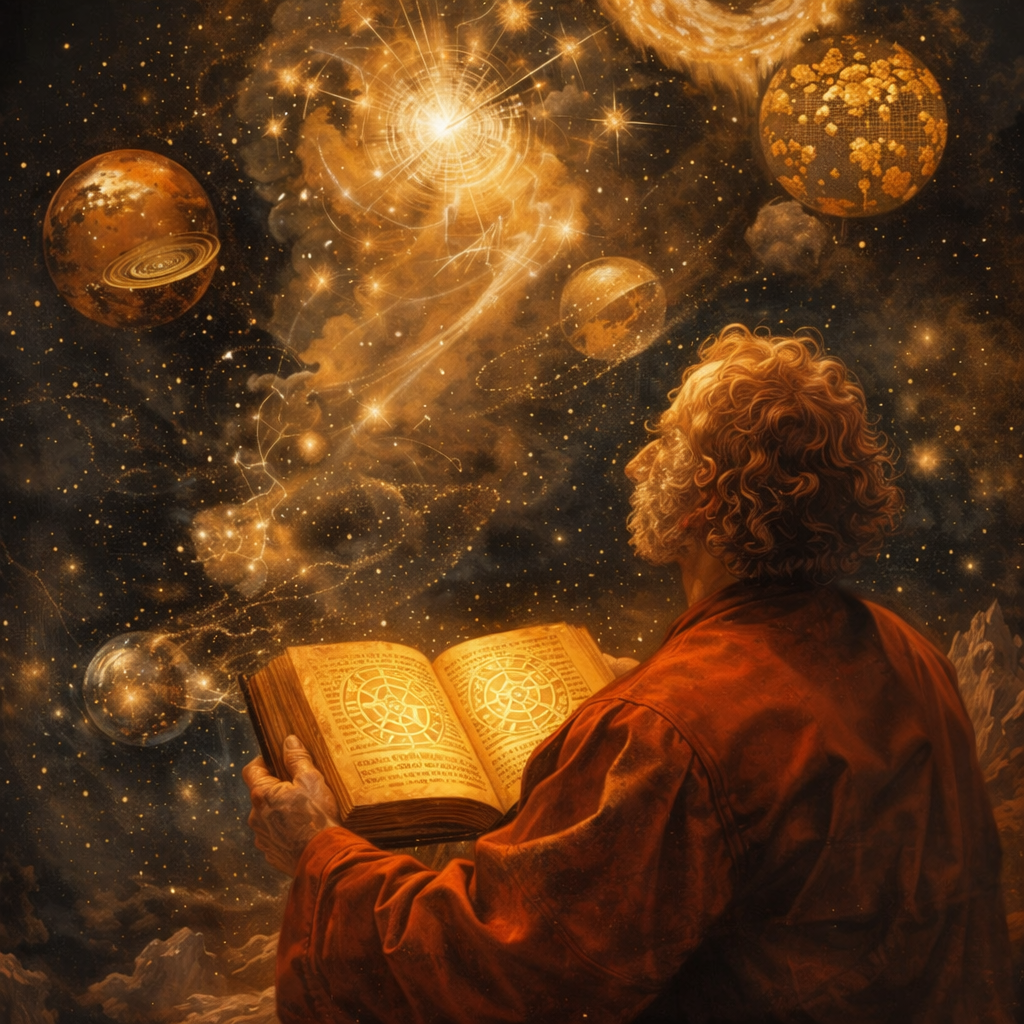

Balthazar Finch (Senior Critic, Occult Philosophy) — Blavatsky's 'Anthropogenesis' remains an unparalleled cornerstone of Theosophical literature. This second volume of 'The Secret Doctrine' is a staggering intellectual and spiritual undertaking, presenting a vast cosmology that challenges conventional evolutionary paradigms. Blavatsky masterfully synthesizes diverse ancient traditions, offering profound insights into humanity's spiritual and physical development through vast cosmic epochs. Her meticulous scholarship, though dense, unlocks secrets of forgotten races and universal laws. This work is indispensable for serious students of occult philosophy, esoteric history, and the deeper mysteries of consciousness, demanding rigorous study but yielding unparalleled illumination.
📝 Description
72
Helena Blavatsky's 'The Secret Doctrine, Vol. II: Anthropogenesis' was published in 1893.
This second volume of Blavatsky's 'The Secret Doctrine' details the evolution of humanity and the cosmos. It posits a complex system of spiritual evolution occurring over vast cosmic cycles, beginning long before recorded history. Blavatsky draws on a wide array of sources, including ancient religious texts, occult traditions, and contemporary scientific theories, to construct her narrative of human origins. The book describes stages of human development, the nature of different root races, and the role of spiritual hierarchies in the evolutionary process.
It presents a cosmology where humanity's physical form is an outgrowth of subtle bodies, animated by divine intelligence. The text argues for a cyclical view of existence, contrasting it with linear progression. Blavatsky aims to demonstrate a universal, underlying spiritual law governing all phenomena. The book is dense with symbolic language and references, requiring careful study to grasp its concepts.
Published in 1893, 'Anthropogenesis' is a key text within the Theosophical movement founded by Helena Blavatsky. It sits alongside her earlier work, 'The Secret Doctrine, Vol. I: Cosmogenesis'. These volumes sought to synthesize Eastern and Western esoteric traditions, presenting a coherent, universalist spiritual philosophy. Blavatsky claimed to draw her material from an ancient body of wisdom, accessible to initiates. The work influenced subsequent occult and New Age movements, shaping modern esoteric thought.
💡 Why Read This Book?
Embark on a profound journey into the hidden history of humanity and the cosmos. 'Anthropogenesis' offers a radical reinterpretation of evolution, grounded in ancient esoteric wisdom. Ideal for seekers of ultimate truth, scholars of comparative mythology, and practitioners exploring consciousness and universal laws. Discover a universe far more intricate and spiritually imbued than commonly perceived.
⭐ Reader Reviews
Honest opinions from readers who have explored this book.
❓ Frequently Asked Questions
What is 'The Secret Doctrine' about?
'The Secret Doctrine' is Helena Blavatsky's magnum opus, a vast synthesis of ancient wisdom that presents a cosmic and human evolutionary scheme, challenging conventional scientific and religious doctrines with a spiritual perspective.
What does 'Anthropogenesis' specifically cover?
This second volume focuses on the evolution of humanity, detailing cosmic cycles, the genesis of physical and spiritual forms, and the development of consciousness across vast epochs, drawing from ancient cosmogonies and occult teachings.
Is this book suitable for beginners?
While intellectually demanding, 'Anthropogenesis' can be approached by dedicated beginners willing to engage with complex philosophical and esoteric concepts. It is best read alongside introductory Theosophical texts or with guidance.
What is the role of 'Root Races' in this book?
The concept of 'Root Races' is central to Blavatsky's anthropogenesis, describing successive stages of humanity's evolution on Earth, each with distinct physical and spiritual characteristics, unfolding over immense periods.
Where does Blavatsky draw her information from?
Blavatsky claims her work is based on ancient esoteric texts, particularly the 'Book of Dzyan,' and a synthesis of global mythologies, philosophies, and religious traditions, interpreted through her unique spiritual understanding.
🔮 Key Themes & Symbolism
Cosmic Evolution and Cycles
This theme explores Blavatsky's radical concept of cosmic evolution, positing that the universe and humanity evolve through vast cycles of manifestation and dissolution. It details the intricate interplay of spiritual and material forces, the role of divine intelligences, and the cyclical nature of existence, moving beyond linear scientific models to embrace a grand, recurring cosmic drama that shapes all life.
The Spiritual Genesis of Humanity
Central to 'Anthropogenesis' is the idea that human existence is not solely a biological accident but a divinely orchestrated spiritual unfolding. Blavatsky delineates the development of subtle bodies, the awakening of consciousness, and the progression through distinct 'Root Races,' each representing a stage in humanity's spiritual and physical evolution. This theme challenges materialistic views by asserting a profound spiritual heritage and destiny for humankind.
Ancient Wisdom and Symbolism
Blavatsky meticulously excavates and synthesizes esoteric knowledge from a global array of ancient traditions, including Vedic, Egyptian, Greek, and Kabbalistic lore. This theme focuses on her interpretation of symbols, allegories, and cosmogonies as keys to understanding universal laws and the hidden workings of nature. The book demonstrates how ancient myths are not mere stories but encoded spiritual teachings designed to guide humanity towards self-realization.
💬 Memorable Quotes
Direct passages from the work, attributed to the author.
“Man is the microcosm of the macrocosm.”
— This profound statement highlights the esoteric principle that the human being mirrors the entire universe, suggesting that by understanding oneself, one can comprehend the greater cosmic order.
“Spirit is the life, the soul the intermediary, and matter the body.”
— This expresses the tripartite nature of existence as presented by Blavatsky, outlining the hierarchical relationship between the divine, the psychic, and the material realms.
💡 Key Ideas
Editorial paraphrase of the work's core concepts — not direct quotes.
Evolution is the law of life.
A foundational tenet of Blavatsky's philosophy, this quote emphasizes that existence is a continuous process of development, not just physically but spiritually, across all planes of being.
The universe is the book of God.
This quote frames the cosmos as a divine text, filled with hidden meanings and spiritual truths accessible to those who can decipher its symbolic language and underlying laws.
Ignorance is the greatest of all sins.
Emphasizing the importance of knowledge and spiritual understanding, this quote suggests that a lack of awareness is the primary obstacle to human progress and enlightenment.
🌙 Esoteric Significance
Tradition
This volume is a core part of the modern esoteric tradition, particularly Theosophy, which Blavatsky founded. It draws heavily from ancient Hermeticism, Gnosticism, Neoplatonism, and Eastern philosophies like Vedanta and Buddhism. Its significance lies in its attempt to synthesize these disparate streams of wisdom into a coherent, universal cosmology and philosophy of evolution, presenting a view of humanity's journey as deeply spiritual and interconnected with cosmic processes.
Symbolism
Blavatsky employs a body of symbolism drawn from global mythologies, religious iconography, and ancient cosmogonies. Key symbols include the 'Monad' (the divine spark), the seven planes of existence, the 'Great Year' (cosmic cycles), and the 'Root Races' (stages of human evolution). These symbols are not mere decorative elements but are presented as coded keys to understanding the fundamental laws of nature, the structure of consciousness, and the spiritual architecture of the universe.
Modern Relevance
Despite its age, 'Anthropogenesis' continues to resonate with modern seekers exploring consciousness, spirituality, and the nature of reality. Its critique of materialistic paradigms and its emphasis on interconnectedness and spiritual evolution offer a counterpoint to contemporary scientific and philosophical trends. The book's exploration of subtle energies, reincarnation, and the hidden potential of humanity remains profoundly relevant for those seeking a deeper understanding of themselves and their place in the cosmos.
👥 Who Should Read This Book
This monumental work is essential for serious students of Theosophy, occult philosophy, and comparative mythology. Scholars of esoteric traditions will find it an invaluable primary source. Spiritual seekers yearning for a profound understanding of human origins and cosmic evolution will be deeply challenged and rewarded. Practitioners of meditation and inner development may find its insights into consciousness and spiritual planes particularly informative. While its density requires dedicated study, the rewards are immense for those committed to uncovering the deeper mysteries of existence.
📜 Historical Context
Published in 1893, 'The Secret Doctrine, Vol. II: Anthropogenesis' emerged during a period of profound intellectual and spiritual ferment. The late Victorian era was marked by scientific advancements, archaeological discoveries, and a growing interest in comparative religion and Eastern philosophies. Charles Darwin's theories of evolution had revolutionized biology, prompting many to question traditional creation narratives. Blavatsky’s work responded to this intellectual climate by offering a grand, esoteric synthesis that sought to reconcile ancient wisdom with emerging scientific thought, providing a spiritual framework for evolution that challenged both religious dogma and purely materialistic science. It became a foundational text for the burgeoning Theosophical movement, influencing countless thinkers and spiritual seekers.
📔 Journal Prompts
Reflect on the concept of 'Root Races' and how it challenges conventional ideas of human history and evolution.
What does Blavatsky's description of the 'microcosm' and 'macrocosm' suggest about your own potential and connection to the universe?
Consider the role of 'symbolism' in ancient traditions as presented in this book. How can understanding these symbols lead to deeper spiritual insight?
Explore the idea of cosmic cycles. How might understanding these vast rhythms change your perspective on personal life and historical events?
Blavatsky emphasizes the spiritual nature of evolution. How does this perspective influence your understanding of your own life's journey and purpose?
🗂️ Glossary
Monad
In Theosophy, the Monad represents the divine spark or the ultimate spiritual principle within each being, the eternal and unchangeable core from which all manifestation originates.
Root Race
A term used by Blavatsky to describe successive stages of humanity's physical and spiritual evolution on Earth, each representing a distinct form and level of consciousness that unfolds over vast cosmic periods.
Dzyan
The ancient, esoteric text from which Blavatsky claims to have derived much of 'The Secret Doctrine.' It is considered a profound repository of cosmic and human evolutionary secrets.
Manvantara
A Sanskrit term signifying a period of cosmic manifestation or a 'Day of Brahma,' representing a vast cycle of existence followed by a period of dissolution or 'Night of Brahma.'
Kundalini
A Sanskrit word referring to a primordial cosmic energy, often described as a coiled serpent, residing at the base of the spine, which, when awakened, ascends through the subtle energy centers to bring about spiritual illumination.
This book appears in 2 collections
🔮 Readers Also Liked
Browse all →




More by Helena Blavatsky
All books →

From the “Theosophy” Collection
View all →




More Free Theosophy & Anthroposophy Books
View all →