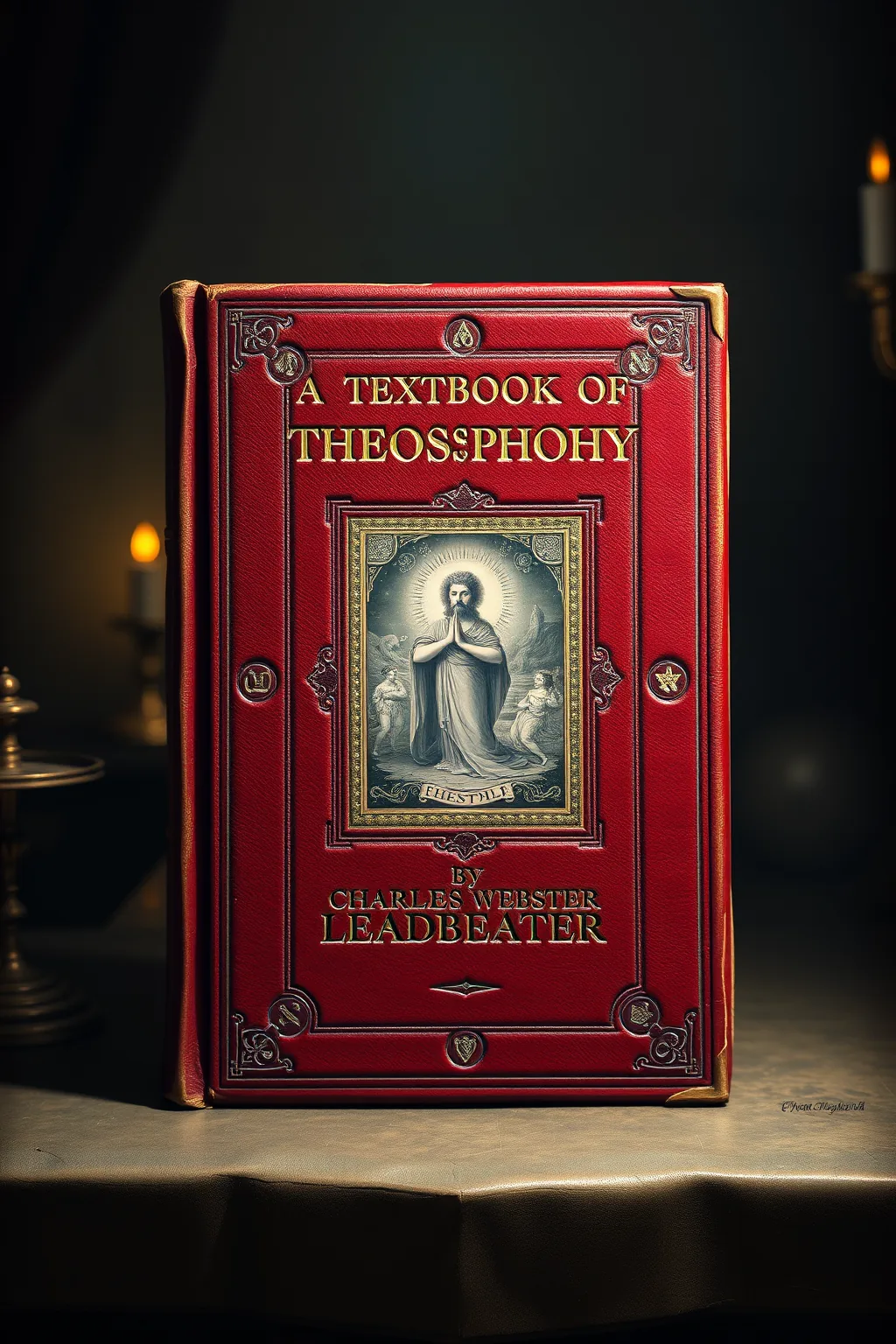
A Textbook of Theosophy
 82
82

A Textbook of Theosophy
Charles Leadbeater's "A Textbook of Theosophy" functions as a remarkably clear, if somewhat dated, primer on a complex spiritual philosophy. Written with the authority of an insider, Leadbeater systematically unpacks the foundational principles of Theosophy, making concepts like the septenary nature of man and the mechanics of reincarnation accessible to a lay audience. His exposition on the different planes of existence, particularly the astral and mental realms, is presented with a conviction that lends the work significant weight for adherents. However, the text's primary limitation lies in its uncritical acceptance of Theosophical doctrine as established fact, offering little room for skeptical inquiry or alternative interpretations. The passage detailing the evolution of the Monad through various kingdoms, while intricate, assumes a level of esoteric knowledge that might prove daunting for absolute beginners. Despite this, the book remains a pivotal document for understanding the Theosophical movement's intellectual architecture in the early 20th century.
📝 Description
82
Charles Leadbeater's 1912 textbook laid out the core ideas of Theosophy for students.
Charles Leadbeater's "A Textbook of Theosophy" presents a structured introduction to the principles of the Theosophical Society. Published in 1912, it addresses universal truths about humanity, the cosmos, and the divine, aiming to clarify the movement's philosophical and spiritual framework for earnest students. Leadbeater explains Theosophy as an inquiry rather than a strict dogma. The book is for individuals seeking a rational and spiritual perspective on existence, one that moves beyond conventional religious thought. It appeals to those interested in consciousness, soul evolution, and the governing principles of both the material and unseen worlds. A receptive mind is helpful for engaging with its concepts, which may challenge standard empirical views.
This work elaborates on key Theosophical concepts such as the different bodies of 'Man'—physical, astral, mental, and causal—alongside reincarnation and karma. It discusses 'Devas' or elemental beings and the progression of consciousness through various planes of existence. The ultimate aim of spiritual development is also covered. Leadbeater frames these ideas as subtle realities that can be perceived through focused study and personal growth.
Published in 1912, "A Textbook of Theosophy" appeared during a time of considerable spiritual and intellectual activity in Europe and America. The Theosophical Society, founded by Helena Blavatsky, aimed to synthesize Eastern and Western esoteric traditions, occultism, and contemporary scientific ideas. Leadbeater's work offered a systematic explanation of these syntheses, contributing to Theosophy's reach in the early 20th century, alongside figures like Annie Besant.
💡 Why Read This Book?
• Gain a foundational understanding of Theosophy's core doctrines, including karma and reincarnation, as presented by a key early proponent, Charles Leadbeater. • Explore the concept of the 'Man' as a multi-bodied entity (physical, astral, mental) and its implications for spiritual evolution, a central theme in Leadbeater's detailed descriptions. • Grasp the historical significance of Theosophy as a synthesis of Eastern and Western thought, contextualized by its publication in 1912 amidst burgeoning spiritual inquiry.
⭐ Reader Reviews
Honest opinions from readers who have explored this book.
❓ Frequently Asked Questions
What is the primary goal of Theosophy as described in Leadbeater's textbook?
The primary goal is the pursuit of universal Truth and the spiritual evolution of humanity. Leadbeater outlines Theosophy as a path to understanding the underlying principles of existence and the cosmos through study and inner development.
Who was Charles Webster Leadbeater and what was his role in Theosophy?
Charles Webster Leadbeater (1854-1934) was a prominent, albeit controversial, author and occultist within the Theosophical Society. He was a prolific writer and lecturer who significantly shaped the movement's teachings, particularly concerning esoteric anatomy and spiritual planes.
When was 'A Textbook of Theosophy' first published?
The first publication date for 'A Textbook of Theosophy' by Charles Webster Leadbeater is cited as March 1, 2007, though its original content originates from much earlier works and teachings by Leadbeater, reflecting Theosophy's early 20th-century prominence.
What are the 'planes of existence' discussed in the book?
The book discusses various planes of existence beyond the physical, including the astral, mental, and causal planes. These are presented as realms where consciousness operates and spiritual evolution occurs through different bodies.
Is Theosophy a religion or a philosophy according to this text?
Leadbeater presents Theosophy as an esoteric course of study at the intersection of philosophy, religion, and science. It is described as a movement dedicated to the study of Truth, aiming to synthesize wisdom from all traditions.
What is the concept of karma and reincarnation in Leadbeater's Theosophy?
Karma is presented as the law of cause and effect governing all actions, while reincarnation is the process by which the soul transmigrates through successive lives to learn and evolve. These are fundamental to understanding spiritual progress.
🔮 Key Themes & Symbolism
The Septenary Constitution of Man
Leadbeater meticulously details the 'Man' as a composite being, comprising not just the physical body but also subtler vehicles: the etheric, astral, mental, and causal bodies, each corresponding to different planes of existence. This framework is crucial for understanding how consciousness operates and evolves. The text explains how experiences on lower planes affect the higher bodies and how development in the higher bodies influences perception and action on the physical. It posits that true spiritual growth involves purifying and mastering these various sheaths, allowing the divine spark within to manifest more fully.
Karma and Reincarnation
Central to Leadbeater's exposition are the laws of karma and reincarnation, presented as the twin engines of spiritual evolution. Karma is depicted as an unerring principle of cause and effect, where every action generates a corresponding reaction that shapes future experiences. Reincarnation is the mechanism through which the soul, or the Monad, undergoes a cycle of births and deaths, gathering experience and progressively unfolding its latent potential. This cycle is not punitive but educational, offering opportunities for learning, purification, and eventual liberation from material existence.
Evolutionary Planes of Consciousness
The textbook maps out a hierarchical structure of existence, comprising various 'planes' or levels of consciousness. These range from the physical and etheric to the astral (emotions), mental (thought), and higher spiritual realms. Leadbeater describes how beings, including humans, evolve through these planes, developing specific faculties and bodies appropriate to each level. This concept provides a framework for understanding psychic phenomena, the nature of the afterlife, and the vast cosmic drama of spiritual unfoldment guided by unseen intelligences.
The Role of Devas and Elementals
Beyond human evolution, Leadbeater introduces the concept of non-human intelligences and elemental beings that inhabit the various planes of existence. These 'Devas' and elementals are presented as co-workers in the grand scheme of evolution, influencing natural phenomena and assisting in the development of lower kingdoms. Understanding their roles offers a broader perspective on the interconnectedness of all life and the intricate workings of the cosmos, suggesting a universe far more populated and dynamic than conventionally perceived.
💬 Memorable Quotes
“Theosophy is a great, wide, and profound subject.”
— This statement underscores the vast scope of Theosophical study, acknowledging its complexity and depth. It suggests that the path of Theosophy is not a simple one but requires significant dedication and intellectual effort to grasp its multifaceted nature.
“The world is a school, and man is the pupil.”
— This paraphrased concept highlights the Theosophical view of earthly existence as a place of learning and growth. It frames life's challenges and experiences as lessons designed to foster spiritual development and the unfolding of the soul.
“The astral body is the vehicle of emotion.”
— This concise statement defines the function of the astral body within the Theosophical model of the human constitution. It links this subtle vehicle directly to the experience and expression of feelings and passions.
“Karma is the ultimate law of justice.”
— This interpretation emphasizes the impartial and precise nature of the law of karma as presented in Theosophy. It suggests that karma ensures balance and accountability for all actions, operating as a fundamental principle of cosmic order.
“Evolution is the process of unfolding latent divinity.”
— This captures the essence of spiritual evolution in Theosophy. It posits that the journey of life is about revealing the inherent spiritual potential and divine nature already present within each being, rather than acquiring something external.
🌙 Esoteric Significance
Tradition
This work is firmly rooted in the Theosophical tradition, a syncretic esoteric movement aiming to synthesize ancient wisdom with modern understanding. It draws heavily from Eastern philosophies, particularly Hinduism and Buddhism, integrating concepts like karma, reincarnation, and cyclic evolution. Leadbeater's exposition fits within this lineage by systematically presenting Theosophical doctrines, often through clairvoyant observation and interpretation, thereby contributing to the formalization and dissemination of the movement's core teachings.
Symbolism
A key symbol explored is the 'Man' himself, viewed not as a singular physical entity but as a complex, multi-layered being composed of various bodies (physical, astral, mental, causal). Another significant motif is the cyclical nature of time and existence, represented by cycles of reincarnation and cosmic ages, illustrating the grand evolutionary sweep. The concept of 'planes' of existence – physical, astral, mental – functions symbolically, representing different states of consciousness and reality accessible to the evolving soul.
Modern Relevance
Leadbeater's work continues to inform contemporary spiritual seekers interested in esoteric psychology, consciousness studies, and comparative religion. Modern New Age thought, certain branches of Western Esotericism, and even some self-help philosophies echo Theosophical ideas concerning karma, reincarnation, and the multi-dimensional nature of the self. Thinkers and practitioners exploring subtle energy systems, past-life regression, and the evolution of consciousness often engage with texts like this as foundational material.
👥 Who Should Read This Book
• Aspiring students of Theosophy seeking a structured overview of its fundamental principles, including karma, reincarnation, and the constitution of man. • Researchers in comparative religion and Western Esotericism interested in understanding the intellectual foundations of the Theosophical movement and its historical impact. • Individuals curious about alternative spiritual frameworks that explore consciousness, evolution, and the unseen dimensions of reality beyond conventional materialism.
📜 Historical Context
Published in the early 20th century, "A Textbook of Theosophy" emerged from a fertile period of spiritual exploration and syncretism. The Theosophical Society, founded in 1875 by Helena Blavatsky, William Quan Judge, and others, sought to unify Eastern esoteric traditions with Western occultism and nascent scientific theories. Leadbeater, alongside Annie Besant, became a dominant voice, disseminating Theosophical teachings. This era saw significant interest in psychical research, spiritualism, and alternative philosophies, partly as a reaction against rigid Victorian materialism and established religious dogma. Theosophy offered a compelling alternative, proposing a cosmic evolution, reincarnation, and a hidden spiritual hierarchy. It engaged with, and often critiqued, contemporary movements like Freemasonry and various branches of Western esotericism, while simultaneously drawing heavily from Hindu and Buddhist philosophies. Theosophy's intellectual reach was considerable, influencing writers and thinkers globally, though it also faced considerable controversy and accusations of charlatanism from more orthodox scientific and religious circles.
📔 Journal Prompts
The Septenary Constitution of Man: How might understanding the astral and mental bodies alter one's perception of emotions and thoughts?
The law of karma: Reflect on a significant life event and consider its potential karmic roots or consequences.
Evolutionary Planes: Imagine navigating the astral plane; what sensory experiences might dominate?
Theosophical Synthesis: How does Theosophy's attempt to blend Eastern and Western thought compare to other syncretic philosophies you know?
The concept of the 'Man' as a pupil: What lessons does the world offer you currently?
🗂️ Glossary
Theosophy
A spiritual philosophy originating in the late 19th century, seeking to synthesize Eastern and Western esoteric traditions, religion, and science to understand universal truths and the nature of divinity.
Karma
The universal law of cause and effect, where actions (causes) inevitably lead to corresponding results (effects) that shape an individual's present and future experiences.
Reincarnation
The process by which the soul or spiritual principle of a being undergoes a cycle of earthly lives, learning and evolving through successive births and deaths.
Astral Body
A subtle, non-physical body associated with emotions, desires, and feelings, considered the vehicle of consciousness on the astral plane.
Mental Body
The subtle vehicle of thought and intellect, corresponding to the mental plane of existence, through which reasoning and conceptualization occur.
Planes of Existence
Different levels or dimensions of reality and consciousness, ranging from the physical to the astral, mental, and higher spiritual realms, each with its own laws and inhabitants.
Monad
The divine spark or eternal spiritual principle within an individual, considered the ultimate source of consciousness that undergoes evolution through successive incarnations.