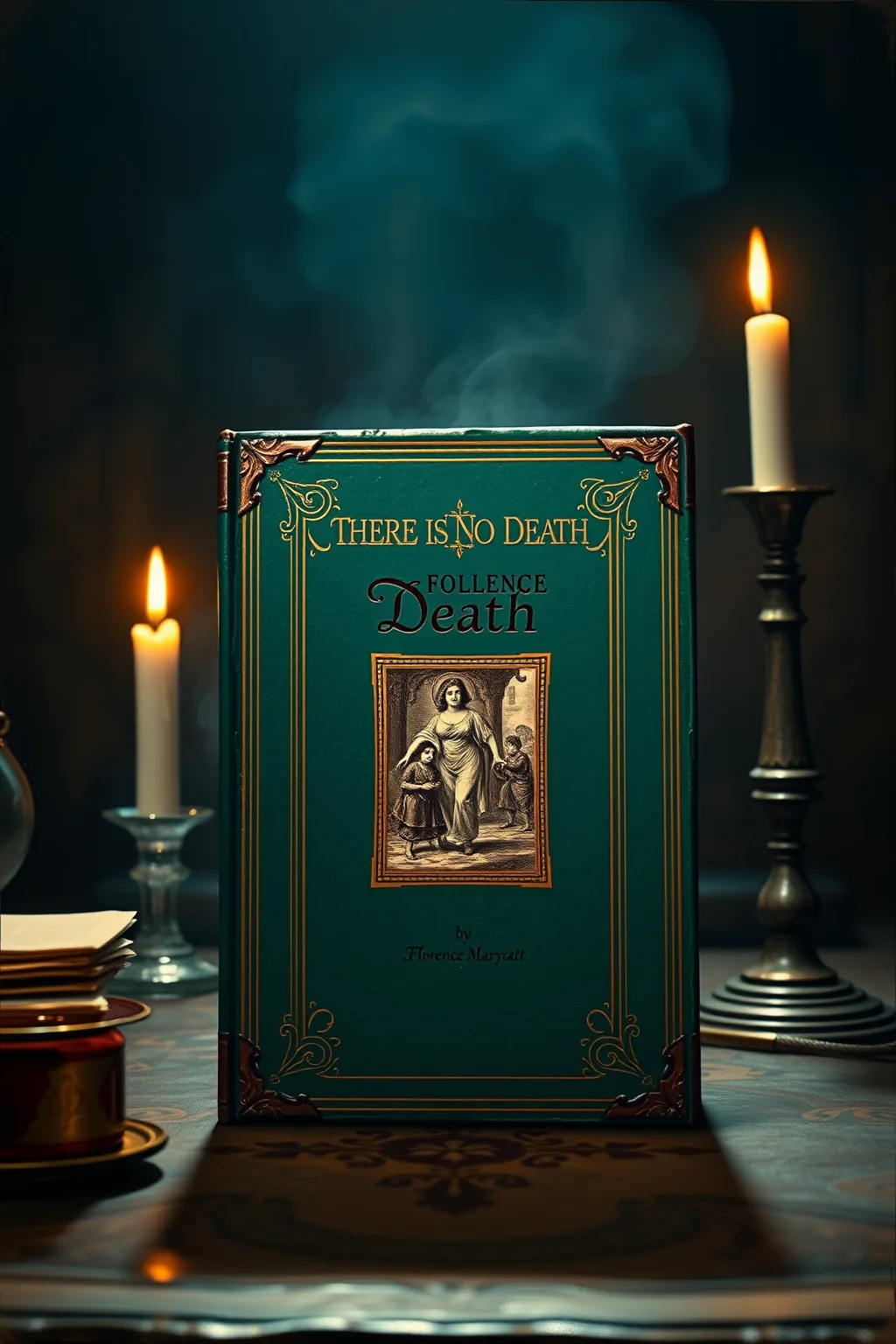
There is No Death
 77
77

There is No Death



Evander Ashcroft, Alchemy & Hermeticism Editor: Florence Marryatt's "There is No Death" is a captivating testament to late Victorian spiritualism, offering a rare, unvarnished account of personal investigations into phenomena that challenged the materialist orthodoxy. Marryatt’s candid narrative style, blending eyewitness testimony with a genuinely inquisitive spirit, makes her explorations into séances and spirit communication both accessible and compelling. Her meticulous recording of encounters with prominent mediums provides invaluable primary source material for understanding the era’s fascination with the afterlife. This work serves as a vital bridge, connecting empirical observation with the profound philosophical questions surrounding personal survival and the nature of existence beyond the flesh. It is a highly recommended read for scholars and seekers alike.
📝 Description
77
Florence Marryatt published "There is No Death" in 1891, detailing her investigations into spiritualism.
Florence Marryatt’s 1891 book "There is No Death" documents her personal experiences with spiritualism. Marryatt, an investigator of psychic phenomena, recounts her attendance at séances and her interactions with prominent figures in the Victorian spiritualist movement. The book includes personal stories, transcripts from séances, and her thoughts on consciousness continuing after death. It reflects a historical period marked by a strong interest in proving life after death. Marryatt aimed to show the connection between the physical world and the spiritual one. The work provides insight into beliefs and hopes for an existence beyond mortal life. It examines the era when people actively questioned the limits of reality and explored the possibility of continued existence.
Marryatt’s account offers a direct look at the methods and beliefs of spiritualism during her time. She presents the evidence gathered from séances and her own spiritualist communications. The book’s focus is on the personal quest for confirmation of an afterlife. It highlights the desire to understand and communicate with the spirit world. Readers will find detailed descriptions of phenomena observed during séances and Marryatt’s interpretations of these events. The narrative is driven by her curiosity and her commitment to documenting her findings.
Published in 1891, "There is No Death" belongs to the tradition of spiritualist literature that gained prominence in the 19th century. This movement sought empirical evidence for life after death and the possibility of communication with spirits. Authors like Marryatt documented séances, mediumistic phenomena, and personal encounters, aiming to validate spiritualist claims. This work is part of a broader esoteric interest in the nature of consciousness and its survival beyond physical dissolution, aligning with other movements that explored the unseen world.
✍️ Author
💡 Why Read This Book?
Embark on a profound exploration of life's greatest mystery. "There is No Death" offers compelling firsthand accounts of Victorian spiritualism, demystifying séances and spirit communication. Ideal for seekers of spiritual truth, scholars of esotericism, and practitioners exploring the continuity of consciousness beyond the physical form. Discover compelling evidence and thoughtful reflections on immortality.
⭐ Reader Reviews
Honest opinions from readers who have explored this book.
❓ Frequently Asked Questions
What historical period does "There is No Death" primarily cover?
The book primarily covers the late Victorian era, with its initial publication in 1891. It vividly documents the spiritualist movement's peak during this fascinating period of scientific and societal change.
Who was Florence Marryatt and what was her role in spiritualism?
Florence Marryatt was an English novelist and an active investigator of spiritualist phenomena. In "There is No Death," she chronicles her personal journey and observations of séances and mediums during the height of the spiritualist movement.
What kind of evidence does Marryatt present for life after death?
Marryatt presents anecdotal evidence derived from her direct experiences at séances, including spirit communications, phenomena witnessed with leading mediums of her time, and personal encounters that she found persuasive.
Is this book suitable for someone new to spiritualism?
Yes, Marryatt's accessible narrative style and focus on personal experience make it a good introduction for those new to spiritualism, offering a historical and personal perspective on the subject.
What philosophical questions does the book address?
The book delves into fundamental philosophical questions about the continuity of personality after death, the nature of consciousness, and the potential for verifiable evidence of an afterlife, prompting readers to ponder existence.
🔮 Key Themes & Symbolism
The Nature of Consciousness and Survival
This theme explores the profound question of whether consciousness, and indeed personality, can persist independently of the physical body. Marryatt's investigations study the possibility of spirit communication as evidence for this continuity, challenging materialistic views of existence and suggesting that the essence of an individual transcends mortal limitations. The book probes the very definition of life and death, positing that death is not an end but a transition, a transformation into another state of being, supported by the phenomena she meticulously records.
Victorian Spiritualism and Mediumship
The book provides a vibrant, firsthand account of the spiritualist movement in the late 19th century, a period of intense public fascination with the possibility of communicating with the departed. Marryatt's detailed descriptions of séances, the methods of prominent mediums, and the atmosphere surrounding these gatherings offer invaluable historical insight. She navigates the skepticism and wonder of the era, critically examining the phenomena while remaining open to their potential implications for understanding the unseen realms and the human desire for connection beyond the veil.
Epistemology of the Paranormal
Marryatt grapples with how we know what we know, particularly concerning phenomena that lie outside conventional scientific understanding. She examines the reliability of eyewitness testimony, the challenges of discerning genuine spiritual manifestations from fraud, and the subjective nature of belief. Her narrative encourages a thoughtful approach to extraordinary claims, advocating for open-minded yet critical inquiry. The book implicitly asks: what constitutes valid evidence for the existence of spirits and the afterlife, and how can we pursue such knowledge ethically and effectively?
💬 Memorable Quotes
Direct passages from the work, attributed to the author.
“There is no death, for all life is eternal.”
— This central tenet suggests that existence is not extinguished but transformed, implying a cosmic continuity that transcends the physical experience of dying.
“The veil between worlds is thin to those who seek.”
— This implies that spiritual perception is not merely passive but requires an active, intentional quest or openness to perceive the unseen dimensions of reality.
“What we call death is but a change of condition.”
— This redefines mortality not as an cessation, but as a transition into a different state or plane of existence, familiar in many esoteric traditions.
“The spirits communicate to comfort, not to frighten.”
— This highlights a benevolent aspect of spirit interaction, suggesting their purpose is often one of solace and guidance for the living.
“Truth lies not in what is seen, but what is felt.”
— This emphasizes the importance of inner intuition and subjective experience as valid pathways to understanding profound truths, beyond empirical observation.
🌙 Esoteric Significance
Tradition
This work aligns closely with the Western esoteric tradition, particularly its branches focused on Spiritualism, Mediumship, and theosophical ideas concerning the survival of the soul. It bridges the gap between empirical investigation and the belief in an unseen, intelligent universe. The exploration of spirit communication and the continuity of personality speaks to Hermeticism's emphasis on correspondence between the visible and invisible realms, and with certain aspects of Neoplatonism concerning the soul's journey.
Symbolism
The central symbol is the "veil" separating the living from the departed, representing the perceived barrier between the material and spiritual worlds. Marryatt's investigations aim to thin or pierce this veil, revealing the continuity of life as an underlying truth. Other symbolic elements include the séance room itself as a liminal space, the phenomena witnessed (lights, voices, apparitions) as symbolic manifestations of spiritual presence, and the mediums as conduits or bridges between dimensions.
Modern Relevance
In an era often dominated by hyper-rationalism and digital detachment, Marryatt's work offers a timely reminder of the enduring human need to explore the mysteries of existence. Her firsthand accounts provide a valuable historical perspective on the persistent quest for evidence of an afterlife. For contemporary seekers, scholars of consciousness, and those interested in the history of parapsychology, the book remains a compelling proof of the possibility of transcending mortal limitations and connecting with realms beyond ordinary perception.
👥 Who Should Read This Book
This book is a rich resource for a diverse audience. **Beginners** to spiritualism will find Marryatt's accessible narrative and personal anecdotes an engaging introduction to the historical movement. **Scholars** of esotericism, religious studies, and the history of science will appreciate its value as a primary source document from the peak of Victorian spiritualism. **Seekers** exploring questions of life, death, and consciousness will find Marryatt's thoughtful reflections and firsthand accounts deeply resonant. **Practitioners** interested in the history of mediumship and the documented phenomena of spirit communication will discover valuable insights into the methods and experiences of the past.
📜 Historical Context
Florence Marryatt's "There is No Death" emerged during a vibrant period of spiritual exploration in the late Victorian era (roughly 1837-1901). This age, marked by rapid industrialization, scientific advancements, and social upheaval, also witnessed a profound public interest in the supernatural and the possibility of life after death. The burgeoning spiritualist movement offered solace and answers to those grappling with loss and the perceived limitations of materialism. Séances became popular social events, and figures like mediums, psychics, and investigators of the paranormal gained significant attention. Marryatt's work is a direct product of this milieu, reflecting the era's intellectual curiosity, its spiritual yearnings, and its ongoing debate between rationalism and the unexplained.
📔 Journal Prompts
Reflect on a personal experience where you felt a connection to something beyond the physical realm. How does Marryatt's approach to evidence compare to your own?
Consider the concept of 'continuity of personality.' What aspects of your personality do you believe are most enduring, and how might they manifest if consciousness survives death?
Imagine attending one of Marryatt's séances. What questions would you be most eager to ask a spirit communicator, and why?
How does the historical context of Victorian spiritualism influence your perception of the phenomena described? Does knowing the era change your interpretation of the evidence?
Marryatt suggests the veil between worlds is thin to those who seek. What does 'seeking' mean in the context of spiritual inquiry, and what are the potential rewards and challenges of such a pursuit?
🗂️ Glossary
Séance
A meeting where people gather, often in a dimly lit room, to attempt to communicate with the spirits of the deceased, typically led by a medium.
Medium
An individual believed to have the ability to communicate with spirits, acting as an intermediary between the living and the dead.
Spiritualism
A religious movement that believes the spirits of the dead can communicate with the living, often through a medium, and that life continues after death.
Spirit Communication
The purported exchange of information or messages between spirits of deceased individuals and living persons, usually facilitated by a medium.
Materialism
A philosophical viewpoint that matter is the fundamental substance in nature, and that all phenomena, including consciousness, are results of material interactions.
This book appears in 2 collections
🔮 Readers Also Liked
Browse all →



From the “Spiritualism” Collection
View all →





More Free Spiritualism & Afterlife Books
View all →