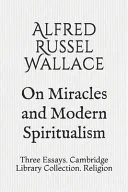
On Miracles and Modern Spiritualism
 74
74

On Miracles and Modern Spiritualism
Wallace’s attempt to bridge the chasm between scientific naturalism and spiritualism is, at best, a fascinating historical document, and at worst, a poignant example of intellectual isolation. His fervent belief, particularly in the third essay concerning 'The Scientific Basis of Spiritualism,' is palpable. He marshers arguments with the earnestness of a seasoned debater, but the scientific rigor expected from a co-founder of evolutionary theory is often absent, replaced by anecdotal evidence and philosophical assertions that feel more like faith than fact. The strength lies in its unflinching portrayal of a brilliant mind wrestling with phenomena beyond the scientific pale of his time. However, the limitation is precisely this lack of empirical grounding; the essays often feel like advocacy rather than objective inquiry. The passage where he dismisses the idea that “all the phenomena of the universe are reducible to the same terms” is emblematic of his willingness to accept the unproven.
Ultimately, it’s a valuable window into a controversial chapter of scientific and spiritual history.
📝 Description
74
In 1875, Alfred Russel Wallace published essays questioning scientific materialism's limits.
Alfred Russel Wallace, known for co-discovering natural selection, presented a collection of essays in 1875 that addressed spiritualism and its apparent conflict with scientific materialism. In this work, Wallace challenged the established scientific views of the late 19th century, arguing for the reality of supernatural phenomena. His personal experiences and intellectual path led him to investigate subjects that most of his scientific colleagues dismissed. This book is suited for individuals interested in the historical intersection of science and spirituality, especially those who study figures that connected these domains. It will attract students of Victorian intellectual history, the development of spiritualism, and the philosophical arguments concerning consciousness and the natural world. Those curious about Wallace's later years and his divergence from mainstream scientific thought will find it particularly relevant.
Wallace's essays appeared during a time of significant scientific progress, particularly in biology, and a simultaneous rise in spiritualist and occult interests. The late 19th century witnessed figures like Charles Darwin establishing evolutionary theory, while movements such as theosophy gained momentum. Wallace, a respected naturalist, faced ostracism from some for his support of spiritualism, a position that contrasted sharply with the mechanistic worldview becoming dominant in academic circles.
Wallace's engagement with spiritualism places this work within a broader late Victorian current that sought to reconcile empirical science with phenomena lying outside its accepted scope. While Darwin's evolutionary theory gained traction, many individuals, including respected scientists like Wallace, grappled with subjective experiences and purported evidence of an afterlife or spiritual forces that materialism could not explain. This period saw a significant public interest in séances, mediumship, and spirit communication, often viewed as a counterpoint to the perceived soullessness of purely mechanistic science. Wallace's contribution is notable for its attempt to bridge these seemingly disparate worlds from a scientific standpoint.
💡 Why Read This Book?
• Understand Alfred Russel Wallace's personal evolution beyond natural selection, specifically his 1875 arguments for spiritualism, revealing a critical intellectual pivot. • Explore the late 19th-century conflict between scientific materialism and emergent spiritualist movements, gaining context for the era's intellectual tensions. • Examine Wallace's critique of purely mechanistic explanations of consciousness, offering a historical perspective on debates about the mind and its potential beyond the physical.
⭐ Reader Reviews
Honest opinions from readers who have explored this book.
❓ Frequently Asked Questions
Who was Alfred Russel Wallace and why is he significant?
Alfred Russel Wallace was a British naturalist, explorer, geographer, anthropologist, and biologist. He is best known for independently conceiving the theory of evolution by natural selection, a concept he developed around the same time as Charles Darwin, leading to their joint presentation of the theory in 1858.
What is Spiritualism and when did it gain popularity?
Spiritualism is a belief system centered on the idea that the spirits of the dead can communicate with the living. It gained significant popularity in the mid-19th century, particularly in the United States and Britain, following reported séances and mediumistic phenomena.
Why did Wallace become interested in Spiritualism?
Wallace cited a variety of personal experiences, including witnessing what he interpreted as spiritualistic phenomena, as key drivers for his investigation into the subject. He felt that scientific materialism offered an incomplete explanation for human consciousness and psychic experiences.
How did the scientific community react to Wallace's views on Spiritualism?
Wallace's advocacy for Spiritualism led to alienation from a significant portion of the scientific community, who viewed his beliefs as unscientific and a departure from his earlier, rigorously empirical work. His ideas challenged the prevailing mechanistic worldview.
What are the main arguments presented in 'On Miracles and Modern Spiritualism'?
The book presents essays arguing for the existence of spiritual phenomena, challenging the limitations of purely materialistic science, and attempting to reconcile spiritualism with natural laws. Wallace sought to validate his personal experiences and the claims of spiritualists.
Is 'On Miracles and Modern Spiritualism' a scientific text?
While written by a prominent scientist, the book functions more as a philosophical and personal defense of spiritualism rather than a scientific treatise. It explores the boundaries of scientific inquiry and personal belief in the late 19th century.
🔮 Key Themes & Symbolism
Science vs. Spirituality
This work grapples with the perceived dichotomy between scientific understanding and spiritual experiences. Wallace, a renowned naturalist, argues that the mechanistic worldview of 19th-century science is insufficient to explain all aspects of reality, particularly consciousness and phenomena attributed to spiritual causes. He posits that a rigid adherence to materialism blinds investigators to truths observable through other means, challenging the scientific establishment of his era to broaden its scope beyond the empirically verifiable.
Critique of Materialism
Wallace directly confronts the prevailing materialistic philosophy that dominated scientific thought. He contends that reducing all existence to matter and energy overlooks crucial elements of human experience, such as intuition, subjective awareness, and alleged interactions with non-physical entities. His critique suggests that a worldview solely based on physical laws is incomplete and fails to account for the full spectrum of existence, advocating for an expanded, less reductionist perspective.
The Nature of Evidence
The essays explore the limitations of conventional scientific evidence when applied to phenomena like miracles and spiritualism. Wallace questions whether evidence must always conform to established scientific paradigms or if personal testimony and subjective experience can hold valid weight. He examines the nature of proof, suggesting that certain phenomena, though not easily replicated in a laboratory, may still be real and indicative of a broader reality than science currently acknowledges.
Wallace's Personal Journey
This book is a proof of Alfred Russel Wallace's intellectual and personal evolution. Following his groundbreaking work on natural selection, he increasingly turned his attention to spiritualism and psychical research. The essays reflect his deep conviction, often stemming from personal encounters, that spiritual phenomena were real and merited serious scientific consideration, even at the cost of his standing within mainstream science.
💬 Memorable Quotes
Direct passages from the work, attributed to the author.
“I cannot avoid the conclusion that the question of the existence of spiritual beings and of the possibility of communication with them has been too hastily dismissed by the men of science.”
— This statement expresses Wallace's central thesis: that the scientific community's dismissal of spiritualism was premature and based on an incomplete understanding of evidence and reality. It highlights his conviction that phenomena beyond current scientific explanation warrant serious investigation.
“Miracles are not violations of natural law, but rather manifestations of higher or more subtle laws not yet understood by science.”
— This interpretation captures Wallace's attempt to reconcile seemingly supernatural events with a naturalistic framework. He proposed that what appears miraculous might simply be the effect of natural laws that are currently beyond our scientific comprehension.
“The materialistic explanation of life is cold, barren, and incomplete.”
— This sentiment, often attributed to Wallace's critique of his contemporaries, expresses his dissatisfaction with a purely physicalist view of the universe. He found such a perspective lacking in warmth and unable to account for the richness of existence.
💡 Key Ideas
Editorial paraphrase of the work's core concepts — not direct quotes.
The human mind, with its power of reason, imagination, and emotion, cannot be fully explained by mere physical processes.
This paraphrase reflects Wallace's argument against strict materialism. He believed that consciousness, thought, and feeling represented faculties that transcended simple biological or chemical reactions, suggesting a non-physical component to human existence.
To deny the reality of spiritualism is to deny a vast body of human experience and testimony.
This paraphrased concept emphasizes Wallace's reliance on collective human experience as a form of evidence. He argued that dismissing spiritualism meant ignoring countless personal accounts and observations that did not fit the prevailing scientific narrative.
🌙 Esoteric Significance
Tradition
Wallace's work occupies a unique space, emerging from the scientific rationalism of the 19th century but engaging directly with the burgeoning Spiritualist movement, which itself had roots in various folk traditions and earlier metaphysical inquiries. It doesn't fit neatly into established esoteric lineages like Hermeticism or Theosophy (which gained prominence slightly later), but it represents a significant attempt by a mainstream scientist to validate experiences that often fell outside empirical science, contributing to a broader intellectual current that sought to reconcile the material and the spiritual.
Symbolism
While Wallace's essays are more philosophical and argumentative than symbolic, the core 'symbol' is the 'miracle' itself – representing phenomena that defy current scientific explanation. He uses it to point towards unseen forces or higher laws. Another implicit symbol is the 'mind' or 'consciousness,' which he elevates as potentially non-physical and capable of interacting with a spiritual realm, contrasting with the purely materialist view of the brain.
Modern Relevance
Wallace's persistent questioning of scientific limitations and his advocacy for considering phenomena beyond the strictly empirical find echoes in contemporary discussions surrounding consciousness studies, parapsychology, and the philosophy of mind. Thinkers and researchers who explore the hard problem of consciousness or investigate anomalous experiences, even if from a secular or scientific perspective, can find Wallace's historical arguments a relevant precursor to their own inquiries.
👥 Who Should Read This Book
• Students of Victorian intellectual history: Gain insight into the cultural and scientific debates surrounding evolution, materialism, and the rise of Spiritualism. • Researchers of parapsychology and consciousness: Understand the historical arguments made by a prominent scientist for phenomena that challenge conventional scientific paradigms. • Individuals interested in the personal journeys of scientific figures: Explore how Alfred Russel Wallace, a key figure in evolutionary theory, navigated his later-life interest in the spiritual and supernatural.
📜 Historical Context
Alfred Russel Wallace penned these essays in 1875, a period when the intellectual field of Victorian England was sharply divided. Charles Darwin’s *On the Origin of Species* (1859) had revolutionized biology, solidifying evolutionary theory and, for many, reinforcing a mechanistic, materialistic worldview. Simultaneously, Spiritualism was experiencing a surge in popularity, fueled by séances and mediumistic claims that captivated segments of society, including prominent figures outside the scientific mainstream. Wallace, a respected naturalist and co-discoverer of natural selection, found himself increasingly drawn to Spiritualism, a stance that alienated him from many scientific colleagues. His work attempted to bridge this divide, arguing that spiritual phenomena were compatible with, or even extensions of, natural laws. This position stood in stark contrast to the empiricism championed by figures like Thomas Henry Huxley, Darwin’s staunch defender, who largely dismissed such claims as delusion or fraud.
📔 Journal Prompts
Wallace's challenge to scientific materialism: How might spiritual phenomena expand our understanding of natural law?
The nature of evidence for spiritual claims: What constitutes valid proof beyond empirical replication?
Wallace's personal experiences: Reflect on moments where personal conviction diverged from societal consensus.
The concept of 'higher laws': Explore the potential for unperceived natural principles governing existence.
Reconciling science and spirituality: How can different ways of knowing coexist without conflict?
🗂️ Glossary
Spiritualism
A belief system asserting that the spirits of the dead can communicate with the living, typically through mediums. It gained widespread interest in the 19th century.
Natural Selection
The process described by Darwin and Wallace whereby organisms better adapted to their environment tend to survive and produce more offspring, driving evolutionary change.
Materialism
A philosophical stance that matter is the fundamental substance in nature, and that all phenomena, including mental states and consciousness, can be explained by material interactions.
Empiricism
The theory that all knowledge is derived from sense-experience, emphasizing observation and experimentation as the basis for scientific understanding.
Miracles
Events or phenomena attributed to supernatural intervention, defying explanation by the known laws of nature.
Psychical Research
An interdisciplinary field that investigates alleged psychic phenomena and other paranormal claims, often employing scientific methods.
Mechanistic Worldview
A perspective that views the universe as a complex machine, operating according to predictable physical laws, with all events being causally determined.