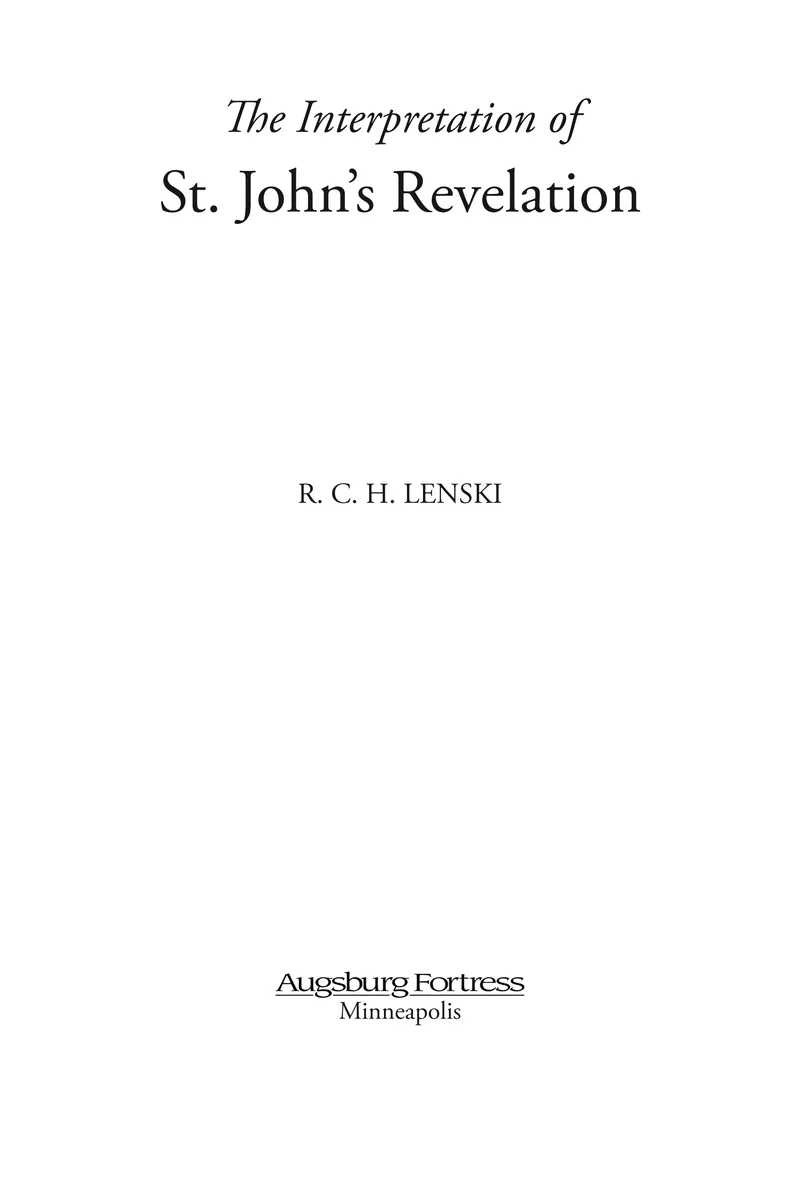
Interpretation of St. John's Revelation
 80
80

Interpretation of St. John's Revelation
Lenski's "Interpretation of St. John's Revelation" offers a dense, scholarly engagement with a notoriously complex text. Its primary strength lies in its methodical, chapter-by-chapter breakdown, providing a solid framework for understanding the intricate visions. Lenski meticulously grounds his interpretations in historical context, a refreshing departure from purely speculative readings. However, the sheer volume of detail can sometimes feel overwhelming, and the prose, while precise, lacks a certain accessibility for the casual reader. A particular passage examining the "seals" (chapters 6-8) exemplifies this: Lenski's detailed historical parallels are illuminating, but the density of citations might deter those not deeply versed in patristic literature. The work serves as a formidable reference for a specific interpretive tradition, but its exhaustive nature is both its virtue and its challenge.
Verdict: A rigorous, context-driven analysis for the dedicated student of Revelation.
📝 Description
80
Richard Charles Henry Lenski's interpretation of St. John's Revelation was first published in 1963.
This volume offers a detailed, verse-by-verse exegesis of the Book of Revelation. Lenski's method aims to understand the eschatological visions within their original historical and theological context. He provides analyses that are both historical and symbolic, engaging directly with the text.
The work is structured for readers who appreciate systematic interpretation and detailed textual study. It addresses individuals interested in biblical prophecy and established theological traditions. Those focused on historical contextualization of scripture will find its approach valuable. Lenski's scholarship engages with the specific language and imagery of Revelation.
Published in the mid-20th century, the book appeared during a time of significant scholarly discussion regarding apocalyptic literature. Debates between different interpretive frameworks for prophecy were active. Lenski's contribution offered a particular viewpoint on the unfolding divine narrative presented by John.
While not strictly esoteric in the sense of occult traditions, Lenski's work engages with the symbolic and prophetic dimensions of Revelation. It addresses interpretations of apocalyptic visions that hold significance for understanding divine action and future events within Christian theology. The book situates these visions within historical and spiritual contexts, aiming for a grounded understanding of their meaning beyond purely literal readings. Its focus on the historical setting of early Christianity and the symbolic nature of the text aligns with scholarly approaches to understanding religious texts that carry deeper meanings.
💡 Why Read This Book?
• Gain a structured understanding of the Book of Revelation's complex imagery, as Lenski systematically unpacks symbols like the "beast" and "New Jerusalem" based on historical and theological scholarship. • Appreciate the 1963 publication context, understanding how this interpretation fits within mid-20th-century theological debates on eschatology and prophecy. • Engage with a detailed textual analysis that provides specific historical parallels for apocalyptic visions, moving beyond abstract symbolism to concrete historical referencing.
⭐ Reader Reviews
Honest opinions from readers who have explored this book.
❓ Frequently Asked Questions
What is Richard Charles Henry Lenski's primary approach to interpreting St. John's Revelation?
Lenski employs a systematic, verse-by-verse exegesis, emphasizing historical context and theological coherence. Published in 1963, his work seeks to understand the prophetic visions within their original setting and their unfolding significance over time.
When was "Interpretation of St. John's Revelation" first published?
The book was first published in 1963, positioning it within the mid-20th century's academic and theological discourse on biblical prophecy and apocalyptic literature.
Does Lenski offer a literal or symbolic interpretation of Revelation?
Lenski's interpretation is largely symbolic and historical, seeking to identify the meaning of John's visions within historical events and theological concepts, rather than solely focusing on a future literal fulfillment.
What are some key symbols discussed in Lenski's "Interpretation of St. John's Revelation"?
Key symbols include the "beast," the "woman clothed with the sun," and the "New Jerusalem." Lenski analyzes these within the framework of historical empires, Israel/the Church, and divine redemption.
Is this book suitable for beginners in biblical studies?
While comprehensive, the book's scholarly depth and detailed exegesis might be more challenging for absolute beginners. It is best suited for those with some background in theology or a dedicated interest in Revelation.
How does Lenski's work compare to other commentaries on Revelation from the same era?
Lenski's 1963 publication stands out for its systematic approach and historical grounding, differing from more futurist or purely dispensationalist views prevalent at the time, offering a more integrated theological perspective.
🔮 Key Themes & Symbolism
Apocalyptic Symbolism
The work meticulously dissects the symbolic language of Revelation, interpreting figures like the "beast" and "harlot" not merely as future entities but as representations of historical powers and spiritual forces opposing divine will. Lenski grounds these interpretations in historical context, exploring how such symbols resonated with John's original audience and their understanding of imperial power and religious corruption.
Historical Contextualization
Lenski emphasizes understanding Revelation within its 1st-century setting. He argues that many of its prophecies found fulfillment in historical events relevant to the early church, particularly concerning Roman imperial power and early Christian persecution. This approach contrasts with purely futurist interpretations, seeking a more immediate and historical relevance for John's visions.
Theological Development
The book traces the theological narrative of Revelation, focusing on themes of divine sovereignty, judgment, redemption, and the ultimate triumph of God's kingdom. Lenski explores how the visions articulate the ongoing struggle between good and evil, the nature of the Church, and the final restoration of creation, presenting a coherent theological framework for the apocalyptic text.
Christocentric Interpretation
Central to Lenski's exegesis is the figure of Christ. He interprets the visions as ultimately pointing to Christ's authority, his past victory, and his future reign. The "Lamb" slain and resurrected is the focal point, through whom judgment is enacted and salvation is achieved, providing a Christological lens for the entire book of Revelation.
💬 Memorable Quotes
“The beast represents powers that oppose God.”
— This paraphrase captures Lenski's view that the 'beast' in Revelation is not a singular entity but a symbol for oppressive, anti-divine political or religious systems throughout history.
“The New Jerusalem signifies God's dwelling with humanity.”
— Lenski interprets the 'New Jerusalem' not just as a physical place but as the ultimate state of perfect communion between God and His redeemed people.
“John's visions were meant for his contemporary readers.”
— This reflects Lenski's emphasis on historical context, suggesting that Revelation's initial audience had specific historical referents for the symbols and prophecies presented.
“The Lamb's sacrifice is central to Revelation's message.”
— This highlights Lenski's Christocentric approach, seeing the atoning work of Jesus Christ as the pivotal event that underpins all the judgments and promises within the book.
“Revelation speaks of divine judgment and ultimate victory.”
— This encapsulates the overarching theme in Lenski's work: the book details God's righteous judgment upon evil while assuring the ultimate triumph of His kingdom and people.
🌙 Esoteric Significance
Tradition
While Lenski's primary grounding is in Lutheran theology, his detailed symbolic analysis of Revelation engages with elements often explored in esoteric traditions. The interpretation of specific symbols and the search for deeper, spiritual meanings within prophetic texts align with methods found in Gnostic, Hermetic, and Kabbalistic studies, though Lenski approaches these through a Christian exegetical lens.
Symbolism
Lenski extensively interprets symbols such as the "four living creatures" (often seen in esoteric contexts as representing cosmic forces or divine attributes) and the "seven seals" (which can be viewed as stages of cosmic or historical unfolding). He relates these to biblical theology, but their symbolic weight often touches upon broader archetypal meanings explored in mystical traditions.
Modern Relevance
Contemporary scholars and theologians interested in the symbolic, historical, and theological dimensions of apocalyptic literature continue to reference Lenski's work. His detailed exegesis provides a foundation for understanding Revelation's complex imagery, influencing modern interpretations that seek to bridge historical context with enduring spiritual truths, resonating with those exploring the intersection of theology and symbolic interpretation.
👥 Who Should Read This Book
• Students of Christian eschatology: Those specifically interested in understanding the Book of Revelation through a historical-critical and theological lens, as Lenski provides a systematic exposition. • Scholars of religious history: Researchers examining mid-20th-century theological interpretations of biblical prophecy will find Lenski's 1963 publication a key text in that discourse. • Dedicated readers of Revelation: Individuals seeking a comprehensive, verse-by-verse analysis that grounds prophetic visions in historical context and theological doctrine.
📜 Historical Context
Richard Charles Henry Lenski's "Interpretation of St. John's Revelation," published in 1963, arrived during a period of significant theological re-evaluation in the mid-20th century. Following World War II, there was a renewed focus on eschatology and the interpretation of apocalyptic literature, often in dialogue with existentialist thought and neo-orthodoxy. Lenski's work offered a detailed, systematically theological commentary that engaged with, and often diverged from, the prevailing dispensationalist interpretations popular in American evangelicalism. While figures like Hal Lindsey would later popularize more futurist views, Lenski's approach, rooted in historical context and Lutheran theology, provided a counterpoint. His exegesis sought to understand Revelation not just as predicting future events but as addressing the spiritual realities and historical challenges faced by the early Church, a perspective that positioned it within broader scholarly discourse.
📔 Journal Prompts
The "beast" as a symbol of oppressive powers in Revelation.
The meaning of the "New Jerusalem" in Lenski's interpretation.
Reflecting on the historical context of Revelation's symbols.
The role of the "Lamb slain" in the book's message.
Interpreting the "seven seals" within the narrative of Revelation.
🗂️ Glossary
Exegesis
Critical explanation or interpretation of a text, especially of scripture. Lenski's work is a detailed exegesis of the Book of Revelation.
Eschatology
The branch of theology concerned with the final destiny of the soul and of humankind; the study of 'end times'.
Apocalyptic Literature
A genre of revelatory literature, often symbolic and prophetic, dealing with the end of the world or a divine revelation about cosmic struggles.
Symbolism
The use of symbols to represent ideas or qualities. Lenski interprets many elements in Revelation symbolically rather than literally.
Dispensationalism
A theological system that interprets biblical history as divided into distinct periods or 'dispensations,' often emphasizing a literal interpretation of prophecy.
Futurist Interpretation
A method of interpreting prophecy, particularly in Revelation, that sees most of its events as yet to occur in the future.
Theological Coherence
The quality of being logically consistent and forming a unified, understandable system of beliefs within theology.