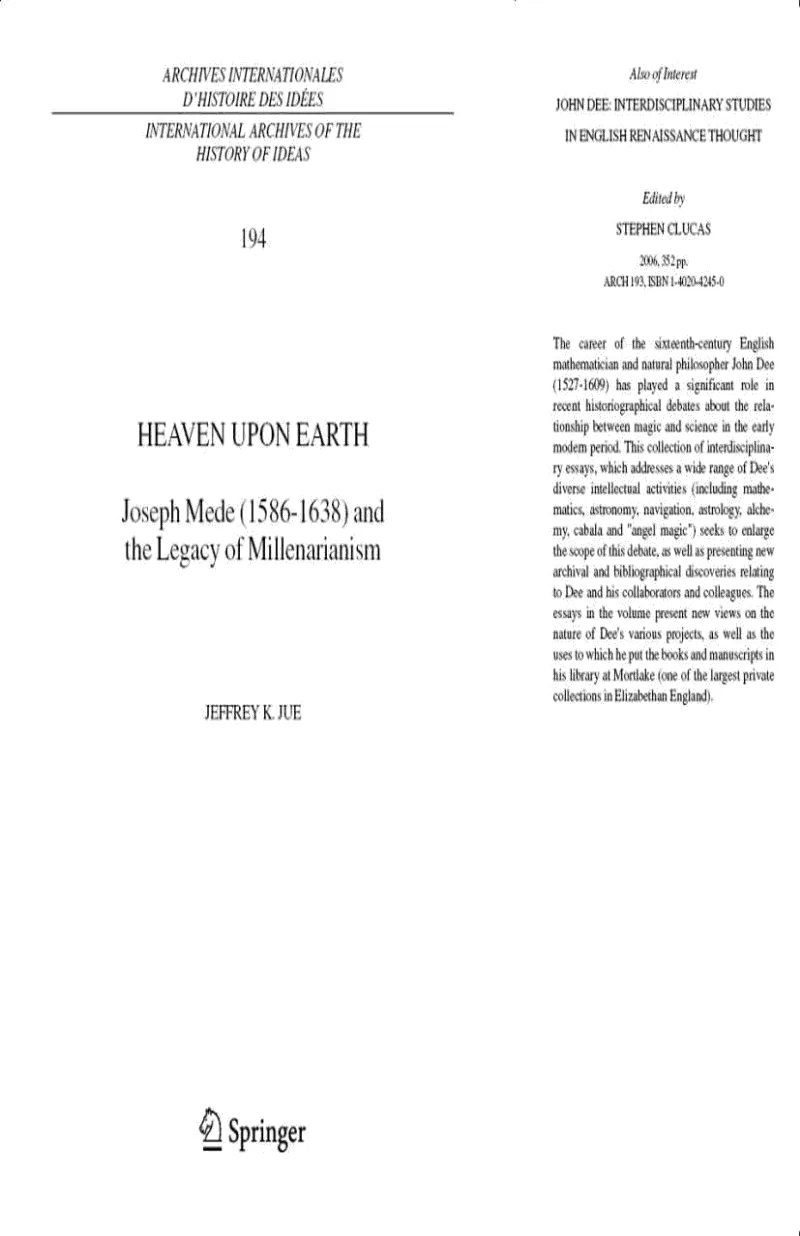
Heaven Upon Earth
 75
75

Heaven Upon Earth
Jeffrey K. Jue's Heaven Upon Earth offers a rigorous examination of apocalyptic thought in early modern Britain, moving beyond simple theological exegesis to engage with political and social history. The book excels in demonstrating how eschatological frameworks were not isolated curiosities but integral to the era's self-understanding and actions. A particular strength lies in its detailed engagement with the historiographical shifts concerning this period, highlighting how interpretations of British apocalypticism have evolved. However, the dense academic prose, while precise, may present a barrier for readers less familiar with the specific academic debates it addresses. The exploration of how the "Wars of the Three Kingdoms" (1640s) were perceived through an apocalyptic lens is especially compelling, revealing a complex interplay of divine providence and human agency. The work provides a solid scholarly contribution, though its accessibility could be improved. It is a valuable resource for specialists, offering significant depth on a crucial intellectual current.
📝 Description
75
Jeffrey K. Jue's Heaven Upon Earth connects apocalyptic thought to early modern British politics and religion.
Heaven Upon Earth examines the relationship between apocalyptic thinking and the religious and political climate of early modern Britain. Rather than a simple timeline, the book shows how expectations of the end times shaped intellectual and spiritual trends during the period from the Reformation in the 1530s to the Wars of the Three Kingdoms in the 1640s. It reveals how a nation defining its identity also considered its ultimate fate.
The study is intended for scholars and serious students of early modern British history, religious studies, and the history of esotericism. Readers interested in how theological ideas affected political discussions and societal fears will find this work particularly relevant. It appeals to those seeking a deeper understanding of how apocalyptic beliefs gave meaning and direction during a time of significant change and conflict. The book situates itself within recent historical scholarship on early modern Britain, acknowledging shifts in interpretation that go beyond older views. It incorporates the complex interactions of internal religious divisions and opposition to the Roman Catholic Church, as well as the political atmosphere that encouraged a sense of responsibility for governing the nation amidst these spiritual and ideological struggles.
This book positions apocalyptic thought not as a marginal belief but as a pervasive force that informed mainstream discourse in early modern Britain. It investigates how prophecies and eschatological visions served as a framework for contemporaries to understand current events and anticipate future outcomes. The work considers the impact of these ideas on national identity, political decisions, and the broader social structure, placing these elements within the broader context of esoteric traditions that sought to interpret divine plans and historical progression.
💡 Why Read This Book?
• Gain insight into the specific ways apocalyptic prophecies, particularly those concerning the millennium, shaped political decisions and national identity in Britain during the 1530s-1640s. • Understand the historiographical evolution of studying early modern British religious thought, moving beyond simplistic narratives of Protestant vs. Catholic to complex internal divisions. • Explore the concept of "British apocalyptic thought" as a framework that provided meaning and influenced societal anxieties during a period of profound religious and political transformation.
⭐ Reader Reviews
Honest opinions from readers who have explored this book.
❓ Frequently Asked Questions
What specific historical period does Heaven Upon Earth focus on regarding British apocalyptic thought?
The book concentrates on early modern Britain, specifically the era spanning from the Reformation in the 1530s through the Wars of the Three Kingdoms in the 1640s.
How does Heaven Upon Earth connect apocalyptic ideas to political events?
It demonstrates how millennial expectations and eschatological visions influenced contemporary interpretations of political struggles and administrative responsibilities within the realm.
Is Heaven Upon Earth a general overview of the Reformation?
No, it is a focused academic study on the specific phenomenon of apocalyptic thought and its impact on British religious and political life during a defined historical period.
Who is the primary audience for this book?
The book is primarily intended for scholars and advanced students of early modern British history, religious studies, and the history of esotericism.
What does the term 'historiographical revisions' mean in the context of this book?
It refers to the ongoing scholarly re-evaluation and changing interpretations of how historians understand the events and intellectual currents of early modern Britain.
What role did opposition to Rome play in the era discussed?
Opposition to Rome was a significant factor that, alongside internal religious divisions, shaped Britain's Protestant identity and influenced the interpretation of national destiny through an apocalyptic lens.
🔮 Key Themes & Symbolism
Apocalyptic Frameworks
The book examines how apocalyptic visions, including millennial expectations, served as a dominant interpretive framework for understanding historical events and national destiny in early modern Britain. It moves beyond viewing these ideas as mere fringe beliefs, illustrating their pervasive influence on intellectual, religious, and political discourse. The work details how contemporaries used these eschatological narratives to make sense of internal divisions and external conflicts, projecting their hopes and fears onto a divinely ordained future timeline.
Religious Struggle and Identity
Central to the analysis is the profound religious struggle that characterized the period from the Reformation onward. Heaven Upon Earth illustrates how this conflict forged a distinct Protestant identity for Britain, even amidst significant internal theological and sectarian divisions. The book highlights how the perceived opposition to Rome fueled a sense of unique national purpose, often articulated through the language of prophecy and divine intervention.
Political Administration and Providence
The work explores the intricate relationship between political administration and the belief in divine providence. It argues that the sense of responsible governance during the era was deeply intertwined with apocalyptic expectations. Contemporaries viewed the administration of the realm not just as a secular duty but as part of a grand, unfolding divine plan, where earthly actions were scrutinized against the backdrop of ultimate, eschatological judgment and renewal.
Historiographical Evolution
Heaven Upon Earth actively engages with and contributes to the ongoing historiographical revisions of early modern British history. It acknowledges how scholarly understanding of this period, particularly concerning religious and apocalyptic thought, has evolved. The book demonstrates a departure from earlier, perhaps simpler, interpretations by incorporating greater nuance regarding the complexity of internal divisions and the multifaceted ways in which apocalyptic ideas permeated society.
💬 Memorable Quotes
“The study of early modern Britain... has undergone a series of historiographical revisions.”
— This statement sets the stage for the book's academic approach, signaling its intent to engage with and contribute to evolving scholarly understanding of the period, rather than presenting a static historical account.
“The dramatic events during that century were marked by a religious struggle that produced a Protestant nation, divided internally, yet clearly opposed to Rome.”
— This highlights the central tension of the era: the formation of a unified Protestant identity in Britain, paradoxically accompanied by deep internal religious schisms and a persistent outward-facing opposition to the Catholic Church.
“Likewise the political environment instilled a sense of responsible awareness regarding the administration of the realm.”
— This points to the intertwined nature of spiritual and political concerns, suggesting that the era's apocalyptic and religious fervor directly influenced how leaders and thinkers approached the practicalities of governance.
“The work explores how millennial expectations shaped the era's intellectual and spiritual currents.”
— This interpretation emphasizes the book's focus on the pervasive influence of apocalyptic beliefs, particularly the concept of a coming millennium, on the broader intellectual and spiritual landscape of early modern Britain.
“Heaven Upon Earth analyzes the connections between apocalyptic thought and the religious and political landscape of early modern Britain.”
— This summary captures the book's core objective: to map the intricate relationships between eschatological thinking and the lived realities of religious practice and political action in a specific historical context.
🌙 Esoteric Significance
Tradition
While not strictly confined to a single esoteric lineage, Heaven Upon Earth engages with the broader Western esoteric tradition's interest in prophecy, divine intervention, and the unfolding of history towards a redemptive end. It touches upon concepts resonant with millenarianism, a strain of thought present in Hermeticism, Kabbalah, and certain forms of Christian mysticism. The work fits within this tradition by demonstrating how esoteric interpretations of biblical prophecy significantly influenced mainstream religious and political thought, particularly in moments of societal crisis and transformation.
Symbolism
The book implicitly engages with apocalyptic symbolism, where concepts like the "end times" or the "millennium" function as powerful motifs representing ultimate judgment, renewal, and divine order. The "religious struggle" itself can be seen as a symbolic battle between forces of good and evil, divine truth and perceived heresy. The idea of Britain as a divinely chosen nation, often central to this period's apocalyptic visions, symbolizes a specific historical manifestation of a divinely guided community within a larger cosmic drama.
Modern Relevance
Contemporary studies of political theology, the history of ideas, and even certain fringe political movements continue to draw upon the understanding of how apocalyptic frameworks can shape collective identity and action. Scholars examining the roots of nationalistic fervor or the influence of religious rhetoric on political discourse might find Jue's work illuminating. It provides historical precedent for how eschatological beliefs can motivate populations and leaders during periods of perceived existential threat or profound societal change.
👥 Who Should Read This Book
• Academic historians and graduate students specializing in early modern British history, the Reformation, and the history of religion, who need to understand the complex interplay of faith and politics. • Scholars of the history of esotericism and apocalyptic thought, seeking to trace the influence of millenarianism on mainstream intellectual and political movements. • Advanced readers interested in how religious anxieties and prophecies shaped societal views of governance and national destiny during periods of significant upheaval.
📜 Historical Context
Jeffrey K. Jue's Heaven Upon Earth emerges from a rich historiographical landscape concerning early modern Britain. The period between the 1530s and the 1640s was defined by the seismic shifts of the English Reformation, the consolidation of Protestantism, and profound internal religious divisions. Intellectual currents were heavily influenced by apocalypticism, millenarianism, and a fervent belief in divine providence shaping national destiny. This era saw intense theological debate, often intertwined with political maneuvering, as exemplified by the religious and political upheavals leading to the Wars of the Three Kingdoms. Contemporaries like John Milton were grappling with questions of religious liberty and divine will, while figures such as Archbishop John Whitgift sought to enforce religious conformity. The reception of such works often occurred within academic circles and theological debates, sometimes facing scrutiny for heterodox interpretations, though specific major censorship events for this particular work are not widely documented as central to its initial publication.
📔 Journal Prompts
The concept of "British apocalyptic thought" as a lens for understanding national identity.
The relationship between internal religious division and external opposition to Rome in shaping a Protestant nation.
The perceived "responsible awareness" regarding the administration of the realm during eras of intense religious struggle.
Interpreting historical events through the framework of "millennial expectations" in early modern Britain.
The historiographical revisions of early modern British history and their impact on understanding religious thought.
🗂️ Glossary
Apocalyptic Thought
A genre of literature and belief systems concerned with the end of the world, divine judgment, and the ultimate triumph of good over evil, often involving prophecies and visions of future events.
Reformation
The 16th-century religious, political, intellectual, and cultural upheaval that splintered Catholic Europe, setting in place the structures and beliefs that would define the continent in the modern era, notably the establishment of Protestant churches.
Wars of the Three Kingdoms
A series of conflicts fought in England, Scotland, and Ireland between 1639 and 1653, often driven by religious tensions, constitutional issues, and nationalistic aspirations.
Millennial Expectations
Beliefs centered on the concept of a "millennium" – typically a thousand-year period of peace and righteousness, often associated with the second coming of Christ, heavily influencing apocalyptic interpretations of history.
Historiographical Revisions
Changes and debates in the way historians interpret and write about the past, reflecting new evidence, methodologies, or theoretical perspectives.
Protestant Nation
A nation whose dominant or official religion is Protestantism, as opposed to Catholicism or other faiths, a status solidified in Britain following the Reformation.
Administration of the Realm
The governance and management of a kingdom or state, including its political, legal, and economic affairs, often viewed through a lens of divine oversight during the early modern period.