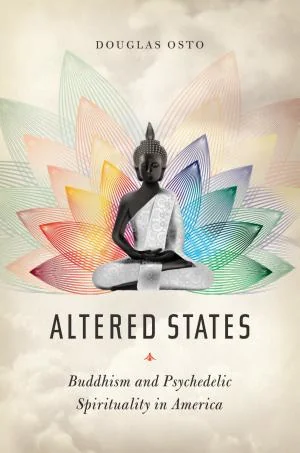
Altered States
 83
83

Altered States
D. E. Osto’s Altered States presents a fascinating, if somewhat narrowly focused, examination of the 1960s convergence of psychedelic exploration and Buddhist practice. The book’s strength lies in its detailed historical research, meticulously tracing the origins and evolution of what Osto terms "psychedelic Buddhism." The account of practitioners attempting to reconcile the immediate, chemically-induced insights with the disciplined path of traditional Buddhism is particularly compelling. However, the work occasionally feels overly academic, sometimes sacrificing narrative flow for analytical depth. Osto’s discussion of the eventual decline of this specific synthesis, while well-argued, could have benefited from a broader exploration of its lingering influence. The exploration of the Buddhist concept of *dukkha* in relation to altered states, while present, feels somewhat underdeveloped. Ultimately, Altered States offers a valuable historical record and critical analysis of a unique countercultural experiment.
📝 Description
83
### What It Is Altered States, by D. E. Osto, chronicles the intersection of 1960s American counterculture, Buddhist meditation, and psychedelic drug use. The work examines how early practitioners sought direct experiential knowledge by merging these seemingly disparate paths. It highlights the divergence within this nascent movement: some practitioners eventually embraced traditional Buddhist discipline, while others continued to synthesize psychedelic exploration with Buddhist philosophy, a practice Osto terms "psychedelic Buddhism."
### Who It's For This book is for academics, historians of religion, and practitioners interested in the historical and philosophical underpinnings of consciousness exploration. It appeals to those curious about the syncretic movements that emerged from the 1960s counterculture, particularly where Western and Eastern spiritual traditions met. Readers seeking a rigorous, research-based account of this specific historical phenomenon will find it valuable.
### Historical Context The 1960s in America was a period of intense cultural and spiritual experimentation. Alongside the Civil Rights Movement and anti-war protests, there was a significant interest in Eastern religions like Buddhism and Hinduism, often filtered through a Western lens. Figures like Timothy Leary promoted psychedelic substances as tools for spiritual awakening, directly influencing how some individuals approached meditation and Buddhist teachings. This era saw a unique fusion where traditional contemplative practices met novel psychoactive compounds, creating a fertile ground for the "psychedelic Buddhism" that Osto investigates.
### Key Concepts Osto's work centers on "psychedelic Buddhism," a concept that describes the intentional integration of psychedelic substances with Buddhist practices and philosophy. It explores the idea of "direct experience" as a primary goal, contrasting it with purely intellectual understanding of dharma. The book also touches upon the "alchemy" of combining these elements, suggesting a process of transformation and synthesis that goes beyond mere juxtaposition. The eventual separation of these paths for many practitioners, and the reasons behind it, forms a crucial part of the narrative.
💡 Why Read This Book?
• Learn about the specific historical moment in the 1960s when American counterculture and Buddhist meditation practices were synthesized, offering a unique perspective on spiritual experimentation. • Understand the concept of "psychedelic Buddhism" as defined by D. E. Osto, examining the rationale and methods of practitioners who combined psychedelics with Buddhist philosophy. • Gain insight into the divergence within this movement, distinguishing between those who continued the psychedelic experiment and those who returned to stricter mental discipline, as detailed in the book's historical tracing.
⭐ Reader Reviews
Honest opinions from readers who have explored this book.
❓ Frequently Asked Questions
When was Altered States by D. E. Osto first published?
Altered States by D. E. Osto was first published on April 26, 2016. This date marks the initial release of the work into the public sphere.
What is the central concept explored in Altered States?
The central concept is "psychedelic Buddhism," an examination of the 1960s American counterculture's attempt to merge psychedelic drug use with Buddhist meditation for direct spiritual experience.
Who were some key figures or influences on the movement described in the book?
While the book focuses on the broader movement, it operates within the historical context influenced by figures like Timothy Leary, who advocated for psychedelics as tools for spiritual awakening during the 1960s.
Does the book argue that psychedelic Buddhism is a valid or lasting spiritual path?
The book analyzes the historical development and eventual divergence of this practice, presenting it as a significant historical experiment rather than endorsing its long-term validity as a distinct spiritual tradition.
What historical period does Altered States primarily cover?
The book primarily covers the 1960s in America, a period characterized by significant cultural shifts and experimental approaches to spirituality and consciousness.
What distinguishes 'psychedelic Buddhism' from traditional Buddhist practices, according to the book?
According to the book, 'psychedelic Buddhism' emphasized immediate, chemically-induced direct experience as a primary means of insight, contrasting with the traditional Buddhist emphasis on gradual mental discipline and ethical conduct.
🔮 Key Themes & Symbolism
Psychedelic Buddhism
This theme explores the unique synthesis of psychedelic substances with Buddhist philosophy and practice that emerged in the 1960s. Osto examines how practitioners sought direct experiential understanding of Buddhist concepts, using psychedelics as a catalyst. The work differentiates this experimental approach from traditional Buddhist paths, focusing on the practitioners' motivations, methods, and the philosophical underpinnings of this 'alchemy.' It details how this synthesis aimed for rapid spiritual insight, contrasting with the gradual cultivation of wisdom through discipline.
Direct Experience vs. Doctrine
A core theme is the pursuit of 'direct experience' of consciousness and reality, contrasted with intellectual or doctrinal understanding of spiritual truths. In the context of the 1960s, psychedelics were seen by some as a shortcut to this direct apprehension, bypassing years of meditation. Osto investigates how this desire for immediate insight played out within the framework of Buddhist teachings, questioning whether such experiences could be integrated meaningfully into a spiritual path or if they remained ephemeral phenomena.
Counterculture and Spirituality
The book situates the rise of psychedelic Buddhism within the broader context of the American counterculture of the 1960s. This era was marked by a rejection of mainstream values and an intense search for alternative spiritualities, often involving Eastern religions and altered states of consciousness. Osto highlights how this cultural milieu provided fertile ground for experiments that blended Western psychedelic use with Eastern contemplative traditions, creating a unique historical moment for syncretic spiritual exploration.
The Evolution of a Movement
Osto traces the trajectory of this experimental movement, detailing its rise and eventual fragmentation. The work examines why some practitioners abandoned psychedelics in favor of strict mental discipline, aligning more closely with traditional Buddhism, while others continued to explore the 'psychedelic' path. This evolution reflects broader tensions between experientialism and disciplined practice, and the challenges of integrating novel methods into established spiritual frameworks.
💬 Memorable Quotes
“Practitioners combined psychedelics with Buddhist meditation to achieve direct experience.”
— This statement encapsulates the core thesis of the book: the intentional merging of two distinct practices – drug-induced altered states and contemplative meditation – with the explicit goal of gaining immediate spiritual insight.
“Some abandoned psychedelics for stricter mental discipline.”
— This highlights a crucial divergence within the movement studied, indicating that the initial synthesis was not universally adopted, with many practitioners ultimately choosing the more traditional, non-drug-dependent path of Buddhist practice.
“Others advanced a fascinating alchemy called psychedelic Buddhism.”
— This phrase suggests a transformative, alchemical process where the combination of psychedelics and Buddhism was seen not just as additive, but as creating something new and potentially profound, a distinct spiritual synthesis.
“The exploration faded with the revolutionary spirit of the sixties.”
— This suggests a historical arc, implying that the specific conditions and cultural enthusiasm of the 1960s were instrumental to the emergence of psychedelic Buddhism, and that its decline was linked to the waning of that era's unique ethos.
“The work explores the combination of psychedelics and Buddhist meditation.”
— This is a straightforward description of the book's subject matter, focusing on the dual elements of psychoactive substance use and traditional contemplative techniques within a specific historical context.
🌙 Esoteric Significance
Tradition
While not strictly belonging to a single lineage like Hermeticism or Theosophy, this work engages with the esoteric impulse to seek direct, non-rational knowledge of ultimate reality. It intersects with Western esotericism's historical interest in altered states and consciousness expansion, often found in traditions exploring visionary experiences. The book reflects a modern manifestation of the perennial philosophy, where diverse spiritual paths are examined for common threads in the pursuit of transcendence.
Symbolism
The primary 'symbol' explored is the altered state of consciousness itself, serving as a gateway or mirror to deeper truths. Within Buddhist traditions, symbols like the lotus (purity emerging from mud) or the mandala (cosmic order) are often contemplated. In this context, psychedelics could be seen as artificially invoking states where such symbolic meanings might be directly perceived or experienced, albeit temporarily, thus acting as a potent, albeit transient, symbolic catalyst.
Modern Relevance
Osto's work remains relevant for contemporary discussions surrounding psychedelics and mental well-being, particularly the resurgence of interest in psilocybin and MDMA for therapeutic and spiritual purposes. Thinkers and practitioners exploring the integration of entheogens into contemplative practices, or those re-examining the history of consciousness studies, find valuable historical and analytical grounding in this research. It informs debates on the relationship between traditional spiritual paths and modern psycho-pharmacological exploration.
👥 Who Should Read This Book
• Students of 20th-century American counterculture interested in the specific ways spiritual exploration manifested. • Academic researchers in religious studies and the history of consciousness seeking a scholarly account of psychedelic Buddhism. • Individuals curious about the historical intersection of Eastern spirituality and Western psychedelic experimentation in the 1960s.
📜 Historical Context
The 1960s were a period of profound cultural upheaval and spiritual searching in America. Amidst the backdrop of the Vietnam War and the Civil Rights Movement, many young people turned away from Western religious and social norms, seeking alternative modes of understanding existence. Eastern religions, particularly Buddhism, gained significant traction, often interpreted through a lens influenced by countercultural ideals. Simultaneously, psychedelic drugs like LSD and psilocybin were being explored for their potential to expand consciousness and facilitate spiritual experiences. Figures like Timothy Leary championed these substances as tools for liberation. This confluence created a unique environment where the disciplined practices of Buddhist meditation were experimentally combined with the potent, immediate effects of psychedelics. This synthesis, termed "psychedelic Buddhism" by scholars like D. E. Osto, represented a radical departure from both traditional Buddhist orthodoxy and mainstream American society, challenging established notions of spiritual attainment and the means by which it could be achieved.
📔 Journal Prompts
The concept of "psychedelic Buddhism" as an "alchemy." What elements were combined, and what was the intended transformative result?
Reflection on the 1960s American counterculture's search for "direct experience" beyond traditional doctrines.
Consider the divergence: why might practitioners abandon psychedelics for stricter mental discipline?
The role of Timothy Leary's influence on the synthesis of psychedelics and Buddhist meditation.
Analyze the tension between chemically-induced insight and gradual spiritual cultivation as presented in the work.
🗂️ Glossary
Altered States of Consciousness
Subjective experiences that differ significantly from a person's usual waking consciousness. These can be induced by various means, including meditation, sensory deprivation, or psychoactive substances.
Psychedelic Buddhism
A term coined by D. E. Osto to describe the synthesis of psychedelic drug use with Buddhist philosophy and practices, particularly prevalent in the 1960s American counterculture.
Direct Experience
In this context, refers to immediate, unmediated apprehension of reality or spiritual truths, often contrasted with intellectual understanding or doctrinal knowledge.
Counterculture
A subculture whose values and norms of behavior differ substantially from those of mainstream society, often in opposition to conventional social and political norms.
Mental Discipline
Refers to the rigorous and sustained practice of mental training, such as meditation, aimed at cultivating focus, insight, and emotional regulation within Buddhist traditions.
Alchemy
Metaphorically used here to describe the complex and transformative process of combining different elements (psychedelics and Buddhist practice) to create a new, potent spiritual synthesis.
Dharma
In Buddhism, refers to the teachings of the Buddha, cosmic law and order, or the ultimate nature of reality.