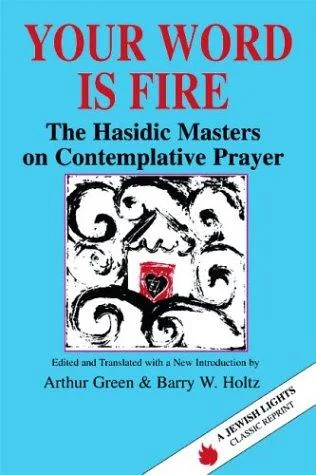
Your word is fire
 83
83

Your word is fire
Arthur Green and Barry W. Holtz's 'Your Word Is Fire' offers a compelling, if sometimes dense, exploration of language as a cosmic force. The strength of the work lies in its meticulous tracing of the concept of the creative Word across diverse mystical traditions, particularly its engagement with Jewish mysticism and Gnosticism. The authors present a rigorous academic approach to what are often considered subjective or intuitive subjects, grounding esoteric ideas in historical and textual analysis. A notable passage is the detailed examination of the Hebrew alphabet's role in creation narratives, highlighting the intricate relationship between divine utterance and material form. However, the book's academic tone, while a strength for scholars, can occasionally feel distant for those seeking a more devotional or experiential path. The 1987 publication date means some contemporary developments in linguistic theory or consciousness studies are not addressed. Nevertheless, 'Your Word Is Fire' remains a significant scholarly contribution to understanding the magical and sacred dimensions of language.
📝 Description
83
### What It Is 'Your Word Is Fire' is a foundational text exploring the profound power and creative potential inherent in language. It examines how spoken and written words shape reality, influence consciousness, and act as conduits for spiritual and magical forces. The book delves into ancient traditions and philosophical underpinnings that view language not merely as communication but as a divine instrument.
### Who It's For This work is for serious students of esoteric philosophy, comparative religion, and the philosophy of language. It appeals to those who question the conventional understanding of words and seek to explore their deeper, often hidden, meanings and applications. Readers interested in Kabbalah, Gnosticism, and the mystical traditions of various cultures will find fertile ground for study.
### Historical Context Published in 1987, 'Your Word Is Fire' emerged during a period of renewed interest in esoteric studies and alternative philosophies. It offered a counterpoint to purely materialist or linguistic-structuralist views of language prevalent in academia. The book engaged with and contributed to ongoing discussions within circles exploring ancient wisdom, Hermeticism, and the potential for language in spiritual practice, situating itself within a lineage that includes thinkers from the Renaissance to contemporary esotericists.
### Key Concepts The central thesis revolves around the concept of the Logos, the divine creative principle often associated with speech or the Word. It investigates the energetic and vibrational qualities of letters and sounds, exploring how these form the building blocks of existence. The book also touches upon the idea of intentionality in speech and writing, suggesting that focused linguistic acts can manifest specific outcomes.
💡 Why Read This Book?
• Learn how ancient traditions conceptualized language as a divine, creative force, moving beyond modern utilitarian views, as explored through the concept of the Logos. • Understand the symbolic and energetic significance of specific alphabets and linguistic structures, particularly the Hebrew letters as presented in the text. • Gain insight into how focused linguistic acts and intentional speech were believed to shape reality, a concept central to the book's thesis.
⭐ Reader Reviews
Honest opinions from readers who have explored this book.
❓ Frequently Asked Questions
What is the primary focus of 'Your Word Is Fire'?
The book primarily focuses on the profound spiritual and creative power of language, exploring how words, sounds, and letters are understood in various esoteric and religious traditions as fundamental forces in creation and manifestation.
Which esoteric traditions are discussed in 'Your Word Is Fire'?
'Your Word Is Fire' draws heavily from Jewish mysticism (Kabbalah), Gnosticism, and Hermetic philosophy, examining their unique perspectives on the divine nature of language and the Word.
Who are the authors of 'Your Word Is Fire'?
The book is authored by Arthur Green and Barry W. Holtz. It was first published in 1987.
What is the concept of the Logos as presented in the book?
The Logos, often translated as 'Word,' is presented as a primordial creative principle or divine utterance that underlies the manifestation of the cosmos, a concept explored across various spiritual philosophies within the book.
Is 'Your Word Is Fire' suitable for beginners in esoteric studies?
While rich in content, the book's academic rigor and depth might be more suited for intermediate to advanced students of esoteric traditions or comparative religion who are comfortable with scholarly analysis of mystical concepts.
What does the title 'Your Word Is Fire' signify?
The title suggests that one's words possess immense power, akin to fire – capable of creation, transformation, and destruction. It points to the active, energetic nature of language when imbued with intent or divine connection.
🔮 Key Themes & Symbolism
The Creative Power of Utterance
This theme explores the ancient and mystical belief that spoken and written words are not mere symbols but potent forces capable of shaping reality. The book examines how divine pronouncements in creation myths and the concept of the Logos demonstrate language's role as a fundamental building block of existence. It suggests that human language, when aligned with divine intent or spiritual power, can participate in this creative process, influencing consciousness and the material world.
Linguistic Symbolism and Mysticism
The work delves into the symbolic meanings attributed to letters, sounds, and alphabets within various mystical traditions, most notably Kabbalah. It presents the idea that specific linguistic forms carry inherent energetic or spiritual significance. For instance, the Hebrew alphabet is explored not just as a means of communication but as a blueprint for creation, with each letter holding profound cosmological and magical properties that can be understood and potentially utilized.
The Word as Divine Principle
Central to the book is the concept of the Logos, or the divine Word, understood as an active, intelligent principle that manifests the universe. This theme traces the evolution of this idea from ancient Greek philosophy through Gnostic and Jewish mystical thought. It posits that the ultimate reality is intrinsically linked to a form of divine speech or consciousness, and that understanding this connection offers a pathway to comprehending the sacred nature of existence.
Intentionality and Manifestation
The book touches upon how focused linguistic intention can lead to specific outcomes. By understanding the underlying energetic structure of words, practitioners in various traditions sought to employ speech and writing for magical or spiritual purposes. This involves not just the words themselves but the consciousness and will behind them, suggesting that language can be a tool for directed manifestation when wielded with knowledge and spiritual connection.
💬 Memorable Quotes
“The very fabric of existence is woven from divine speech.”
— This statement encapsulates the core idea that the universe originates from and is sustained by a fundamental, divine linguistic principle, suggesting a profound connection between consciousness, word, and reality.
“Each letter is a vessel of primordial energy.”
— This interpretation highlights the view, particularly in traditions like Kabbalah, that individual letters of sacred alphabets are not arbitrary symbols but contain potent, inherent energies that form the basis of all creation.
“To speak is to participate in the ongoing creation of the world.”
— This paraphrase suggests that human speech, when understood in its deepest sense, is not merely communicative but actively contributes to the unfolding of reality, echoing the primordial act of creation through divine utterance.
“The power of the Name is the power of the reality it represents.”
— This concept links the efficacy of divine names or sacred words directly to the underlying reality or force they signify, implying that knowing and invoking such names grants access to that power.
“Understanding the structure of sacred language unlocks cosmic secrets.”
— This interpretation points to the belief that the intricate patterns and divine architecture within sacred texts and languages hold keys to understanding the fundamental laws and mysteries of the universe.
🌙 Esoteric Significance
Tradition
The work is deeply rooted in the traditions of Jewish Mysticism (Kabbalah) and Gnosticism, examining the concept of the Logos and the creative power of divine utterance. It fits within the broader Hermetic lineage by exploring the idea that understanding the fundamental principles of the cosmos, particularly through language, can lead to spiritual illumination and a deeper connection with the divine.
Symbolism
Key symbols include the Hebrew alphabet, where each letter is considered a divine entity and a building block of reality, and the concept of the Name of God, understood as embodying divine power and essence. The 'Word' itself functions as a primary symbol for the creative, ordering principle that manifests the universe, representing both divine thought and its actualization.
Modern Relevance
Contemporary thinkers and practitioners in fields like consciousness studies, comparative religion, and certain branches of contemporary Western esotericism continue to draw on the book's exploration of linguistic power. Its examination of how intentional language can influence reality resonates with modern concepts of manifestation, positive affirmation, and the energetic properties of sound and speech.
👥 Who Should Read This Book
• Students of Kabbalah and Jewish Mysticism seeking a scholarly yet profound exploration of the linguistic basis of creation. • Comparative religion scholars interested in the universal concept of the Logos and the divine power attributed to language across cultures. • Individuals exploring the philosophy of language and consciousness who are curious about non-materialist perspectives on word and reality.
📜 Historical Context
Published in 1987, 'Your Word Is Fire' arrived during a period of burgeoning interest in esoteric studies and comparative mysticism, often fueled by counter-cultural movements and a search for alternative spiritual frameworks. The academic landscape, while increasingly interested in religious studies, often maintained a critical distance from overtly mystical claims. This work positioned itself within the scholarly investigation of religious traditions, particularly Jewish mysticism, offering a rigorous analysis of language's role in cosmology and theology. It engaged with scholarly discourse on the nature of religious experience and the power of sacred texts, providing a counterpoint to more secular linguistic theories. While not a mainstream academic bestseller, it contributed to the growing body of scholarship that sought to understand the metaphysical dimensions of language, drawing parallels with thinkers like Gershom Scholem who extensively studied Kabbalah, a key influence on the book's perspective.
📔 Journal Prompts
The concept of the Logos: How does the idea of divine speech as a creative force challenge your understanding of reality?
Sacred alphabets: Reflect on the potential energetic or symbolic significance of the letters in your own native alphabet.
The power of the Name: Consider instances where invoking a specific name or title held significant power or meaning for you.
Intentional speech: Analyze a recent significant communication – was it purely informative, or did it carry a deeper, perhaps unconscious, intent?
Language as creation: How might viewing your own words as creative acts alter your daily communication?
🗂️ Glossary
Logos
A Greek term, often translated as 'Word,' 'Reason,' or 'Principle.' In philosophy and theology, it refers to a divine intermediary or the fundamental creative force through which the universe is manifested.
Kabbalah
A system of Jewish mysticism focused on understanding the divine nature of God and the universe, often through esoteric interpretations of the Torah and the use of Hebrew letters and divine names.
Gnosticism
A diverse set of religious and philosophical movements characterized by a belief in spiritual knowledge (gnosis) as the path to salvation, often involving a dualistic worldview and complex cosmologies.
Hermeticism
A philosophical and religious tradition based on writings attributed to Hermes Trismegistus, emphasizing divine wisdom, the interconnectedness of all things, and the principle of 'As Above, So Below.'
Divine Utterance
The concept that the universe was brought into being through God's spoken word or divine pronouncements, a theme prominent in creation narratives across various religious traditions.
Theurgy
A system of religious rites and practices aimed at invoking divine beings or powers, often involving sacred language, rituals, and symbolic actions to achieve spiritual union or transformation.
Primordial Energy
The fundamental, unmanifested energetic force believed to exist at the beginning of creation, from which all physical and spiritual reality eventually emerges. Often associated with divine speech or thought.