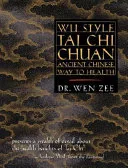
Wu Style Tai Chi Chuan
 78
78

Wu Style Tai Chi Chuan
Wen Zee's "Wu Style Tai Chi Chuan" offers a clear, if somewhat dry, exposition on a specific martial art form. Its primary strength lies in its methodical breakdown of the solo form, providing step-by-step guidance that even a novice can follow. The historical introduction, while brief, effectively contextualizes the Wu style within the broader landscape of Tai Chi. A minor limitation is the occasional lack of vivid descriptive language; the philosophical underpinnings, while present, could benefit from more evocative prose to fully capture their esoteric essence. The section detailing the health benefits, however, is particularly well-articulated, citing specific physiological advantages. Overall, it functions reliably as a technical manual for the Wu style.
📝 Description
78
Wen Zee's 2002 book outlines the Wu style of Tai Chi Chuan, blending Taoist philosophy with physical practice.
Published in 2002, Wu Style Tai Chi Chuan by Wen Zee offers a detailed look at a specific school within the martial art. The practice itself is deeply connected to Taoist philosophy, uniting the mind, internal energy, and physical movement. The book functions as both a historical record and a practical manual. It covers the origins and philosophical foundations of Tai Chi before concentrating on the distinctive features of the Wu style.
The text is for those who want a structured method for practicing Tai Chi, especially those drawn to the Wu style's focus on inner development and health. It will appeal to students of martial arts, meditation, and Taoist ideas who want to grasp the theory behind the movements. Individuals aiming to enhance their physical health through gentle yet effective exercises will find specific instructions here.
The development of Tai Chi Chuan has roots in ancient Chinese martial arts and Taoist thought. The Wu style, a significant branch, developed its own unique traits. This book places the Wu style within that larger historical context, showing its progression and its relationship to other martial arts lineages. It recognizes the knowledge passed down through many generations of practitioners.
Wu Style Tai Chi Chuan is situated within the broader tradition of internal martial arts that draw heavily on Taoist principles. Practices like Tai Chi aim to cultivate internal energy, or qi, aligning the practitioner with natural forces. The emphasis on yielding, stillness, and balancing opposing energies reflects core Taoist concepts, such as those found in the Tao Te Ching. This book specifically details how the Wu style embodies these philosophical underpinnings through its unique forms and training methods, connecting physical cultivation to spiritual development.
💡 Why Read This Book?
• Gain practical instruction in the Wu Style Tai Chi Chuan solo form, a detailed sequence presented with step-by-step guidance, enabling you to begin practice immediately. • Understand the specific Taoist philosophical principles, such as yielding and stillness, that inform the Wu style's movements and internal energy cultivation. • Discover the unique "three-in-one exercise" concept, learning how this practice harmonizes mind, qi, and body for integrated health benefits not commonly found in other disciplines.
⭐ Reader Reviews
Honest opinions from readers who have explored this book.
❓ Frequently Asked Questions
When was Wu Style Tai Chi Chuan first published?
The book "Wu Style Tai Chi Chuan" by Wen Zee was first published in 2002, making it a relatively modern guide to this traditional martial art.
What is the "three-in-one exercise" mentioned in the book?
The "three-in-one exercise" refers to the Wu Style's unique approach of simultaneously invigorating the mind, the internal energy (qi), and the physical body through its practice.
Does the book provide instruction for beginners?
Yes, the book details the Tai Chi Chuan solo form through step-by-step instruction, making it accessible for individuals beginning their study of the practice.
What philosophical tradition is central to Tai Chi Chuan as described in this book?
The book emphasizes that Tai Chi Chuan, and specifically the Wu style, incorporates the principles of Taoist philosophy, integrating ancient wisdom with martial arts.
What are the primary benefits of practicing Wu Style Tai Chi?
The text outlines multiple health benefits, focusing on invigorating the mind, enhancing internal energy (qi) flow, and improving physical well-being through its systematic practice.
Is this book only about martial combat applications?
While rooted in martial arts, the book primarily focuses on the health and internal cultivation aspects of Wu Style Tai Chi, detailing its benefits for mind and body.
🔮 Key Themes & Symbolism
Taoist Philosophy Embodied
This work explicates how the Wu style of Tai Chi Chuan serves as a practical manifestation of Taoist principles. Concepts such as yielding, rootedness, and the dynamic interplay of yin and yang are not merely discussed but are translated into the precise physical movements and internal energy cultivation detailed within the solo form. The text explores how these ancient philosophical tenets inform the art's effectiveness in promoting balance and harmony within the practitioner.
The 'Three-in-One Exercise'
Central to the Wu style's unique identity is its designation as the "three-in-one exercise." This concept highlights the integrated approach to personal development inherent in the practice. The book details how each posture and transition within the solo form is designed to simultaneously stimulate and harmonize the practitioner's mental acuity, the flow of vital internal energy (qi), and the physical structure of the body. This holistic methodology underpins its extensive health benefits.
Solo Form as Cultivation
The detailed exposition of the Tai Chi Chuan solo form is presented not just as a sequence of movements, but as a profound method of self-cultivation. The book guides the reader through the specific postures and transitions, emphasizing their role in developing internal strength, enhancing bodily awareness, and fostering mental tranquility. Practicing this form, as described, becomes a meditative discipline that bridges the gap between the physical and the energetic dimensions of being.
Martial Arts Heritage
While focusing on health and internal cultivation, the text acknowledges the deep roots of Tai Chi Chuan within traditional Chinese martial arts. It touches upon the accumulated knowledge of generations of practitioners, framing the Wu style as a refined expression of this lineage. The book implicitly connects the aesthetic grace of the movements to their underlying principles of effectiveness and strategy, inherited from centuries of martial development.
💬 Memorable Quotes
“Wu Style is known as the "three-in-one exercise."”
— This concise statement encapsulates the Wu style's core philosophy: the simultaneous cultivation of mental clarity, vital energy (qi), and physical form, distinguishing it as a holistic practice.
“Tai Chi Chuan incorporates the principles of Taoist philosophy with the accumulated knowledge of the traditional martial arts.”
— This highlights the dual foundation of Tai Chi Chuan, blending esoteric philosophical concepts like balance and flow with practical, time-tested martial techniques.
“Step-by-step instruction in the practice of the Tai Chi Chuan solo form is presented.”
— This indicates the book's practical utility, offering a structured, instructional approach for readers to learn and engage with the physical practice of the art.
“The book details its multiple health benefits.”
— This points to the tangible outcomes of practicing Wu Style Tai Chi, emphasizing its positive impact on physical well-being and internal energetic balance.
“Developed over many centuries, Tai Chi Chuan...”
— This phrase emphasizes the deep historical lineage and evolutionary process behind Tai Chi Chuan, suggesting a practice refined by generations of experience.
🌙 Esoteric Significance
Tradition
Wu Style Tai Chi Chuan fits within the broader esoteric tradition of Taoist internal arts. While not strictly a religious text, it draws heavily from Taoist philosophy, emphasizing concepts like the flow of qi, balance (yin/yang), and yielding. Its lineage connects to ancient Chinese contemplative practices that seek to harmonize the individual with the natural order (the Tao), making it a practical application of esoteric principles for physical and energetic well-being.
Symbolism
The practice itself is symbolic. The 'three-in-one exercise' symbolizes the integration of the microcosm (human being) with the macrocosm (the Tao). The concept of yielding, central to Taoism and embodied in Tai Chi movements, symbolizes the power of flexibility and non-resistance in overcoming obstacles, reflecting the natural processes of water or wind. The coordinated flow of qi represents the vital life force that animates all things.
Modern Relevance
Contemporary practices focused on mindfulness, somatic awareness, and energy work often draw inspiration from or find parallels in Tai Chi Chuan. Thinkers and practitioners in fields like embodied cognition, alternative healing modalities, and even certain branches of contemplative psychology can find resonance in the Wu Style's emphasis on integrated mind-body practice and the cultivation of internal energy. Its structured approach offers a tangible method for achieving states of balance and presence.
👥 Who Should Read This Book
• Individuals interested in Taoist philosophy seeking a practical, embodied understanding of its principles through movement. • Martial arts practitioners looking to deepen their practice by focusing on internal energy (qi) cultivation and mind-body integration within a specific style. • Health-conscious individuals seeking gentle, low-impact exercises proven to enhance physical well-being, mental clarity, and energetic balance.
📜 Historical Context
The early 21st century saw a continued global interest in traditional Eastern practices, including martial arts and mind-body disciplines. In 2002, when Wen Zee's "Wu Style Tai Chi Chuan" was first published, the landscape of martial arts literature was diverse, with many texts focusing on either external forms or combat applications. This work emerged within a context where Taoist philosophy was increasingly being explored for its health and spiritual benefits, separate from purely martial pursuits. While competing schools of thought like Shaolin Kung Fu emphasized external power, and other Tai Chi lineages focused on different stylistic nuances, the Wu style presented here distinguished itself through its specific "three-in-one" approach. The book's publication added to the growing body of accessible guides for Western audiences seeking to understand and practice these ancient arts, contributing to the broader discourse on mind-body integration.
📔 Journal Prompts
The "three-in-one exercise" and its effect on your mental state.
Reflecting on Taoist principles like yielding as demonstrated in the solo form.
The role of accumulated knowledge in your personal practice of Tai Chi.
How the step-by-step instruction translates into physical sensation.
Analyzing the concept of invigorating qi through specific movements.
🗂️ Glossary
Tai Chi Chuan
A traditional Chinese martial art practiced for both its defensive and health benefits. Known for its slow, flowing movements and emphasis on internal energy.
Wu Style
One of the major family styles of Tai Chi Chuan, characterized by specific postures, movement principles, and emphasis on internal cultivation.
Qi (Chi)
The vital life force or energy believed to flow through the body and the universe in traditional Chinese philosophy and medicine.
Taoism
An ancient Chinese philosophy emphasizing living in harmony with the Tao (the Way), characterized by principles like naturalness, spontaneity, and balance.
Solo Form
A prescribed sequence of movements practiced individually, forming the core of Tai Chi Chuan training for developing skill and internal awareness.
Yin and Yang
The Taoist concept of complementary, interconnected, and interdependent forces that describe the dynamic balance of the universe.
Three-in-one exercise
A specific characteristic of the Wu Style Tai Chi Chuan, referring to the simultaneous cultivation of mind, internal energy (qi), and physical body.