The will to believe
 82
82

The will to believe
James's "The Will to Believe" remains a potent articulation of the human impulse to commit to beliefs, even in the face of epistemic uncertainty. His central argument, that for certain kinds of 'living, forced, and momentous' choices, belief can precede and even facilitate verification, is forcefully presented. The essay "The Will to Believe" itself is a masterclass in philosophical persuasion, directly confronting empiricist objections with a focus on the practical consequences of our assent. However, the collection's strength is also its potential weakness; the later essays, while exploring related themes, don't always cohere as tightly with the central thesis. The distinction between a belief that *makes* itself true and one that is simply *held* despite lack of evidence can sometimes feel philosophically slippery. Nevertheless, the book's insistence on the agency of the believer in shaping their own reality, particularly concerning 'over-beliefs,' offers a vital counterpoint to purely deterministic or skeptical outlooks. It is a vital text for anyone examining the psychology of conviction.
📝 Description
82
### What It Is
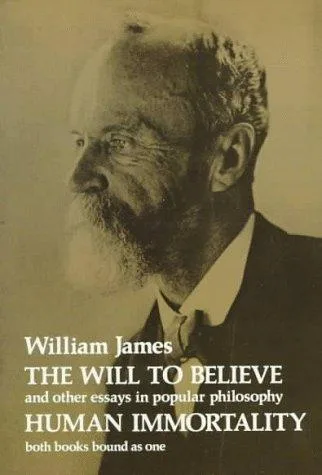
The Will to Believe, first published in 1956, is a collection of essays by the American philosopher William James. It is not a systematic treatise but rather a series of arguments exploring the nature of belief, faith, and the human will. James confronts the perceived conflict between scientific rationalism and religious or pragmatic belief, proposing that in certain circumstances, the act of believing can itself be a factor in making a belief true. The work grapples with questions of free will, determinism, and the ethical implications of our convictions.
### Who It's For
This book is for thinkers wrestling with the foundations of their own convictions, particularly where science and faith appear to diverge. It will appeal to those interested in pragmatism, the philosophy of religion, and the psychology of belief. Readers who appreciate philosophical inquiry that engages directly with lived experience and the practical consequences of ideas will find James's approach compelling. It is also relevant for students of early 20th-century American intellectual history.
### Historical Context
Published during a period of intense intellectual ferment, The Will to Believe emerged from a philosophical landscape dominated by positivism and scientific naturalism. James, a key figure in American pragmatism alongside Charles Sanders Peirce, challenged the prevailing skepticism. He directly engaged with thinkers like Clifford, whose essay "The Ethics of Belief" argued against believing anything on insufficient evidence. James's work offered a counterpoint, suggesting that for certain types of 'living, forced, and momentous' options, belief might be psychologically and even epistemically warranted. The book's reception highlighted the ongoing debate between empirical rigor and the human need for meaning and commitment.
### Key Concepts
Central to the work is James's concept of the 'will to believe,' which posits that in situations involving a choice between two hypotheses, where neither can be proven or disproven by evidence alone, and where the choice is momentous (significant) and forced (unavoidable), an individual is justified in believing what they want. This is distinct from simply believing whatever one wishes without consequence. James also distinguishes between 'over-beliefs' – those beyond immediate proof – and the empirical facts they might relate to. The work explores the function of 'faith' not as blind acceptance, but as a psychological force that can actualize possibilities.
💡 Why Read This Book?
• Understand the pragmatic justification for belief in the face of uncertainty, a concept James details in his 1956 collection, offering a framework beyond strict empiricism. • Examine the "living, forced, and momentous" nature of choices, a specific category James introduces to explain when belief can be a valid act. • Explore the psychological role of "over-beliefs," as discussed in the book, and their impact on individual agency and decision-making in areas lacking definitive proof.
⭐ Reader Reviews
Honest opinions from readers who have explored this book.
❓ Frequently Asked Questions
What is the core idea behind William James's 'will to believe'?
The core idea is that for certain choices that are 'living, forced, and momentous,' where evidence is insufficient to decide, one is justified in believing what they want, as belief itself can help bring about the desired outcome.
When was 'The Will to Believe' first published?
The collection of essays, 'The Will to Believe,' was first published in 1956, though its constituent essays were written earlier by William James.
How does James's philosophy differ from pure empiricism?
James's pragmatism, as seen in this work, allows for belief in propositions not yet empirically verified, especially if the belief is psychologically beneficial and the choice is unavoidable, contrasting with strict empiricism's reliance solely on observable evidence.
What are 'over-beliefs' according to William James?
Over-beliefs are propositions that go beyond the immediately verifiable facts of experience. James argues that in certain situations, these over-beliefs are necessary for guiding our actions and can, in fact, influence the outcome.
What kind of choices does James consider 'forced'?
Forced choices are those where one must decide between two options; there is no possibility of remaining neutral or postponing the decision. This is a key criterion for applying the 'will to believe'.
Is 'The Will to Believe' a religious text?
No, it is a philosophical work exploring the nature of belief, including religious belief, but it is not a religious text. James uses philosophical arguments to discuss faith and conviction.
🔮 Key Themes & Symbolism
Pragmatic Justification for Belief
James argues that for certain significant and unavoidable decisions, belief can be justified even without conclusive empirical evidence. This "will to believe" is not about wishful thinking but a recognition that in "living, forced, and momentous" situations, our psychological commitment can play a role in actualizing possibilities. The 1956 publication date belies the earlier philosophical context, yet the core argument remains potent for those seeking to reconcile intellectual skepticism with the demands of conviction, particularly in areas like ethics and religion where proof is elusive.
The Nature of 'Forced' and 'Momentous' Choices
Central to James's thesis are choices that are simultaneously 'forced' (meaning one must choose, inaction is itself a choice) and 'momentous' (having significant consequences for the individual). These are the domains where pure rationalism falters, and the psychological act of believing becomes a relevant factor. The book explores how such choices, often related to personal faith or ethical commitments, necessitate a pragmatic approach where the belief itself can contribute to the truth of the proposition.
The Role of Psychology in Epistemology
James bridges the gap between psychology and epistemology, asserting that our psychological predispositions and the act of willing to believe have a legitimate place in determining what we hold to be true, especially beyond the realm of scientific certainty. He challenges the notion that intellectual integrity demands waiting for absolute proof in all matters. The work examines how our mental states and the very act of assertion can shape reality, influencing our perception and experience of truth.
Over-Beliefs and Human Agency
The concept of 'over-beliefs' is critical: propositions that extend beyond immediate empirical evidence but are necessary for guiding our lives and actions. James contends that these are not irrational but are often the very foundation upon which we build meaning and make progress. This perspective empowers the individual, suggesting that our capacity to believe and commit is not a flaw but a fundamental aspect of human agency and our ability to create our own truths.
💬 Memorable Quotes
“Our passional natures, then, must be brought into the open.”
— James asserts that our emotional and volitional inclinations are not to be suppressed in the pursuit of truth, especially when dealing with choices that cannot be settled by cold reason alone.
“When two men have a controversy, and are each convinced of their own side, and neither will change their mind, they must either fight or satisy themselves with the situation.”
— This highlights the 'forced' nature of some disagreements where resolution requires a commitment or acceptance, suggesting that in such impasses, belief plays a crucial role in moving forward.
“Granting, then, that that faith may be needed to make our will act, the question becomes: Is our belief in ourselves the only kind of belief which is needed?”
— This probes the extent of 'will to believe,' questioning whether self-belief is sufficient or if belief in external possibilities or truths is also a necessary component for human action and fulfillment.
“The fact that I have no means of proving my case must not prevent me from acting as if it were true.”
— This encapsulates the core pragmatic idea that in the absence of proof, acting *as if* a belief were true, particularly for momentous choices, can be a valid and even necessary stance.
“We must believe, or we shall cease to be.”
— This interpretation suggests that a fundamental aspect of human existence and action is the act of believing; without it, life loses its direction and purpose, implying belief is a prerequisite for living.
🌙 Esoteric Significance
Tradition
While not strictly an esoteric text, "The Will to Believe" aligns with certain Hermetic and Gnostic principles emphasizing the power of the individual mind and will in shaping reality. The Hermetic axiom "As Above, So Below" can be seen reflected in James's idea that internal states (belief) can influence external manifestations. It departs from purely dogmatic traditions by grounding its claims in psychological experience and pragmatic outcomes rather than divine revelation or ancient texts.
Symbolism
The central 'will' can be interpreted as the active, volitional principle—a concept resonant with the Hermetic idea of the divine spark within humanity capable of creative action. The 'choice' represents the crossroads often symbolized by the Pythagorean 'Y' or the Kabbalistic path, where one must select a direction that shapes one's destiny. The idea of 'truth' itself, in James's pragmatic view, becomes less a static entity and more a dynamic process, akin to the alchemical transformation sought in Hermeticism.
Modern Relevance
James's work continues to influence fields such as positive psychology, self-help literature, and even quantum physics interpretations that explore observer effects. Thinkers in the law of attraction movement and proponents of 'manifestation' often draw upon the idea that belief can shape reality, echoing James's pragmatic approach to 'over-beliefs.' His emphasis on the practical consequences of ideas remains pertinent for contemporary discussions on cognitive biases and decision-making.
👥 Who Should Read This Book
• Individuals grappling with the conflict between scientific rationalism and personal faith, seeking philosophical justification for belief beyond empirical proof. • Students of American pragmatism and philosophy of religion, interested in William James's foundational arguments on belief and evidence. • Those exploring the psychological underpinnings of conviction and decision-making, particularly concerning 'living, forced, and momentous' choices.
📜 Historical Context
William James's "The Will to Believe," first published in 1956, emerged from the intellectual currents of late 19th and early 20th-century American philosophy. It directly challenged the dominant positivist and empiricist viewpoints championed by figures like Thomas Henry Huxley and W.K. Clifford, who advocated for belief based solely on sufficient evidence. James, a founder of pragmatism alongside Charles Sanders Peirce, proposed that for certain types of choices—those that are "living, forced, and momentous"—belief could be permissible and even necessary, acting as a catalyst for outcomes. His contemporary, Henri Bergson, also explored the limits of intellect and the role of intuition in understanding reality, representing a broader shift away from strict rationalism. The book's reception underscored a significant debate regarding the intellectual and practical implications of faith, reason, and personal conviction in a rapidly modernizing world.
📔 Journal Prompts
The "will to believe" in the context of a "living, forced, and momentous" choice.
Considering "over-beliefs" and their role in personal conviction.
The psychological necessity of belief versus empirical proof.
Reflecting on how a belief might actively help create its own truth.
The tension between intellectual skepticism and the need for commitment.
🗂️ Glossary
Will to Believe
James's concept that in certain situations, belief is not only permissible but psychologically necessary and can contribute to making a proposition true.
Living, Forced, and Momentous
Criteria James uses to define choices where belief is justified: 'Living' (a real option for the believer), 'Forced' (must choose), and 'Momentous' (significant consequences).
Over-belief
A proposition that goes beyond immediately verifiable facts but is necessary for guiding actions or understanding life; a form of faith or hypothesis.
Pragmatism
A philosophical approach associated with James, focusing on the practical consequences and usefulness of ideas as the basis for their truth or validity.
Empiricism
The philosophical stance that knowledge comes primarily or solely from sensory experience and evidence.
Passional Nature
Refers to an individual's emotional, volitional, and intuitive faculties, which James argued play a legitimate role in forming beliefs.
Hypothesis
In James's context, a proposition or belief that is not yet proven but is held and acted upon, potentially influencing its own verification.