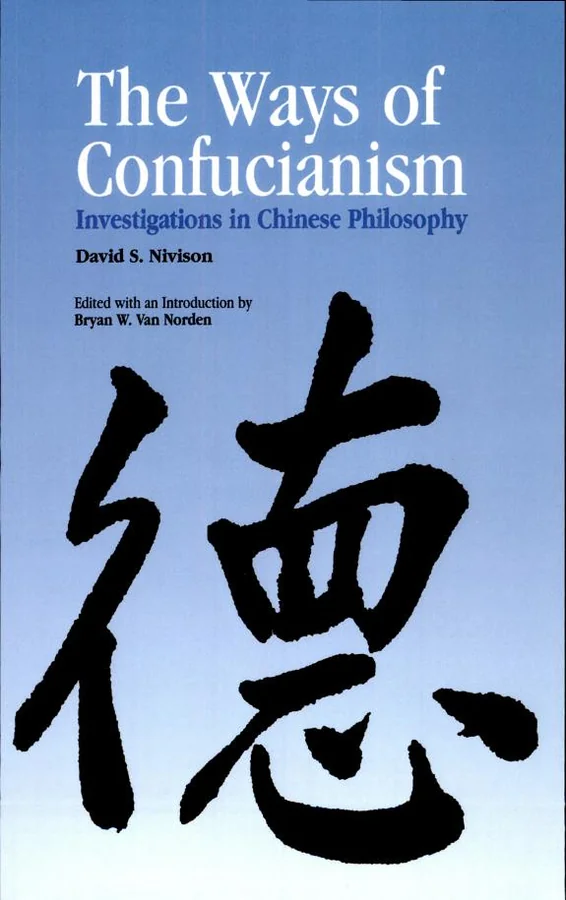
The Ways of Confucianism
 83
83

The Ways of Confucianism
David S. Nivison's The Ways of Confucianism succeeds in presenting a remarkably diverse intellectual landscape where many might expect monolithic dogma. His strength lies in dissecting the subtle yet significant divergences among thinkers, particularly highlighting the contrasting views of Mencius and Xunzi on human nature, a core debate that shapes much subsequent Confucian discourse. The book navigates this complexity with scholarly precision, though at times the sheer density of historical and philosophical detail might feel overwhelming for a reader unacquainted with the subject. A passage detailing Wang Yangming's syncretic approach, bridging Mencian idealism with Buddhist influences, offers a particularly compelling illustration of Confucianism's capacity for adaptation. Nivison's work is a valuable, if demanding, scholarly resource.
📝 Description
83
### What It Is
The Ways of Confucianism offers a comprehensive exploration of one of the world's most enduring philosophical traditions. David S. Nivison, a noted scholar, meticulously traces the evolution of Confucian thought across two millennia. This work is not a simple historical survey but an interpretative guide, bringing to life the distinct voices and intellectual currents within Confucianism. It examines foundational texts and the contributions of key figures, demonstrating the tradition's dynamism and adaptability.
### Who It's For
This book is for students of philosophy, comparative religion, and intellectual history. It is particularly valuable for those seeking to understand the philosophical underpinnings of East Asian cultures and political thought. Readers interested in the development of ethical systems and the application of ancient wisdom to contemporary issues will find its detailed analysis rewarding. It serves as an accessible entry point for newcomers and a rigorous resource for advanced scholars.
### Historical Context
Published in 1996, The Ways of Confucianism emerged during a period of renewed global interest in non-Western philosophies and their relevance. Nivison's work engages with the long scholarly tradition of interpreting Confucianism, from its origins in the Spring and Autumn period (771–476 BCE) to its later developments. It situates Confucianism within broader East Asian intellectual history, acknowledging its interactions with Daoism and Buddhism, while highlighting its unique emphasis on social harmony, ethical cultivation, and governance. The book addresses a global academic audience.
### Key Concepts
The core of Confucianism, as presented by Nivison, revolves around the concept of *ren* (仁), often translated as benevolence or humaneness, and its practical application in social and political life. The text also elucidates the differing interpretations of human nature, notably the contrast between Mencius's view of innate goodness and Xunzi's emphasis on education and ritual to curb natural inclinations. The pursuit of the *junzi* (君子), the noble or exemplary person, through self-cultivation and adherence to *li* (礼), or ritual propriety, forms another central theme. The work underscores the pragmatic and ethical focus of this tradition.
💡 Why Read This Book?
• Gain a nuanced understanding of *ren* (仁) and its practical application beyond simple benevolence, as explored through the analyses of figures like Confucius and Mencius. • Grasp the fundamental debate between Mencius's belief in innate human goodness and Xunzi's emphasis on external cultivation through ritual (*li*). • Appreciate the evolution of Confucian thought through key figures such as Wang Yangming and Dai Zhen, understanding how their ideas contributed to the tradition's adaptability over two thousand years.
⭐ Reader Reviews
Honest opinions from readers who have explored this book.
❓ Frequently Asked Questions
When was David S. Nivison's 'The Ways of Confucianism' first published?
The Ways of Confucianism by David S. Nivison was first published in 1996, making it a relatively modern scholarly interpretation of a long-standing philosophical tradition.
What are the main Confucian concepts discussed in the book?
The book discusses key concepts such as *ren* (benevolence), *li* (ritual propriety), the ideal of the *junzi* (noble person), and differing views on human nature, particularly contrasting Mencius and Xunzi.
Which historical figures from Confucianism are covered?
Nivison's work covers a broad historical spectrum, from Confucius himself and Mencius, to later thinkers like Wang Yangming, Dai Zhen, and Zhang Xuecheng.
Is 'The Ways of Confucianism' suitable for beginners?
While rigorous, the book aims to elucidate complex ideas for a scholarly audience. Beginners might benefit from supplemental introductory material, but its detailed analysis offers a deep dive into the subject.
What is the primary philosophical contribution of Mencius as discussed by Nivison?
Nivison highlights Mencius's significant contribution in arguing for the inherent goodness of human nature, a foundational concept for much of later Confucian ethics and political philosophy.
How does the book address the concept of 'ritual propriety' (*li*)?
The book explores *li* not merely as empty ceremony, but as a crucial framework for cultivating moral character and maintaining social order, as articulated by thinkers across centuries.
🔮 Key Themes & Symbolism
The Evolution of Ren
Nivison traces the central Confucian concept of *ren* (仁), often translated as benevolence or humaneness, through its development over two thousand years. He shows how this core virtue, emphasizing empathy and ethical conduct, was interpreted and applied differently by key figures. From Confucius's foundational teachings on interpersonal relationships to Mencius's assertion of innate human goodness, the exploration reveals *ren* not as a static ideal but as a continuously debated and practiced principle within the tradition, crucial for individual cultivation and societal harmony.
Human Nature: Mencius vs. Xunzi
A pivotal aspect of Confucian philosophy is the debate over human nature, which Nivison meticulously examines. He contrasts Mencius's optimistic view that humans are inherently good, requiring only nourishment to flourish, with Xunzi's more cautious perspective that human nature is initially flawed and requires rigorous education, ritual (*li*), and the guidance of sages to achieve moral order. This fundamental disagreement profoundly shaped subsequent Confucian thought, influencing approaches to governance, ethics, and self-cultivation across different dynasties.
The Ideal of the Junzi
The pursuit of becoming a *junzi* (君子), or noble person, is a recurring motif. Nivison illustrates how this ideal represents the practical goal of Confucian ethical training – the cultivation of a virtuous individual who embodies benevolence, righteousness, propriety, and wisdom. The book demonstrates that achieving *junzi* status is not an innate state but a lifelong process of learning, self-reflection, and adherence to societal norms and rituals, making Confucianism a deeply practical ethical system focused on character development.
Confucianism's Adaptability
The work highlights Confucianism's remarkable capacity for adaptation and synthesis over centuries. Nivison examines how later thinkers like Wang Yangming integrated Neo-Confucianism with elements of Buddhism, or how Dai Zhen engaged with evidential scholarship, demonstrating the tradition's resilience and intellectual dynamism. This adaptability allowed Confucianism to remain a dominant force in Chinese intellectual and social life, responding to new challenges and incorporating diverse philosophical currents while maintaining its core ethical framework.
💬 Memorable Quotes
“Nivison elucidates the differing interpretations of human nature, notably the contrast between Mencius's view of innate goodness and Xunzi's emphasis on education and ritual.”
— This highlights a core philosophical divergence within Confucianism concerning whether virtue is inherent or must be externally imposed, shaping distinct pedagogical and ethical approaches.
“The text explores key thinkers from Confucius himself, through Mencius and Xunzi, to such later Confucians as Wang Yangming.”
— This demonstrates the book's chronological scope, showcasing the lineage of thought and the evolution of Confucian ideas across significant historical periods and intellectual figures.
“The pursuit of the *junzi* (君子), the noble or exemplary person, through self-cultivation and adherence to *li* (礼), or ritual propriety, forms a central theme.”
— This points to the practical, ethical aim of Confucianism: the development of a morally upright individual through disciplined practice and social engagement.
“Nivison brings out the exciting variety within Confucian thought.”
— This suggests the book challenges simplistic notions of Confucianism, revealing its internal debates, diverse schools of thought, and intellectual richness over time.
“The book interprets and elucidates key thinkers from over two thousand years.”
— This emphasizes the scholarly depth and interpretive framework Nivison employs to make complex historical philosophical ideas accessible and understandable.
🌙 Esoteric Significance
Tradition
While Confucianism is primarily a socio-ethical and political philosophy, its emphasis on self-cultivation, the alignment of the individual with cosmic order (Tian, 天), and the pursuit of harmony can be seen as having parallels with certain esoteric traditions focused on inner transformation and ethical perfection. It doesn't fit neatly into Western esoteric lineages like Hermeticism or Kabbalah but shares the goal of achieving a higher state of being through disciplined practice and understanding.
Symbolism
Key symbols include the concept of *Tian* (天), often translated as Heaven, representing a moral order and cosmic principle that individuals strive to align with. The *junzi* (君子) itself functions as an archetypal symbol of perfected humanity. Ritual (*li*, 礼) acts as a symbolic language for expressing respect, maintaining social hierarchies, and enacting ethical principles, serving as a tangible manifestation of inner virtue.
Modern Relevance
Contemporary thinkers and practitioners in fields like East Asian philosophy, comparative ethics, and even certain forms of mindfulness and personal development draw upon Confucian ideals. Its focus on relational ethics, the importance of social roles, and the cultivation of virtues like trustworthiness and benevolence offers frameworks for addressing modern challenges in governance, business ethics, and interpersonal relationships, particularly in East Asian contexts and beyond.
👥 Who Should Read This Book
• Scholars of East Asian philosophy and intellectual history seeking a detailed overview of Confucianism's development across key figures and periods. • Students of comparative religion and ethics interested in understanding the foundational principles and debates within a major world tradition. • Individuals engaged in personal development and ethical cultivation who wish to explore systematic approaches to character building rooted in ancient wisdom.
📜 Historical Context
Published in 1996, David S. Nivison's *The Ways of Confucianism* arrived during a period of increasing global engagement with non-Western philosophical traditions. It addressed the ongoing scholarly project of understanding Confucianism, a system that had profoundly shaped East Asian civilization since its inception in the Spring and Autumn period (771–476 BCE). Nivison's work engages with the legacy of scholars who interpreted Mencius and Xunzi, particularly their contrasting views on human nature. It also situates Confucianism within its broader intellectual milieu, acknowledging its historical dialogues and divergences with schools like Daoism and Buddhism. The book aimed to provide a comprehensive yet accessible overview for an international academic readership, offering a nuanced perspective on a tradition often misunderstood in the West.
📔 Journal Prompts
The cultivation of *ren* (仁) as a practice.
Xunzi's perspective on the necessity of ritual (*li*, 礼).
The ideal of the *junzi* (君子) in contemporary life.
Contrasting Mencius's view of human nature with practical observations.
The role of historical figures like Wang Yangming in shaping Confucian thought.
🗂️ Glossary
Ren (仁)
A core Confucian virtue, often translated as benevolence, humaneness, or goodness. It signifies empathy, compassion, and the ethical quality of being truly human in relation to others.
Li (礼)
Ritual propriety, etiquette, and social norms. It encompasses ceremonies, customs, and proper conduct, seen as essential for cultivating virtue and maintaining social harmony.
Junzi (君子)
The noble person, gentleman, or exemplary individual. It represents the ideal outcome of Confucian self-cultivation, embodying moral excellence and ethical leadership.
Mencius (Mengzi)
A key Confucian philosopher (c. 372–289 BCE) known for his defense of innate human goodness and his emphasis on the ruler's moral responsibility.
Xunzi (Xun Kuang)
Another influential Confucian philosopher (c. 310–235 BCE) who argued that human nature is inherently selfish and requires education, ritual, and law to become good.
Wang Yangming (Wang Shouren)
A prominent Neo-Confucian philosopher (1472–1529) who synthesized Mencian idealism with Buddhist concepts, emphasizing intuitive knowledge and the unity of knowledge and action.
Tian (天)
Heaven or Sky. In Confucianism, it represents a cosmic moral order and a guiding principle that humans should align themselves with through ethical conduct.