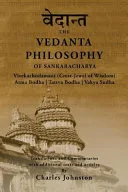
The Vedanta Philosophy of Sankaracharya
 82
82

The Vedanta Philosophy of Sankaracharya
Charles Johnston’s "The Vedanta Philosophy of Sankaracharya" offers a lucid, if somewhat dated, exposition of Advaita Vedanta. Johnston’s admiration for Adi Shankara is palpable, particularly in his interpretation of the mind’s potential as an ally rather than an obstacle. He highlights Shankara’s genius in transforming the mind into a tool for spiritual insight, a concept well-articulated in his preface. The work's strength lies in its systematic presentation of complex doctrines, making them accessible to a Western audience. However, the prose, while earnest, occasionally leans towards devotional fervor rather than critical detachment, which might be a limitation for readers seeking purely academic analysis. The discussion on Maya, for instance, could benefit from more varied philosophical comparisons. Nonetheless, Johnston provides a valuable entry point into Shankara's profound system, emphasizing the power of intellect directed toward ultimate truth.
📝 Description
82
Charles Johnston's 1903 book explains Adi Shankara's Advaita Vedanta philosophy.
This book examines the Advaita Vedanta school of Hindu philosophy as presented by Adi Shankara, an 8th-century Indian philosopher. Charles Johnston breaks down Shankara's core teachings, focusing on the concept of Brahman as the sole reality and the illusory nature of the perceived world, known as Maya. The work is intended for students of Eastern philosophy who want a rigorous intellectual grasp of Advaita Vedanta. It covers metaphysical ideas and their application to spiritual realization.
Johnston's work appeared in the early 20th century, a time when Western interest in Indian thought was growing. Figures connected with the Theosophical Society were popularizing Indian spiritual ideas. Johnston's study of Shankara fits into this period of comparative philosophy and esoteric scholarship. The book centers on key Advaita concepts: Brahman (absolute reality), Atman (the self), and Maya (illusion). It details the path to liberation, Moksha, through discriminative knowledge, Viveka, and overcoming ignorance, Avidya, to realize the unity of Atman and Brahman.
Published in 1903, Johnston's work engages with the Advaita Vedanta tradition, a major school of Hindu philosophy emphasizing non-dualism. This perspective posits that reality is ultimately one, a single, undifferentiated consciousness (Brahman), and that the apparent multiplicity of the world is an illusion (Maya). The book details the path to liberation (Moksha) by realizing the identity of the individual self (Atman) with Brahman. Johnston's interpretation situates Shankara's teachings within a broader context of comparative philosophy, appearing during a period of increased Western engagement with Indian spiritual and philosophical systems.
💡 Why Read This Book?
• Gain a precise understanding of Advaita Vedanta's core tenets, such as Brahman and Maya, as presented through the lens of Adi Shankara's philosophy, directly addressing the metaphysical framework discussed in the early chapters. • Explore Charles Johnston's unique interpretation of how the mind, often seen as a barrier, can be transformed into an "ally" for spiritual realization, a concept central to his preface and analysis. • Grasp the practical implications of Shankara's teachings for achieving liberation (Moksha), understanding the path of Viveka as outlined in the book's later sections.
⭐ Reader Reviews
Honest opinions from readers who have explored this book.
❓ Frequently Asked Questions
When was Charles Johnston's translation and interpretation of Sankaracharya first published?
Charles Johnston's "The Vedanta Philosophy of Sankaracharya" was first published on September 29, 2014, though its genesis lies in earlier intellectual engagement with Advaita Vedanta.
What is the central philosophical school discussed in this book?
The book primarily discusses Advaita Vedanta, a prominent school of Hindu philosophy that emphasizes the oneness of reality and the illusory nature of the phenomenal world.
Who was Adi Shankara?
Adi Shankara was an 8th-century Indian philosopher and theologian who consolidated the Advaita Vedanta tradition, arguing for the non-duality of Atman (the individual self) and Brahman (the ultimate reality).
What is Maya according to Advaita Vedanta?
Maya, as explored in the text, refers to the cosmic illusion that the phenomenal world is real and distinct from Brahman, obscuring the true nature of reality.
What is the ultimate goal of the philosophy presented by Sankaracharya?
The ultimate goal is Moksha, or liberation, achieved through the realization of the identity between the individual soul (Atman) and the absolute reality (Brahman), thereby transcending the cycle of birth and death.
How does Charles Johnston view the role of the mind in spiritual practice?
Johnston views the mind not as an enemy but as a potential ally, capable of being trained and utilized as a tool to understand the Real and achieve spiritual insight, as he states in his preface.
🔮 Key Themes & Symbolism
The Nature of Reality
This work expounds upon the Advaita Vedanta tenet that Brahman alone is real, and the world of multiplicity perceived through the senses is ultimately illusory (Maya). It contrasts this absolute view with empirical reality, arguing that true understanding comes from recognizing the underlying unity. Johnston emphasizes Shankara's method of dissecting perception to reveal the singular, unchanging substratum of existence, a concept crucial for spiritual liberation.
The Mind as an Ally
Contrary to some traditions that view the mind as the primary obstacle to enlightenment, Johnston highlights Shankara's perspective. Shankara's philosophy, as presented here, shows how the mind, when properly understood and disciplined, can become a powerful instrument for realizing the truth of non-duality. Johnston interprets this as a sophisticated approach to mental training, turning the 'slayer of the Real' into a servant of the soul.
Path to Liberation (Moksha)
The book details the practical application of Advaita Vedanta for achieving Moksha. This involves the rigorous intellectual discernment (Viveka) between the real (Brahman) and the unreal (Maya), and the cultivation of detachment. Johnston outlines Shankara's emphasis on knowledge (Jnana) as the direct means to overcome ignorance (Avidya) and realize the inherent oneness of the individual self (Atman) with the ultimate reality (Brahman).
The Illusory World (Maya)
A central concept explored is Maya, the power that veils the true nature of reality and projects the illusion of a diverse, independent world. Johnston explains Maya not as mere nothingness, but as a creative power whose manifestations are transient and ultimately unreal when compared to Brahman. Understanding Maya is presented as a critical step in dismantling false perceptions and achieving spiritual insight.
💬 Memorable Quotes
Direct passages from the work, attributed to the author.
“Sankara has shown how to draw the grains of gold from the matrix of the mind, to make the mind the door-keeper of the soul.”
— This powerful metaphor illustrates Shankara's method of extracting valuable wisdom from the mind. It posits the mind not as a source of delusion, but as a gateway to deeper spiritual understanding when properly cultivated and directed.
“Interpretation: Liberation (Moksha) is achieved not through ritual or devotion alone, but through direct knowledge and the intellectual discrimination (Viveka) of the real from the unreal.”
— This interpretation points to the emphasis on Jnana Yoga (the path of knowledge) within Shankara's philosophy. It underscores the intellectual rigor required to dismantle ignorance and realize the ultimate truth of non-duality.
💡 Key Ideas
Editorial paraphrase of the work's core concepts — not direct quotes.
Sankaracharya is, for me, the greatest of all Masters of the Mind; he has, indeed, conquered and circumvented the mind at every turning, making a slave, nay, even a most effective servant and ally of that power which, for so many teachers, has bee ceaselessly reprobated, as the Slayer of the Real.
This quote from Johnston's preface expresses his high regard for Shankara, emphasizing his innovative approach to the mind. It suggests Shankara's teachings transform mental obstacles into tools for spiritual progress, a unique perspective within philosophical discourse.
Interpretation: The work explores the idea that the phenomenal world, with its apparent diversity and change, is a projection or illusion (Maya) that obscures the singular, unchanging reality of Brahman.
This paraphrased concept highlights a core tenet of Advaita Vedanta. It suggests that what we perceive as separate entities are, in essence, manifestations of a single, underlying consciousness or existence.
Interpretation: The individual self (Atman) is not distinct from the absolute reality (Brahman); their apparent difference is a result of ignorance.
This is the central Mahavakya (Great Saying) of Advaita Vedanta, summarized here. It signifies the ultimate realization that the essence of each individual is identical with the fundamental ground of all being.
🌙 Esoteric Significance
Tradition
This work is rooted in the Advaita Vedanta tradition, a major school within Hindu philosophy. Esoterically, it aligns with contemplative and mystical paths across traditions that emphasize direct realization of ultimate reality. While distinct from Western Hermeticism or Kabbalah, it shares the goal of uncovering an underlying unity behind apparent diversity, a common thread in many esoteric lineages.
Symbolism
The text frequently engages with the concept of Brahman, the ultimate, undifferentiated reality, often symbolized by the sacred syllable 'Om'. Maya, the illusion of the phenomenal world, can be seen as a symbol of veiling or cosmic play. The 'grains of gold' metaphor points to the inherent spiritual wealth within the individual, obscured by ignorance.
Modern Relevance
Contemporary thinkers and practitioners in non-dual spiritual traditions, mindfulness, and consciousness studies often draw upon the insights of Shankara. Modern interpretations of Advaita Vedanta, found in various spiritual movements and philosophical discussions, continue to explore the nature of self, consciousness, and reality, echoing the foundational principles presented in this work.
👥 Who Should Read This Book
• Students of comparative philosophy seeking a rigorous introduction to Advaita Vedanta, particularly those interested in the monistic perspective of Adi Shankara. • Esoteric practitioners interested in Eastern spiritual traditions and their metaphysical underpinnings, aiming to understand the concept of Maya and the path to realizing Brahman. • Readers drawn to Charles Johnston's specific interpretations of Eastern thought, looking for his insights into the mind's role in spiritual realization.
📜 Historical Context
Charles Johnston's "The Vedanta Philosophy of Sankaracharya" emerged from a fertile period of Eastern thought exploration in the West, particularly around the turn of the 20th century. This era witnessed the growing influence of figures like Helena Blavatsky and the Theosophical Society, which actively promoted Indian philosophies. Johnston, himself a figure associated with esoteric interpretations, sought to bridge the gap between the complex doctrines of Advaita Vedanta and a Western audience. His work engaged with the intellectual currents of comparative religion and philosophy, offering a distinct perspective on the teachings of Adi Shankara, an 8th-century Indian philosopher. This period also saw other Western scholars and mystics engaging with Vedanta, including Swami Vivekananda, who famously addressed the Parliament of Religions in Chicago in 1893, bringing Vedanta concepts to a wider public. Johnston's contribution fits within this broader movement, aiming to illuminate Shankara's non-dualistic system for a new readership.
📔 Journal Prompts
The matrix of the mind as described by Johnston: what are its perceived limitations and its potential as an ally?
Reflect on the concept of Maya and how it might influence your perception of daily experiences.
How does the realization of Atman being Brahman, as presented in the text, challenge conventional notions of self?
Consider the process of Viveka: discerning the real from the unreal in your own life.
What does it mean for the mind to become the 'door-keeper of the soul'?
🗂️ Glossary
Advaita Vedanta
A school of Hindu philosophy emphasizing non-duality, teaching that the individual soul (Atman) is identical with the ultimate reality (Brahman).
Brahman
The supreme, unchanging, absolute reality that is the ground of all existence in Hindu philosophy, particularly in Advaita Vedanta.
Atman
The self or soul; the inner essence of an individual, which in Advaita Vedanta is understood to be identical with Brahman.
Maya
A concept in Hinduism, particularly Advaita Vedanta, referring to the illusory power that conceals the true nature of reality and makes the phenomenal world appear real.
Moksha
Liberation or release from the cycle of birth and death (samsara); the ultimate goal in many Indian religions, achieved through spiritual knowledge and realization.
Viveka
Discrimination or discernment; the intellectual ability to distinguish between the real (eternal, unchanging Brahman) and the unreal (transient, changing world).
Avidya
Ignorance; specifically, the fundamental ignorance that obscures the true nature of reality and leads to the mistaken identification of the self with the non-self.