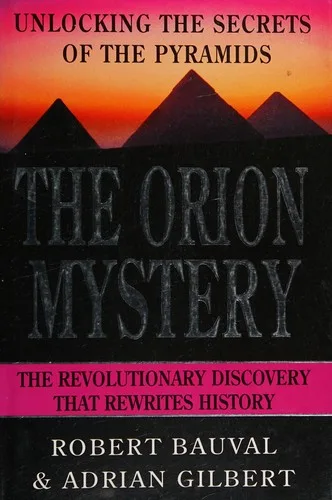
The Orion mystery
 82
82

The Orion mystery
Bauval and Gilbert's "The Orion Mystery" offers a compelling, if contentious, reinterpretation of the Giza plateau. Their core argument – that the pyramid complex is a terrestrial map of Orion's Belt – is presented with meticulous detail, drawing on precise astronomical data and architectural measurements. The strength lies in the sheer audacity and the detailed correlations they draw between the stars and the pyramids, particularly the proposed alignment around 10,500 BC. This date itself is a significant departure from mainstream Egyptology, which firmly places the pyramids within the Fourth Dynasty. However, the limitation is precisely this reliance on a specific, ancient epoch to make the correlation work, which requires accepting a much older and largely undocumented period of sophisticated construction. The authors' detailed analysis of pyramid elevation versus stellar magnitude for Alnitak, Alnilam, and Mintaka is a striking passage that forms the backbone of their theory. Ultimately, the book presents a fascinating puzzle, but one where the proposed solution rests on a foundation that many scholars find difficult to accept due to a lack of corroborating evidence for such an advanced civilization at that proposed date. It remains a significant contribution to speculative archaeoastronomy.
📝 Description
82
### What It Is
The Orion Mystery, by Robert Bauval and Adrian Geoffrey Gilbert, presents a controversial thesis linking the layout of the Giza pyramids to the alignment of the stars in the constellation Orion. First published in 1994, this work proposes that the ancient Egyptians, specifically during the era of the Old Kingdom, intentionally mirrored the celestial pattern of Orion's Belt with the placement and relative size of the three main pyramids at Giza. The authors argue this was not a mere coincidence but a deliberate act of cosmic mapping, reflecting a sophisticated understanding of astronomy and a deep reverence for the stars. The book meticulously details their analysis, correlating pyramid positions with stellar positions at a specific point in prehistory.
### Who It's For
This book is aimed at readers interested in ancient mysteries, archaeoastronomy, and alternative theories about Egyptian civilization. It will appeal to those who question mainstream archaeological interpretations and are drawn to the idea of a lost, advanced ancient knowledge. Individuals fascinated by the pyramids of Giza, the symbolism of Orion, and the potential for ancient cultures to possess sophisticated astronomical understanding will find this text engaging. It is particularly suited for those with an open mind regarding fringe theories and who enjoy detailed analytical arguments.
### Historical Context
The 1990s saw a burgeoning interest in archaeoastronomy and alternative historical narratives. Bauval and Gilbert's work emerged within this climate, challenging prevailing Egyptological views that dated the Giza pyramids primarily to the Fourth Dynasty (circa 2580–2560 BC). Their theory proposed a much older date, aligning with a specific epoch when Orion's Belt would have appeared in a particular orientation in the sky, a concept they termed the 'Orion Correlation Theory'. This theory gained traction among proponents of ancient astronaut theories and those seeking evidence of a precursor civilization. It sparked considerable debate within academic circles and among the public interested in ancient Egypt.
### Key Concepts
The central concept is the "Orion Correlation Theory," which posits that the three pyramids of Giza were deliberately aligned to represent the three stars of Orion's Belt. The authors focus on the relative positions, sizes, and elevations of the pyramids (Khufu, Khafre, and Menkaure) and compare them to the stars Alnitak, Alnilam, and Mintaka. They argue that this alignment was intended to represent the constellation as it appeared around 10,500 BC, suggesting an older origin for the pyramid complex than commonly accepted. The book also explores the Egyptian concept of the Duat (underworld) and its connection to celestial bodies, particularly Orion, which was associated with the god Osiris.
💡 Why Read This Book?
• Gain a detailed understanding of the "Orion Correlation Theory," which proposes a precise celestial map using the Giza pyramids and Orion's Belt, challenging conventional timelines of ancient Egyptian construction. • Explore the astronomical knowledge attributed to Old Kingdom Egyptians, specifically their potential understanding of stellar alignments and their connection to religious beliefs about Osiris and the Duat. • Examine alternative interpretations of ancient monuments and their potential astronomical significance, moving beyond standard archaeological narratives to consider cosmological frameworks.
⭐ Reader Reviews
Honest opinions from readers who have explored this book.
❓ Frequently Asked Questions
What is the main theory presented in "The Orion Mystery"?
The book's central thesis is the "Orion Correlation Theory," which suggests the three main pyramids at Giza were built to mirror the alignment and relative brightness of the stars in Orion's Belt around 10,500 BC.
Who are the authors of "The Orion Mystery"?
The authors are Robert Bauval and Adrian Geoffrey Gilbert. The book was first published in 1994.
What evidence do Bauval and Gilbert use to support their theory?
They analyze the relative positions, sizes, and elevations of the Giza pyramids (Khufu, Khafre, Menkaure) and compare them to the positions and magnitudes of the stars in Orion's Belt, particularly during a proposed ancient epoch.
Does "The Orion Mystery" align with mainstream Egyptology?
No, the theory presented in "The Orion Mystery" challenges mainstream Egyptological dating of the Giza pyramids, which typically places their construction much later, during the Fourth Dynasty (around 2500 BC).
What ancient Egyptian concepts does the book explore?
The book explores the Egyptian concept of the Duat (underworld) and its celestial associations, particularly the god Osiris and his connection to the constellation Orion.
Is the Orion Correlation Theory widely accepted?
The Orion Correlation Theory is a speculative theory and is not widely accepted by mainstream Egyptologists or archaeologists, although it has garnered interest among proponents of alternative ancient history.
🔮 Key Themes & Symbolism
Orion Correlation Theory
The central tenet of the book posits that the Giza pyramid complex is a deliberate terrestrial representation of the three stars of Orion's Belt. Bauval and Gilbert meticulously detail how the relative positions, sizes, and elevations of the pyramids of Khufu, Khafre, and Menkaure correspond to the stars Alnitak, Alnilam, and Mintaka. This correlation, they argue, points to a specific epoch around 10,500 BC, suggesting a much older origin for the pyramids than conventionally accepted and highlighting a profound ancient astronomical consciousness.
Ancient Astronomical Knowledge
The work emphasizes a sophisticated level of astronomical understanding possessed by ancient Egyptians, potentially predating the commonly accepted Old Kingdom period. It suggests a deliberate use of celestial alignments not just for calendrical purposes but for monumental architecture, linking earthly structures to cosmic patterns. This theme challenges the notion of gradual development in Egyptian civilization, proposing a peak of knowledge that influenced the very design of iconic structures like the Giza pyramids.
Osiris and the Duat
Bauval and Gilbert connect the Orion constellation to the Egyptian god Osiris, ruler of the underworld (Duat). They propose that the pyramids, by mirroring Orion, served as a symbolic gateway or marker related to Osiris's journey and resurrection. This intertwines the architectural mystery with ancient Egyptian mythology and beliefs about the afterlife, suggesting the pyramids were not merely tombs but cosmic engines or spiritual markers tied to celestial cycles and divine rebirth.
Challenging Conventional Timelines
A significant theme is the direct confrontation with established archaeological and historical timelines for ancient Egypt. By proposing an origin for the Giza pyramids around 10,500 BC, the authors necessitate a re-evaluation of the technological capabilities, societal organization, and intellectual achievements of humanity during that prehistoric era. This challenges the linear progression of history often presented in academic discourse.
💬 Memorable Quotes
“The three largest pyramids at Giza form a perfect reflection of the three stars of Orion's Belt.”
— This is the core assertion of the Orion Correlation Theory. It frames the book's central argument: that the precise placement and scale of these ancient structures were not arbitrary but a deliberate celestial map.
“The alignment suggests an epoch around 10,500 BC.”
— This paraphrase highlights the specific date proposed by the authors for the intended alignment of the pyramids with Orion's Belt, a date far earlier than conventional Egyptological timelines.
“The pyramids are terrestrial markers of celestial constants.”
— This interpretation captures the essence of the authors' view that the pyramids served as enduring monuments designed to represent and interact with unchanging cosmic patterns, specifically the stars of Orion.
“Orion, the god Osiris, was linked to resurrection and the afterlife.”
— This paraphrased concept emphasizes the mythological and religious significance the authors attribute to the Orion constellation within ancient Egyptian belief systems, connecting it directly to the purpose of the pyramids.
“We propose a re-dating of the Giza complex based on astronomical evidence.”
— This represents the authors' direct challenge to established historical dating, framing their work as a revisionist study based on their interpretation of astronomical alignments rather than solely on textual or archaeological evidence.
🌙 Esoteric Significance
Tradition
The work draws heavily on Hermetic and Gnostic undercurrents that posit ancient civilizations possessed superior, lost knowledge, particularly concerning cosmology and the divine. It aligns with esoteric traditions that see terrestrial structures as mirroring celestial realities, a concept found in various forms across Hermeticism, Pythagoreanism, and later Theosophy. The emphasis on stellar alignments and their connection to a divine plan echoes ancient mystical cosmologies and the idea of sacred geography where Earth and Heaven are interconnected.
Symbolism
The primary symbol is the constellation Orion itself, linked to the Egyptian god Osiris, representing resurrection, kingship, and the afterlife. The three stars of Orion's Belt are directly mapped onto the three main Giza pyramids. This creates a powerful symbolic equation: Pyramids = Orion = Osiris = Eternal Life/Cosmic Order. The arrangement and scale are presented not as arbitrary but as a deliberate symbolic act, imbuing the Giza plateau with profound cosmological meaning tied to celestial cycles and divine principles.
Modern Relevance
Bauval and Gilbert's work continues to be a foundational text for many involved in archaeoastronomy and speculative ancient history. It influences contemporary discussions on ancient Egyptian cosmology, the potential for advanced prehistoric civilizations, and the interpretation of megalithic sites worldwide. Modern proponents of ancient alien theories and researchers exploring consciousness and ancient structures often reference "The Orion Mystery" as evidence for sophisticated, non-mainstream understandings of our past and its cosmic connections.
👥 Who Should Read This Book
• Students of archaeoastronomy interested in the potential astronomical alignments of ancient sites, particularly the Giza pyramids. • Readers fascinated by alternative theories about ancient Egyptian civilization and their potential astronomical or cosmological knowledge. • Individuals exploring the intersection of mythology, religion, and monumental architecture, seeking to understand how ancient cultures perceived their place in the cosmos.
📜 Historical Context
Published in 1994, "The Orion Mystery" emerged during a period of heightened public fascination with ancient mysteries and alternative histories, fueled by popular works like Graham Hancock's "Fingerprints of the Gods." The book directly engaged with and challenged the established consensus within Egyptology, which firmly dated the Giza pyramids to the Fourth Dynasty (circa 2580–2560 BC), primarily associated with Pharaohs Khufu, Khafre, and Menkaure. Bauval and Gilbert’s "Orion Correlation Theory" proposed a much older origin, circa 10,500 BC, a time period typically associated with hunter-gatherer societies, not monumental stone construction. This radical re-dating placed their work in stark contrast to prevailing academic thought. While figures like John Anthony West had already popularized ideas of older origins for the Sphinx, Bauval and Gilbert provided a specific astronomical mechanism and date. The work was met with significant skepticism from mainstream archaeologists and Egyptologists, who pointed to a lack of supporting evidence for such an ancient civilization capable of constructing the pyramids, while it found a receptive audience among enthusiasts of archaeoastronomy and ancient mysteries.
📔 Journal Prompts
The Orion Correlation Theory's mapping of Giza pyramids to Orion's Belt.
The concept of the Duat and its celestial associations.
Ancient Egyptians' potential astronomical knowledge around 10,500 BC.
The symbolic link between Osiris and the Orion constellation.
Comparing conventional Egyptology with astronomical interpretations of pyramid construction.
🗂️ Glossary
Orion Correlation Theory
The central hypothesis of the book, suggesting that the three main pyramids at Giza are deliberately aligned to mirror the three stars of Orion's Belt, implying a specific, ancient date for their construction.
Duat
In ancient Egyptian religion, the underworld or realm of the dead, often depicted as a place of trials and transformation, associated with celestial cycles and the god Osiris.
Archaeoastronomy
The interdisciplinary study of how people in the past perceived and used celestial phenomena and how these connections influenced their cultures, traditions, and monuments.
Fourth Dynasty
A period in ancient Egyptian history (circa 2613–2494 BC) traditionally credited with the construction of the great pyramids at Giza, including the Pyramid of Khufu.
Osiris
An ancient Egyptian deity associated with the afterlife, the underworld, and resurrection. He was often identified with the constellation Orion.
Pyramidology
The study of pyramids, often including speculative or esoteric interpretations of their construction, purpose, and symbolism, going beyond mainstream archaeological explanations.
Celestial Alignment
The precise positioning of celestial bodies relative to each other or to terrestrial landmarks, believed by some to hold significant meaning or purpose in ancient cultures.