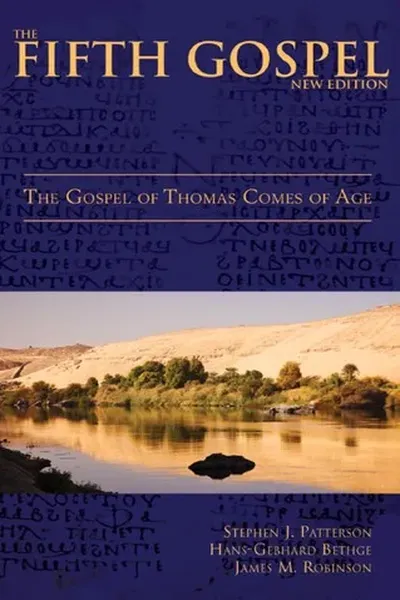
The Gospel of Thomas and Jesus

 74
74

The Gospel of Thomas and Jesus
Stephen J. Patterson's 1993 examination of the Gospel of Thomas offers a disciplined, scholarly perspective on this enigmatic text. Rather than succumbing to mystical speculation, Patterson grounds his analysis in textual and historical evidence, distinguishing the Gospel of Thomas from later Gnostic interpretations. He meticulously dissects the sayings, proposing methods for discerning their authenticity and historical layers. A particular strength is Patterson's clear exposition of the challenges in dating and attributing the sayings, highlighting the complexities of early Christian textual transmission. While valuable for its rigor, the book's dense academic style might prove a barrier for general readers. One concrete passage that exemplifies Patterson's approach is his detailed comparison of Thomasic sayings with their parallels in the canonical Gospels, meticulously noting variations in wording and theological emphasis. This work serves as a crucial resource for those dedicated to the critical study of early Christian apocrypha.
📝 Description
74
### What It Is
The Gospel of Thomas and Jesus, authored by Stephen J. Patterson and first published in 1993, offers a scholarly examination of the Coptic Gospel of Thomas. This work scrutinizes the sayings gospel, exploring its origins and its relationship to the canonical Gospels of Matthew, Mark, Luke, and John. Patterson investigates the textual evidence, linguistic analysis, and historical context to understand Thomas's unique place within early Christian literature. The book delves into the nature of the sayings, distinguishing between those likely originating from Jesus and those that may have developed later within the early Christian communities.
### Who It's For
This book is intended for serious students of early Christianity, Gnosticism, and textual criticism. It will appeal to scholars, theologians, and independent researchers interested in the historical Jesus and non-canonical scriptures. Those seeking a rigorous, evidence-based approach to understanding the Gospel of Thomas, rather than a devotional or purely theological interpretation, will find value here. It is also suitable for individuals with a background in biblical studies or ancient history who wish to expand their knowledge of alternative early Christian texts.
### Historical Context
Published in 1993, Patterson's work emerged during a period of significant scholarly engagement with the Nag Hammadi library, of which the Gospel of Thomas is a part. The discovery and subsequent translation of these texts in the mid-20th century had already revolutionized the study of early Christianity, challenging traditional narratives. Patterson's analysis situates the Gospel of Thomas within this evolving landscape of scholarship, contributing to ongoing debates about the diversity of early Christian thought and the construction of the New Testament canon. His work engages with the prevailing academic discourse on source criticism and the historical Jesus.
### Key Concepts
The central focus is the Gospel of Thomas as a collection of sayings attributed to Jesus. Patterson examines the concept of "Sayings Gospels" and their potential antiquity. He discusses the "Q source" hypothesis, a theoretical document believed to contain sayings of Jesus also found in Matthew and Luke but not Mark, and explores how the Gospel of Thomas might relate to, or predate, such hypothetical sources. The book also addresses the nature of early Christian communities and their varied interpretations of Jesus' teachings, moving beyond a singular, monolithic view of early Christianity.
💡 Why Read This Book?
• Gain a nuanced understanding of the Gospel of Thomas by learning Patterson's methodology for analyzing its sayings, differentiating them from later elaborations, a process he details through comparative textual analysis. • Appreciate the historical context of early Christian diversity by exploring how Patterson situates the Gospel of Thomas alongside canonical texts, challenging monolithic views of the period around its compilation. • Grasp the scholarly debate surrounding the "Q source" by understanding how Patterson's work on the sayings gospel contributes to discussions about early Jesus traditions and their transmission.
⭐ Reader Reviews
Honest opinions from readers who have explored this book.
❓ Frequently Asked Questions
When was Stephen J. Patterson's "The Gospel of Thomas and Jesus" first published?
Stephen J. Patterson's "The Gospel of Thomas and Jesus" was first published in 1993, a significant year for scholarship engaging with the Nag Hammadi library's discoveries.
What is the primary focus of "The Gospel of Thomas and Jesus"?
The book's primary focus is a scholarly examination of the Coptic Gospel of Thomas, analyzing its sayings, historical origins, and relationship to the New Testament Gospels.
Does Patterson's book interpret the Gospel of Thomas from a Gnostic perspective?
No, Patterson's work is a critical and historical analysis. While it discusses Gnosticism, its aim is to understand the Gospel of Thomas's own historical context and potential earlier layers, not to promote Gnostic theology.
What scholarly debate does Patterson's work engage with?
Patterson's work engages with the scholarly debate surrounding the "Q source" and the nature of early Jesus traditions, exploring how the Gospel of Thomas fits into these discussions.
Is "The Gospel of Thomas and Jesus" accessible to beginners in biblical studies?
The book is primarily aimed at scholars and advanced students due to its rigorous academic approach and detailed textual analysis, which may be challenging for absolute beginners.
What role does the Nag Hammadi library play in Patterson's research?
The Nag Hammadi library, which contains the Gospel of Thomas, is foundational to Patterson's research, providing the primary texts and context for his historical and textual investigations.
🔮 Key Themes & Symbolism
Authenticity of Sayings
Patterson rigorously investigates the authenticity of the sayings attributed to Jesus in the Gospel of Thomas. He employs critical methods to distinguish between sayings that likely reflect early Jesus traditions and those that may have been shaped by later Christian communities or Gnostic interpreters. This involves detailed comparisons with canonical texts and consideration of linguistic and thematic consistency, offering a framework for evaluating the historical plausibility of individual sayings found within the Coptic text.
Relationship to Canonical Gospels
A core theme is the complex relationship between the Gospel of Thomas and the canonical Gospels of Matthew, Mark, Luke, and John. Patterson examines whether Thomas represents an independent tradition, a source used by the canonical writers, or a later compilation. His analysis explores the implications of these possibilities for understanding the development of early Christian narratives and the formation of the New Testament canon, particularly concerning the hypothetical "Q source."
Early Christian Diversity
The work underscores the significant diversity within early Christianity. By presenting the Gospel of Thomas as a distinct collection of Jesus' sayings, Patterson highlights that early followers of Jesus held varied beliefs and preserved different traditions. This challenges the notion of a single, unified early Christian movement and emphasizes the pluralistic landscape in which the Jesus movement evolved during its formative decades.
Textual Criticism of Sayings
Patterson applies principles of textual criticism to the sayings found in the Gospel of Thomas. This involves meticulous examination of the Greek and Coptic texts, considering scribal variations, translation issues, and the underlying linguistic strata. The goal is to reconstruct the earliest possible form of the sayings and understand the processes of their transmission and interpretation across different early Christian groups.
💬 Memorable Quotes
“The sayings gospel tradition may represent a very early form of Christian literature.”
— This interpretation highlights Patterson's view that collections of Jesus' sayings, like the Gospel of Thomas, could predate or exist alongside the narratives found in the canonical Gospels, suggesting a significant layer of early Christian oral and written tradition.
“Distinguishing between historical Jesus material and later theological development is paramount.”
— This paraphrased concept emphasizes Patterson's core methodological principle: the critical need to separate authentic teachings of Jesus from later interpretations and accretions that emerged as Christianity developed within various communities.
“The Gospel of Thomas offers a different lens through which to view Jesus' teachings.”
— This interpretation suggests that the Gospel of Thomas, due to its unique collection of sayings and lack of narrative, presents a distinct perspective on Jesus' message, focusing on wisdom and inner knowledge rather than the crucifixion and resurrection narratives.
“The textual evidence for the sayings gospel is complex and requires careful analysis.”
— This interpretation underscores the scholarly challenges involved in studying the Gospel of Thomas, pointing to the intricate nature of its textual history, translation issues from Greek to Coptic, and the difficulty in establishing definitive origins.
“Understanding the milieu of early Christian groups is crucial for interpreting their texts.”
— This paraphrased concept stresses the importance of historical context in deciphering the meaning and purpose of early Christian writings, including the Gospel of Thomas, by considering the specific social, religious, and intellectual environments in which they were produced and circulated.
🌙 Esoteric Significance
Tradition
While not strictly Gnostic in its own presentation, Patterson's work is deeply engaged with the Gnostic texts of the Nag Hammadi library, of which the Gospel of Thomas is a key component. It explores the lineage of wisdom traditions that influenced both early orthodox Christianity and various Gnostic movements. Patterson's analysis facilitates understanding how esoteric interpretations of Jesus' teachings, emphasizing inner knowledge and spiritual awakening, existed and evolved alongside more dogmatic, institutionalized forms of early Christianity.
Symbolism
The Gospel of Thomas, as analyzed by Patterson, is rich with symbolic language and paradoxical sayings. Key motifs include light (representing divine knowledge or enlightenment), the kingdom of God (often presented as internal or imminent, rather than a future event), and the concept of the "living Jesus" (a spiritual presence accessible through understanding his words). Patterson examines these symbols to understand their meaning within the context of early wisdom traditions and their potential esoteric interpretations, highlighting their departure from conventional religious symbolism.
Modern Relevance
Patterson's meticulous scholarship on the Gospel of Thomas remains highly relevant for contemporary spiritual seekers and scholars interested in alternative interpretations of Jesus' teachings. Thinkers and practitioners exploring contemplative Christianity, mystical traditions, and the historical Jesus outside of mainstream dogma often draw upon the insights provided by Patterson's work. His analysis helps bridge the gap between ancient wisdom and modern quests for spiritual meaning, informing discussions in comparative religion and esoteric studies.
👥 Who Should Read This Book
• Students of early Christianity: Those seeking to understand the diversity of beliefs and texts beyond the New Testament canon will find Patterson's analysis of the Gospel of Thomas essential. • Researchers of the Historical Jesus: Scholars and enthusiasts dedicated to reconstructing the earliest possible traditions about Jesus will benefit from Patterson's critical methodology for examining the sayings. • Comparative Religion Scholars: Individuals studying the intersection of various religious traditions will find value in Patterson's placement of the Gospel of Thomas within the broader context of ancient wisdom literature and early esoteric thought.
📜 Historical Context
Stephen J. Patterson's "The Gospel of Thomas and Jesus" (1993) arrived during a fervent period of scholarly exploration into the Nag Hammadi library, discovered in 1945. The mid-20th century translations of texts like the Gospel of Thomas had already fundamentally altered perceptions of early Christianity, revealing a far more diverse landscape than previously assumed by many. Patterson's work contributed to ongoing debates about the "Q source," a hypothetical document containing sayings of Jesus shared by Matthew and Luke but absent in Mark. He engaged with scholars like James M. Robinson, a key figure in the Nag Hammadi studies, and positioned his analysis within the broader discourse on the historical Jesus and the formation of Christian orthodoxy. The reception of the Nag Hammadi texts was initially met with both excitement and suspicion, with some early Christian groups concerned about their potential to undermine established doctrines, though Patterson's focus remained firmly on critical scholarship.
📔 Journal Prompts
The concept of the 'living Jesus' as presented through Thomas's sayings.
Patterson's distinction between early sayings and later interpretations of Jesus' words.
The symbolic meaning of 'light' in the context of the Gospel of Thomas.
Reflecting on the 'kingdom of God' as an internal state, as suggested by Thomas.
The implications of the Gospel of Thomas for understanding early Christian diversity.
🗂️ Glossary
Gospel of Thomas
A non-canonical Christian text, part of the Nag Hammadi library, consisting of a collection of 114 sayings attributed to Jesus. It is often referred to as a "sayings gospel."
Nag Hammadi Library
A collection of early Christian and Gnostic texts discovered near Nag Hammadi, Egypt, in 1945. These texts provide invaluable insights into a broader spectrum of early religious thought.
Q source
A hypothetical document containing sayings of Jesus, believed by many scholars to have been used as a source by the authors of the Gospels of Matthew and Luke. The Gospel of Thomas is often compared to Q.
Textual Criticism
The academic discipline focused on identifying and rectifying errors that may have been introduced through the process of manuscript copying, aiming to reconstruct the original text.
Sayings Gospel
A genre of early Christian literature that primarily consists of sayings attributed to Jesus, with minimal narrative or biographical content. The Gospel of Thomas is the most prominent example.
Canonical Gospels
The four Gospels included in the New Testament of the Christian Bible: Matthew, Mark, Luke, and John. They are accepted by mainstream Christian traditions as authoritative.
Coptic
A late stage of the Egyptian language, written using a modified Greek alphabet. The Gospel of Thomas survives in a Coptic translation.