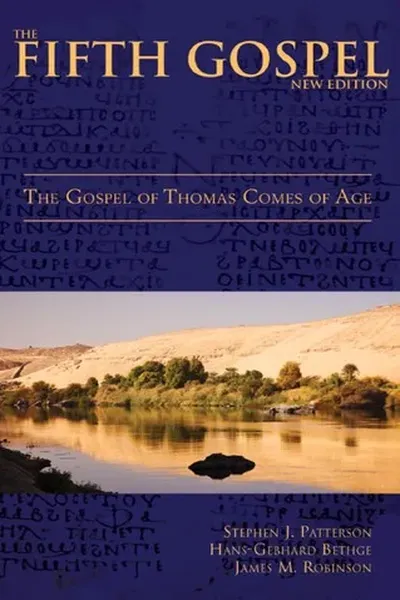
The fifth gospel

 71
71

The fifth gospel
Stephen J. Patterson’s *The Fifth Gospel* offers a refreshing, if sometimes stark, appraisal of the New Testament Gospels. Rather than treating them as monolithic accounts, Patterson meticulously peels back the layers of tradition and editorial work to reveal the distinct voices and historical pressures that shaped them. His analysis of the potential development of sayings and events, particularly when discussing the Synoptic Gospels, is both rigorous and illuminating. A notable strength is his clear exposition of complex source-criticism theories. However, the book's academic rigor, while commendable, can occasionally lead to dense passages that may challenge the casual reader. The discussion surrounding the potential 'Q source' offers a particularly compelling argument for viewing the Gospels as evolving narratives. Patterson's work provides a valuable, critical perspective on texts often approached with unexamined reverence.
Verdict: A critical examination that revises traditional understandings of the Gospels.
📝 Description
71
### What It Is The Fifth Gospel, by Stephen J. Patterson, first published in 2011, presents a scholarly yet accessible examination of the New Testament Gospels. It approaches these foundational texts not as divinely dictated narratives, but as historical documents shaped by complex human authorship and evolving theological perspectives. Patterson's work seeks to uncover the layers of meaning and potential historical kernels obscured by centuries of interpretation and tradition. The book challenges readers to reconsider their assumptions about the origins and development of Christian scripture.
### Who It's For This book is primarily for individuals with a serious interest in the historical Jesus, early Christianity, and textual criticism of religious documents. It will appeal to scholars, students of theology and religious studies, and lay readers who possess a background in biblical studies or a strong desire to engage with critical academic approaches to scripture. Those seeking a purely devotional or faith-affirming text might find its analytical stance challenging, but anyone curious about the historical context and scholarly debate surrounding the Gospels will find it valuable.
### Historical Context Patterson's work emerges from a long tradition of biblical scholarship that dates back to the Enlightenment, particularly the German *Formgeschichte* (form criticism) and *Redaktionsgeschichte* (redaction criticism) movements of the early 20th century. These methods sought to identify the earliest oral traditions and the editorial processes behind the canonical Gospels. Contemporary scholars like Bart Ehrman, with whom Patterson shares a critical yet respectful approach to textual authenticity, also engage in similar historical reconstructions. The book is part of a broader academic discourse questioning the historicity and singular authorship of biblical accounts, a discourse that has seen significant development since the mid-19th century.
### Key Concepts The book explores the concept of gospel traditions as fluid oral and written compositions that were adapted and reshaped by different communities over time. Patterson investigates the likely sources and influences on the Gospel writers, suggesting that they were not merely passive recorders but active theological agents. The work examines the criteria scholars use to assess the historical reliability of biblical accounts, differentiating between the Jesus of history and the Christ of faith. The concept of 'synoptic parallels' and the proposed 'Q source' are often discussed within this framework, providing a lens through which to understand the relationship between Matthew, Mark, and Luke.
💡 Why Read This Book?
• Gain a nuanced understanding of the Synoptic Problem by examining the proposed 'Q source' and its implications for Gospel composition, offering insights beyond standard biblical commentaries. • Learn to differentiate between the historical Jesus and later theological interpretations by analyzing Patterson's criteria for historical authenticity, a skill applicable to many ancient texts. • Appreciate the Gospels as products of specific historical and cultural contexts by exploring their potential oral and written transmission, moving beyond devotional readings to a critical perspective.
⭐ Reader Reviews
Honest opinions from readers who have explored this book.
❓ Frequently Asked Questions
What is the primary argument of Stephen J. Patterson's The Fifth Gospel?
The book argues that the canonical Gospels are not direct historical accounts but rather composite works developed over time, reflecting the theological aims and community contexts of their authors and editors.
When was The Fifth Gospel first published?
The Fifth Gospel by Stephen J. Patterson was first published in 2011.
What is the 'Q source' discussed in The Fifth Gospel?
The 'Q source' (from the German 'Quelle' meaning 'source') is a hypothetical document posited by scholars to explain material shared by the Gospels of Matthew and Luke but absent from Mark. Patterson explores its role in gospel development.
Does the book claim to disprove the existence of Jesus?
No, Patterson's work focuses on the historical and literary development of the Gospels, not on disproving Jesus' existence. It seeks to reconstruct the historical Jesus by analyzing the texts critically.
Who would benefit most from reading The Fifth Gospel?
Students of theology, religious studies, historical Jesus research, and anyone interested in critical approaches to biblical texts would find this book highly beneficial.
What academic field does The Fifth Gospel contribute to?
The book significantly contributes to New Testament studies, particularly in the areas of textual criticism, source criticism, and historical Jesus research.
🔮 Key Themes & Symbolism
Gospel Development
Patterson posits that the four canonical Gospels are not simple eyewitness accounts but rather complex literary works that evolved over time. He emphasizes the role of oral traditions, editorial choices, and theological agendas in shaping these narratives. The concept of multiple layers of composition, influenced by different communities and evolving doctrines, is central to understanding how the Gospels came to be the texts we have today. This perspective challenges the notion of a single, static original account.
Source Criticism
A significant focus is placed on source criticism, particularly the 'Q source' hypothesis. Patterson uses this method to analyze the relationships between the Synoptic Gospels (Matthew, Mark, and Luke), suggesting that common material shared between Matthew and Luke, but not Mark, likely originated from a now-lost document. This approach aims to reconstruct earlier stages of gospel tradition and understand the editorial work performed by the canonical authors.
Historical Jesus vs. Christ of Faith
The book meticulously distinguishes between the 'Jesus of history' – the figure who lived in 1st-century Judea – and the 'Christ of faith' – the theological figure developed by early Christian communities. Patterson explores the criteria scholars use to sift through the Gospel narratives to find historically plausible elements, acknowledging the inherent challenges and interpretive work involved in such a reconstruction.
Community Influence
Patterson highlights how the socio-historical contexts and specific theological needs of early Christian communities influenced the composition and transmission of the Gospels. He suggests that the narratives were adapted and sometimes created to address particular issues, doctrines, or apologetic needs within these developing groups. This underscores the Gospels as living documents responding to real-world concerns.
💬 Memorable Quotes
“The Gospels are not merely ancient history; they are theology crafted in history.”
— This statement encapsulates Patterson's view that the Gospel writers were not neutral historians but active theological thinkers who shaped their narratives to convey specific beliefs and doctrines about Jesus and his significance.
“We must ask not only what the texts say, but why they say it in this particular way.”
— This encourages a critical reading that moves beyond surface meaning to explore the underlying motivations, editorial decisions, and historical circumstances that influenced the composition of the Gospels.
“The search for the historical Jesus is an ongoing scholarly endeavor, not a closed case.”
— This highlights the dynamic nature of historical Jesus research, emphasizing that new interpretations and critical methods continually refine, rather than definitively settle, our understanding of the figure behind the Gospels.
“The Synoptic Problem remains a crucial puzzle for understanding Gospel origins.”
— This points to the enduring challenge posed by the similarities and differences among Matthew, Mark, and Luke, and the scholarly attempts, like the postulation of the Q source, to solve it.
“Tradition is not identical with history.”
— This serves as a core reminder that what has been passed down through generations, especially in religious texts, requires critical examination to separate historical kernels from later accretions or theological elaborations.
🌙 Esoteric Significance
Tradition
While not strictly an esoteric text in the vein of Hermeticism or Kabbalah, *The Fifth Gospel* engages with traditions of textual interpretation that are foundational to many esoteric paths. It operates within the broad lineage of critical biblical scholarship that seeks hidden meanings and historical realities behind the exoteric presentation of religious texts. Its approach to uncovering layers of meaning and authorial intent can be seen as a secular parallel to esoteric methods of scriptural exegesis, aiming to reveal a 'deeper' truth obscured by surface narratives.
Symbolism
The book itself doesn't focus on traditional esoteric symbols but rather on the symbolic weight carried by the Gospel narratives themselves. For instance, the concept of the 'Kingdom of God' is examined not just as a theological tenet but as a historically charged idea that Jesus likely articulated and which was later reinterpreted by his followers. The very act of questioning the authorship and transmission of the Gospels can be seen as symbolic of a broader quest for authenticity and hidden knowledge.
Modern Relevance
Patterson's work remains relevant for modern scholars and seekers interested in demythologizing religious texts and understanding their historical origins. Thinkers and movements focused on historical Jesus research, comparative religion, and secular interpretations of scripture draw upon the critical methodologies he employs. His approach provides a framework for analyzing any foundational text, encouraging a rigorous examination of its historical context and authorial intent, which resonates with contemporary intellectual currents valuing evidence-based inquiry.
👥 Who Should Read This Book
• Students of New Testament studies seeking a critical, source-based analysis of the Gospels, moving beyond traditional theological interpretations. • Researchers interested in the historical Jesus and the development of early Christian thought, who want to understand the scholarly methods used to reconstruct this period. • Skeptics and critical thinkers who wish to engage with academic arguments about the historicity and composition of biblical texts from a scholarly perspective.
📜 Historical Context
Published in 2011, *The Fifth Gospel* arrives amidst a robust and ongoing scholarly debate concerning the historical Jesus and the formation of the New Testament. The book engages directly with methodologies established in the late 19th and early 20th centuries, particularly German *Formgeschichte* and *Redaktionsgeschichte*, which pioneered critical approaches to the Gospels. Patterson's work stands in dialogue with contemporary scholars like Bart D. Ehrman, whose own prolific writings on the historical Jesus and textual criticism have significantly shaped public and academic discourse. While not a direct response, *The Fifth Gospel* implicitly addresses the continued questioning of Gospel historicity that figures like Ehrman represent. The intellectual climate of the early 21st century, characterized by a broader acceptance of critical inquiry into religious texts, provides fertile ground for Patterson's analysis, which builds upon decades of academic scholarship that challenged literal interpretations and emphasized the human authorship of scripture.
📔 Journal Prompts
The concept of the 'Q source' as a potential early Gospel text.
Patterson's criteria for assessing the historical reliability of Gospel sayings.
The distinction between the 'historical Jesus' and the 'Christ of faith'.
How community needs might have shaped the Gospel narratives.
The implications of viewing Gospels as 'theology crafted in history'.
🗂️ Glossary
Synoptic Gospels
The Gospels of Matthew, Mark, and Luke, which share a significant amount of material and similar narrative structures, leading to the 'Synoptic Problem' of their literary relationship.
Q Source
A hypothetical document, distinct from the Gospel of Mark, believed by many scholars to contain the sayings of Jesus and to have been used as a source by the authors of Matthew and Luke.
Source Criticism
A method of biblical analysis that seeks to identify and analyze the various sources (oral or written) that were used by the authors of a text.
Form Criticism (Formgeschichte)
A method that analyzes the historical setting and social function of different literary forms (genres) within biblical texts to understand their origins and development.
Redaction Criticism (Redaktionsgeschichte)
A method that examines how editors ('redactors') shaped and arranged their sources to convey particular theological messages or perspectives.
Historical Jesus
The figure of Jesus of Nazareth as he is understood through critical-historical methods, as distinct from the theological interpretations of Jesus developed later in Christian tradition.
Christ of Faith
The theological understanding of Jesus as the divine Son of God, the Messiah, and savior, as developed and believed by Christians throughout history.