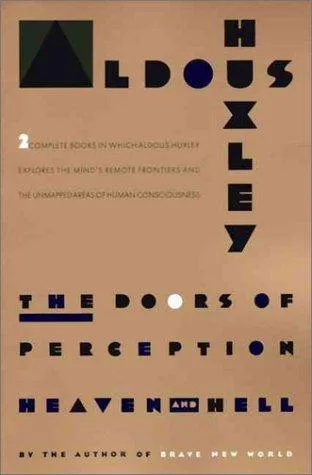
The Doors of Perception / Heaven and Hell
 74
74

The Doors of Perception / Heaven and Hell
Huxley's dual essays offer a stark, intellectual counterpoint to the often sentimentalized accounts of altered states. "The Doors of Perception" is particularly arresting for its precise, almost clinical, yet deeply poetic description of mescaline's effects. Huxley doesn't just describe hallucinations; he meticulously analyzes the shift in his own consciousness, particularly his experience with a vase of flowers, which he describes as becoming intensely present and self-sufficient. The limitation, if one can call it that, is the sheer intellectual rigor; this isn't a free-flowing mystical outpouring but a controlled philosophical investigation. "Heaven and Hell" further clarifies his dualistic model of consciousness, presenting a compelling argument for the value of transcending our everyday mental constructs. The strength lies in Huxley's ability to articulate ineffable experiences with philosophical depth and literary grace, making complex ideas accessible without sacrificing nuance. It remains a vital examination of the mind's architecture and its potential expansions.
📝 Description
74
Aldous Huxley's 1954 essay "The Doors of Perception" recounts his mescaline experience.
Aldous Huxley's "The Doors of Perception" and "Heaven and Hell," published together in 1956, examine consciousness and the nature of reality. The first part details Huxley's 1953 mescaline experiences, analyzed through mysticism and psychology. He describes a radical shift in perception, moving from the ego-centric view to a direct apprehension of the world. "Heaven and Hell" contrasts two states of mind. The "closed" mind operates within ordinary categories, while the "open" mind perceives reality directly, free from mental constructs. These essays together form a detailed look at altered states and their potential for spiritual understanding.
This collection appeals to readers interested in consciousness studies, philosophy, and visionary writing. It is for those curious about psychedelics as a tool for mental exploration, not for recreational use. Students of 20th-century literature and counterculture will find these texts significant. Anyone seeking a thoughtful exploration of perception, reality, and human experience will find valuable material here.
Published in 1956, these essays arrived when Western intellectuals were increasingly drawn to Eastern philosophies and contemplative practices. Huxley's work connects his psychedelic experiences to perennialist ideas about consciousness, drawing parallels between altered states and mystical traditions. He frames his mescaline journey not as mere hallucination but as a glimpse into a deeper reality, aligning with esoteric thought that posits subjective experience can reveal truths beyond ordinary perception. The book engaged with a growing interest in non-ordinary states as a path to spiritual insight.
💡 Why Read This Book?
• Understand the concept of the brain as a 'reducing valve' for perception, as detailed in "The Doors of Perception," and how Huxley believed substances might temporarily alter this mechanism. • Explore Huxley's philosophical distinction between the "closed" and "open" mind presented in "Heaven and Hell," offering a framework for analyzing different modes of consciousness. • Gain insight into the historical context of psychedelic research and its intellectual reception in the 1950s, a critical period for understanding altered states beyond simple drug effects.
⭐ Reader Reviews
Honest opinions from readers who have explored this book.
❓ Frequently Asked Questions
What specific psychedelic did Aldous Huxley use in "The Doors of Perception"?
Aldous Huxley famously used mescaline, a naturally occurring psychedelic alkaloid derived from the Peyote cactus, during his experiments described in "The Doors of Perception."
What is the 'reducing valve' theory Huxley discusses?
Huxley's 'reducing valve' theory posits that the brain filters out most of the information available to our senses, allowing only what is necessary for survival and social functioning to reach consciousness.
How does "Heaven and Hell" relate to "The Doors of Perception"?
"Heaven and Hell" elaborates on the philosophical implications of "The Doors of Perception," contrasting the everyday "closed" consciousness with the "open" consciousness experienced under psychedelics or through mystical practices.
When were "The Doors of Perception" and "Heaven and Hell" first published?
Both "The Doors of Perception" and "Heaven and Hell" were first published in 1956 by the Chatto & Windus publishing house in London.
Is "The Doors of Perception" a scientific study or a personal account?
It is primarily a personal account of Huxley's subjective experiences with mescaline, interpreted through his philosophical and mystical perspectives, rather than a formal scientific study.
What is the significance of the vase of flowers in "The Doors of Perception"?
The vase of flowers serves as a central example in "The Doors of Perception" for Huxley's description of how the mescaline experience dissolved his conventional perception of objects, revealing their intense, self-sufficient 'is-ness'.
🔮 Key Themes & Symbolism
The Perceptual Filter
Huxley introduces the concept of the brain as a 'reducing valve,' limiting our awareness to essential information. This filter, crucial for everyday functioning and ego-preservation, screens out the overwhelming totality of reality. The work posits that certain substances or practices can temporarily 'open' this valve, granting access to a more direct, unmediated experience of the world. This expanded perception is not merely visual but encompasses a profound alteration of time, space, and self-awareness, challenging our conventional understanding of what is real.
Open vs. Closed Consciousness
In "Heaven and Hell," Huxley contrasts two fundamental modes of consciousness. The 'closed' mind operates through language, categorization, and the ego, creating a familiar, navigable reality but obscuring deeper truths. The 'open' mind, conversely, perceives the world as it is, free from conceptual labels and the tyranny of the self. This state, akin to mystical or visionary experiences, allows for the apprehension of archetypal forms and a direct connection to the underlying fabric of existence. The book suggests a potential for integrating these states.
The Nature of Reality
Huxley questions the objective reality we commonly accept, suggesting it is a construct shaped by our biological and psychological limitations. By exploring altered states, he implies that the 'normal' state is just one facet of a much vaster, more complex reality. The work probes whether these experiences offer glimpses into a higher, spiritual dimension or simply reveal the latent capacities of the human mind. The text encourages readers to consider the limitations of their own perceptual framework and the possibility of experiencing existence more fully.
Mysticism and Psychedelics
The book bridges the gap between psychedelic experiences and traditional mystical insights. Huxley draws parallels between the profound sense of unity, timelessness, and ego dissolution reported by those under the influence of mescaline and the descriptions found in the literature of various spiritual traditions. He explores whether psychedelics can serve as a shortcut or a valid pathway to the same states of consciousness that mystics have sought through asceticism and contemplation, posing questions about the nature of these states themselves.
💬 Memorable Quotes
“The world is the world, and the things in it are the things in it. They are not my ideas about them.”
— This statement captures Huxley's attempt to perceive objects, like the vase of flowers, in their pure 'is-ness,' stripped of personal associations and conceptual overlays, highlighting the raw presence of things in the 'open' mind.
“After an experience of the Mind's Eye, the ordinary world looks like a pale imitation of itself.”
— This reflects the profound impact of visionary states, suggesting that the direct apprehension of archetypal forms or inner realities renders the mundane world less vivid and significant by comparison.
“The facts are simple and sublime. Happily, the human mind is so constructed that it can, if it wishes, perceive them.”
— Huxley expresses an optimistic view that the fundamental truths of existence are accessible to human consciousness, provided the mind is willing to shed its limitations and perceive directly.
“We are so accustomed to our own egos, we can’t imagine anything else.”
— This paraphrase highlights Huxley's observation that our sense of self, our ego, is so ingrained that it prevents us from conceiving of alternative states of being or perceiving reality without its constant mediation.
“Normal consciousness is a state of extreme limitation.”
— This assertion from "Heaven and Hell" frames ordinary waking awareness not as the baseline reality, but as a highly restricted form of perception, implying that greater awareness is possible.
🌙 Esoteric Significance
Tradition
Huxley's work, while not strictly adhering to any single esoteric tradition, draws heavily on themes found in Gnosticism and Neoplatonism, particularly the idea of a higher, true reality obscured by the material world and the limitations of ordinary perception. His concept of the 'reducing valve' can be seen as a secularized interpretation of esoteric doctrines regarding the veils of illusion (maya) or the divine spark trapped within the material form. He engages with the perennial philosophy, seeking universal truths across diverse mystical traditions.
Symbolism
The 'doors of perception' themselves symbolize the thresholds of consciousness, the points of entry into altered states or higher realities. The vase of flowers, in its intensified visual presence, represents the direct apprehension of 'is-ness' – the unmediated reality of objects when freed from conceptual labels. The contrast between 'Heaven' (the divine, unconditioned perception) and 'Hell' (the ego-bound, conditioned perception) symbolizes the dual potential of consciousness, a theme echoed in many dualistic esoteric systems.
Modern Relevance
Huxley's writings remain foundational for contemporary discussions on consciousness, psychedelics, and transpersonal psychology. Thinkers and practitioners in fields such as psychedelic-assisted therapy, mindfulness, and contemplative studies frequently cite his work. His exploration of the 'perceptual filter' continues to inform research into brain function and altered states. Furthermore, his articulation of 'open' consciousness resonates with modern mindfulness movements and the search for deeper meaning beyond materialism.
👥 Who Should Read This Book
• Students of consciousness and altered states: Those seeking a rigorous, philosophical exploration of the mind's potential beyond its ordinary functioning will find Huxley's analysis compelling. • Explorers of visionary literature: Readers interested in the literary and intellectual history of altered states and countercultural movements will appreciate this foundational text. • Philosophically-minded individuals: Anyone questioning the nature of reality, perception, and the self will benefit from Huxley's articulate and thought-provoking examination.
📜 Historical Context
Published in 1956, "The Doors of Perception" emerged during a pivotal moment in post-war Western intellectualism. While the use of psychedelics like mescaline was still largely confined to academic and psychiatric research (e.g., by figures like Humphry Osmond, who coined the term 'psychedelic'), Huxley's literary account brought the subject to a wider public consciousness. This coincided with a growing disillusionment with materialism and a search for alternative modes of experience, particularly among artists and writers. The era was also marked by burgeoning interest in Eastern philosophies and mysticism, which provided a framework for interpreting such experiences. Huxley's work was received with intense interest and controversy, influencing figures like Timothy Leary and the nascent counterculture. It stood in contrast to the existentialist currents prevalent in Europe, offering a more inward-looking, perceptual exploration of meaning.
📔 Journal Prompts
The 'reducing valve' of the brain and its implications for perceiving everyday reality.
Heavenly versus hellish states of consciousness as conceptualized by Huxley.
The self-sufficient 'is-ness' of objects as described after taking mescaline.
Comparing Huxley's 'open' mind to concepts of enlightenment in other traditions.
The role of language in constructing or obscuring reality, per "Heaven and Hell."
🗂️ Glossary
Reducing Valve
A concept proposed by Aldous Huxley, suggesting the brain filters out most sensory input, allowing only information necessary for survival and social interaction to reach consciousness.
Mescaline
A psychedelic drug derived from the Peyote cactus, known for producing visual hallucinations and altered states of consciousness, famously used by Huxley.
Perceptual Filter
Synonymous with the 'reducing valve,' this refers to the brain's mechanism for limiting sensory awareness to a manageable and functional range.
Closed Consciousness
Huxley's term for ordinary, ego-bound awareness, characterized by categorization, language, and a filtered perception of reality.
Open Consciousness
A state of expanded awareness where the perceptual filter is reduced, allowing for a more direct, unmediated experience of reality and universal forms.
Is-ness
The perceived intrinsic reality or pure existence of an object, experienced directly without conceptual interpretation, as described by Huxley.
Mind's Eye
The faculty of inner vision or imagination, which Huxley explored as potentially accessing archetypal forms or a deeper reality.