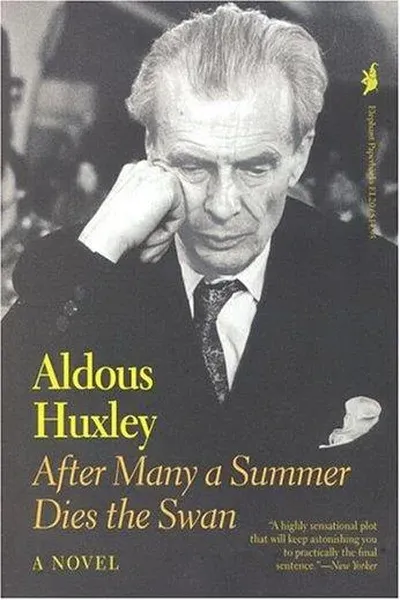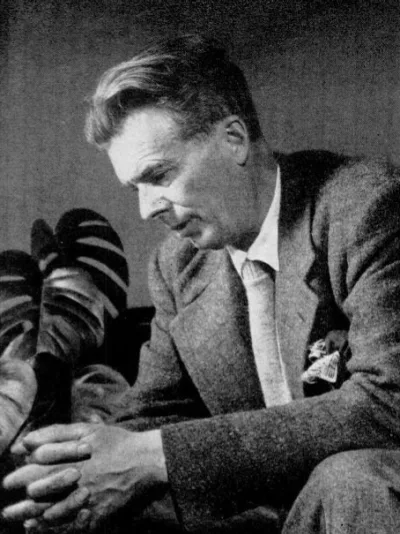
Aldous Huxley was an English writer and philosopher known for his novels, essays, and explorations of mysticism and altered states of consciousness.
Aldous Huxley, born in 1894 into a prominent intellectual family, became a prolific English writer and philosopher whose career spanned nearly 50 books. After graduating from Oxford with a degree in English literature, he published various genres including novels, essays, poetry, and screenplays. Initially known for witty social satires, his work evolved to explore deeper philosophical and mystical themes. He spent the latter part of his life in the United States, becoming recognized as a leading intellectual of his time.
Huxley's intellectual journey led him to explore philosophical mysticism and universalism, examining commonalities between Eastern and Western spiritual traditions. His experiences with psychedelic substances, particularly mescaline, informed works like "The Doors of Perception." He also famously presented visions of a dystopian future in "Brave New World" and a utopian society in "Island." Throughout his life, Huxley was a pacifist and engaged with various philosophical and spiritual movements, including Vedanta and meditation.
Early Life and Education
Aldous Leonard Huxley was born in England in 1894, the son of writer Leonard Huxley and grandson of the notable zoologist Thomas Henry Huxley. His early education was impacted by his mother's illness and death, and a significant eye condition that left him nearly blind for several years. This visual impairment ended his aspirations of becoming a doctor but, according to his brother Julian, may have been a "blessing in disguise," fostering his "universalism" and ability to engage with a wide range of knowledge. He studied English literature at Balliol College, Oxford, and briefly taught French at Eton College, where he encountered future writers like George Orwell.
Literary Career and Philosophical Evolution
Huxley began his writing career in his early twenties, gaining recognition for his social satires like "Crome Yellow." His fifth novel, "Brave New World" (1932), marked a significant departure, presenting a dystopian vision of a society controlled by scientific conditioning and mass production. During the 1920s and 30s, he also contributed to prominent magazines and became involved in pacifist movements, writing extensively on the subject. His move to California in 1937 coincided with a deepening interest in Eastern philosophies and mysticism, influenced by figures like Gerald Heard and Swami Prabhavananda.
Exploration of Mysticism and Consciousness
Later in his life, Huxley delved deeply into philosophical mysticism and universalism, seeking common threads in global spiritual traditions. His book "The Perennial Philosophy" explored these shared mystical insights. His personal experiences with psychedelic drugs, notably mescaline, documented in "The Doors of Perception," led him to investigate altered states of consciousness and their potential for spiritual insight. These explorations, alongside his earlier social critiques and utopian/dystopian visions, cemented his reputation as a profound thinker on the human condition and the nature of reality.
Key Ideas
- Exploration of dystopian and utopian societies through literature.
- Investigation of philosophical mysticism and universalism across cultures.
- Analysis of altered states of consciousness, particularly through psychedelic experiences.
- Critique of scientific progress and its potential dehumanizing effects.
- Advocacy for pacifism and social reform.
Books by
15 free public domain books · Read online or download