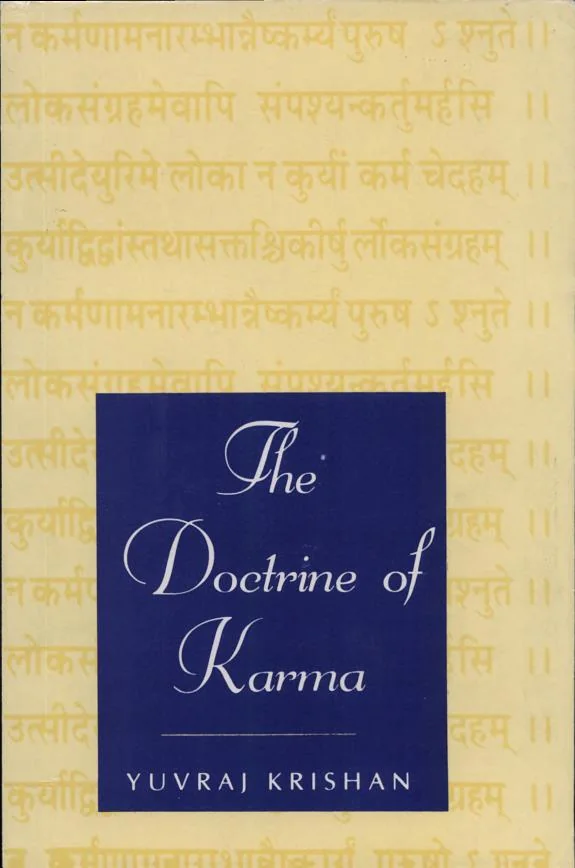
The Doctrine of Karma
 73
73

The Doctrine of Karma
Y. Krishan’s *The Doctrine of Karma* offers a deeply learned, if somewhat dry, survey of a concept central to much of Eastern thought. The author's commitment to tracing the historical lineage of karma across Hinduism, Buddhism, and Jainism is commendable, presenting a complex intellectual history with admirable clarity. A particular strength lies in its careful distinction between the nuances of the doctrine in each tradition, moving beyond simplistic generalizations. The work’s primary limitation is its academic tone, which, while precise, can feel less accessible to the casual reader. For instance, the detailed exegesis of Upanishadic verses, while vital for scholarly rigor, might deter those seeking a more immediate philosophical connection. Krishan anchors the discussion in the early 20th century’s burgeoning academic interest in Indian religions, placing it within a significant intellectual milieu. Nevertheless, for serious students of comparative religion, it remains an indispensable reference.
📝 Description
73
### What It Is This extensive exploration, first published in 1997, meticulously dissects the Doctrine of Karma. It traces the historical genesis and conceptual evolution of this fundamental principle across three major Indian religious traditions: Hinduism, Buddhism, and Jainism. The work aims for comprehensiveness, covering all conceivable facets of karmic law as understood within these distinct yet interconnected philosophical frameworks. Its approach is rigorously historical, charting the doctrine's development from its earliest manifestations to its more complex articulations.
### Who It's For Scholars of comparative religion and philosophy will find a detailed comparative analysis. Students of Eastern spiritual traditions, particularly those focusing on the intricate ethical and metaphysical systems of Hinduism, Buddhism, and Jainism, will gain a foundational understanding. Advanced practitioners seeking to deepen their grasp of the causal mechanics underpinning spiritual progression and the nature of existence will appreciate the thoroughness.
### Historical Context The genesis of the doctrine is examined from its earliest scriptural appearances. The work traces the concept's intellectual journey through Vedic hymns, Upanishadic dialogues, and the foundational texts of Buddhism and Jainism. It highlights how the doctrine became a central tenet, explaining suffering, rebirth, and the path to liberation within these traditions. The analysis underscores the doctrine's pervasive influence on Indian ethical thought and soteriology.
### Key Concepts The book unpacks the concept of *karma* not merely as action, but as volitional action and its consequences. It differentiates between *sanchita karma* (accumulated past karma), *prarabdha karma* (karma currently manifesting), and *kriyamana karma* (karma being created in the present). The interplay between *dharma* (duty/righteousness) and karma is explored, as is the ultimate aim of transcending the karmic cycle through various paths to *moksha* or *nirvana*.
💡 Why Read This Book?
• Gain a comprehensive understanding of karma’s multifaceted nature, as explored through its historical development in Hinduism, Buddhism, and Jainism, as detailed in the book's extensive tracing of the doctrine's genesis. • Understand the distinct interpretations of karmic law within different Indian philosophical schools, differentiating between concepts like *sanchita*, *prarabdha*, and *kriyamana* karma as presented in the text. • Appreciate the doctrine’s role in shaping ethical frameworks and soteriological goals within Indian traditions, as the book connects karma to paths of liberation like *moksha* and *nirvana*.
⭐ Reader Reviews
Honest opinions from readers who have explored this book.
❓ Frequently Asked Questions
When was Y. Krishan's 'The Doctrine of Karma' first published?
The seminal work 'The Doctrine of Karma' by Y. Krishan was first published in 1997, marking a significant contribution to the academic study of Indian philosophical concepts.
What are the main religious traditions discussed in 'The Doctrine of Karma'?
The book primarily focuses on the Doctrine of Karma as it is understood and developed within Hinduism, Buddhism, and Jainism, offering a comparative historical analysis.
Does the book explain different types of karma?
Yes, Y. Krishan's work delineates various categories of karma, including *sanchita* (accumulated), *prarabdha* (manifesting), and *kriyamana* (presently created) karma, explaining their roles in the cycle of existence.
What is the historical approach of 'The Doctrine of Karma'?
The book adopts a historical approach, tracing the genesis and evolution of the karmic doctrine from its earliest scriptural appearances through its complex philosophical articulations across centuries.
Who is Y. Krishan?
Y. Krishan, also known as Yuvraj Krishan, is an author recognized for scholarly works on Indian philosophy and religion, particularly his comprehensive studies of the Doctrine of Karma.
Is this book suitable for beginners in Eastern philosophy?
While comprehensive, the book's academic depth makes it most suitable for students and scholars of comparative religion and philosophy, or those with a dedicated interest in the intricacies of Indian spiritual traditions.
🔮 Key Themes & Symbolism
Karmic Causality
This theme centers on the intricate web of cause and effect that defines existence according to Indian spiritual traditions. The book details how volitional actions, or karma, inevitably lead to consequences, shaping an individual's present circumstances and future rebirths. It explores the doctrine's role in explaining suffering and the perceived order within the cosmos, moving beyond simple notions of fate to a system of moral accountability inherent in the universe itself.
Soteriological Paths
Central to the doctrine of karma is the concept of liberation from the cycle of birth, death, and rebirth (samsara). The work examines how different traditions, notably Hinduism, Buddhism, and Jainism, propose distinct paths to achieve this ultimate freedom, termed *moksha* or *nirvana*. It highlights practices and philosophical understandings aimed at transcending karmic accumulation and realizing a state of eternal peace or enlightenment.
Comparative Doctrine Analysis
A significant aspect of the book involves a detailed comparison of how the Doctrine of Karma is conceived across Hinduism, Buddhism, and Jainism. It meticulously outlines the similarities and divergences in their respective interpretations, scriptural bases, and practical implications. This comparative approach reveals the doctrine's adaptability and its foundational importance in shaping the unique ethical and metaphysical landscapes of each tradition.
Historical Evolution
The book charts the historical trajectory of the karmic concept, from its nascent forms in ancient Indian texts to its sophisticated philosophical elaborations. It reconstructs the intellectual journey, showing how the doctrine was debated, refined, and integrated into the broader religious and philosophical discourse over centuries. Understanding this evolution is key to grasping its enduring significance and its role in Indian intellectual history.
💬 Memorable Quotes
“Karma is the doctrine of causality.”
— This concise statement encapsulates the core function of karma as a universal law of cause and effect, dictating that every action generates a corresponding reaction that influences future experiences.
“The genesis of the doctrine in Vedic literature.”
— This phrase points to the foundational texts of Hinduism as the earliest documented source for the concept of karma, marking the starting point for its subsequent development and interpretation.
“Distinguishing between Hinduism, Buddhism, and Jainism.”
— This highlights the book's commitment to a nuanced, comparative approach, recognizing that while the concept of karma is shared, its specific meanings and implications vary significantly across these major Indian religious systems.
“All conceivable facets of karmic law.”
— This phrase suggests the book's ambition for thoroughness, aiming to cover the doctrine of karma in its entirety, exploring every known angle and application within the discussed traditions.
“The approach is essentially historical.”
— This statement clarifies the book's methodology, emphasizing that its primary focus is on tracing the development and historical context of the karma doctrine rather than presenting a purely theological or philosophical treatise.
🌙 Esoteric Significance
Tradition
While not strictly adhering to a single esoteric lineage like Theosophy or Hermeticism, this work deeply engages with the metaphysical and cosmological frameworks foundational to many esoteric traditions originating in India. It provides the doctrinal bedrock for understanding concepts like reincarnation, spiritual evolution, and the lawfulness of the universe, which are often reinterpreted within Western esoteric circles.
Symbolism
The book implicitly explores symbols such as the wheel of *samsara* (the cycle of birth and death), the chain of causality, and the concept of *dharma* as the cosmic order. These symbols are not merely decorative but represent fundamental principles governing existence, action, and consequence, forming the symbolic language through which karmic law is understood and experienced across lifetimes.
Modern Relevance
Contemporary esoteric practitioners and thinkers, particularly those involved in mindfulness, yoga philosophy, and reincarnation studies, draw implicitly or explicitly on the principles elucidated in works like this. Modern interpretations often seek to harmonize the doctrine of karma with psychological well-being and personal growth, adapting its ancient wisdom for contemporary spiritual seekers.
👥 Who Should Read This Book
['• Students of comparative religion: Gain a structured understanding of how karma functions as a core tenet across Hinduism, Buddhism, and Jainism, with detailed historical context.', "• Philosophy scholars: Access a rigorous analysis of causality, ethics, and soteriology within Indian philosophical systems, exploring the doctrine's intellectual evolution.", '• Esoteric practitioners: Deepen comprehension of reincarnation, spiritual causality, and liberation concepts that underpin many Eastern-inspired spiritual paths.']
📜 Historical Context
Published in 1997, Y. Krishan's *The Doctrine of Karma* emerged during a period of sustained academic interest in Indian religions, building upon foundational scholarship from figures like Surendranath Dasgupta and Radhakrishnan. The late 20th century saw continued efforts to systematically analyze complex philosophical systems, moving beyond earlier, often Orientalist, interpretations. This work positioned itself within the ongoing scholarly discourse by offering a detailed, historically grounded comparative study of karma across Hinduism, Buddhism, and Jainism. It engaged with the intellectual currents that sought to understand the ethical and metaphysical underpinnings of these traditions, particularly their explanations for suffering and the path to liberation. The book’s comprehensive scope and focus on textual evolution provided a valuable resource for scholars in comparative religion and philosophy, contributing to a more nuanced understanding of Indian thought when contrasted with Western philosophical traditions.
📔 Journal Prompts
The historical genesis of the doctrine across Vedic, Buddhist, and Jain texts.
The interplay between *sanchita*, *prarabdha*, and *kriyamana* karma in shaping present experience.
The concept of *moksha* or *nirvana* as the ultimate transcendence of karmic cycles.
The ethical implications of the doctrine of causality in daily life.
Comparative analysis of karmic interpretations in Hinduism versus Buddhism.
🗂️ Glossary
Karma
In Indian religions, karma refers to volitional action and its resultant consequences. It is the principle of cause and effect that governs the cycle of rebirth and shapes an individual's destiny.
Samsara
The continuous cycle of birth, death, and rebirth, driven by karma and ignorance. Liberation from samsara is the ultimate goal in many Indian spiritual traditions.
Moksha
A Sanskrit term signifying liberation or release from the cycle of samsara. It represents the ultimate spiritual goal in Hinduism and Jainism.
Nirvana
A Pali term, primarily used in Buddhism, denoting the state of enlightenment, liberation from suffering, and the cessation of the cycle of rebirth.
Sanchita Karma
The accumulated karma from all past lives, which has yet to fructify. It represents the total karmic balance awaiting manifestation.
Prarabdha Karma
The portion of *sanchita karma* that is currently manifesting in the present lifetime, determining one's circumstances and experiences.
Kriyamana Karma
The karma being created by one's actions in the present life, which will bear fruit in the future, either in this life or subsequent ones.








![[Catalogue of Walter Moseley's Book Sale]](/img/thumb/catalogue-of-walter-moseley-s-book-sale-george-redway.webp)