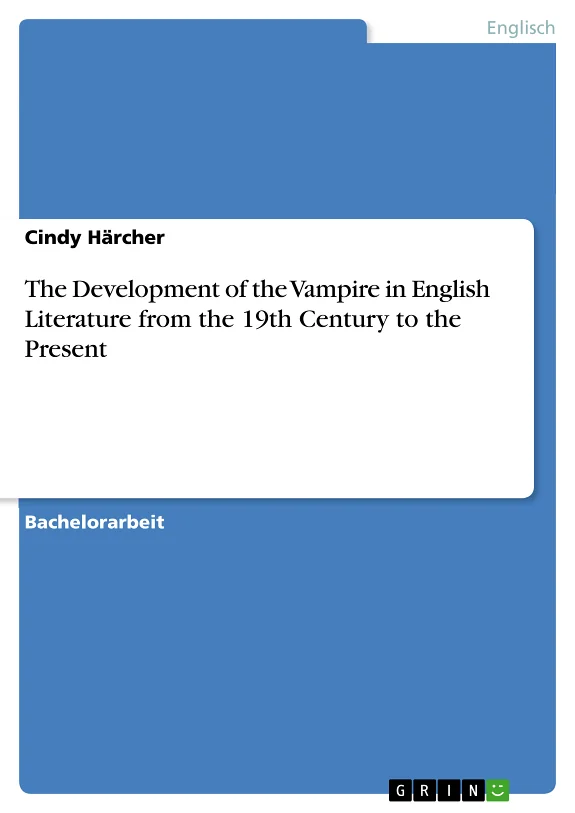
The Development of the Vampire in English Literature from the 19th Century to the Present
 76
76

The Development of the Vampire in English Literature from the 19th Century to the Present
Härcher's analysis of the English literary vampire, from its nascent 19th-century form to its contemporary iterations, offers a clear and accessible framework. The central argument, that the vampire functions as both a metaphor for its age and a reflective surface for the reader, is consistently supported through literary examples. The work's strength lies in its systematic charting of this evolution, particularly its transition from the purely monstrous to the alluring anti-hero. A slight limitation is the academic tone, which, while precise, occasionally lacks the narrative flair one might expect when discussing such a dramatically charged figure. The exploration of Bram Stoker's Dracula as a pivotal, yet ultimately transitional, figure in this development is particularly insightful, highlighting how the Count still embodied traditional evil while hinting at the seductive potential that later authors would exploit. This study provides a solid foundation for understanding the archetype's shifting cultural significance.
📝 Description
76
### What It Is Cindy Härcher's "The Development of the Vampire in English Literature from the 19th Century to the Present" is an academic examination of the evolution of the vampire archetype. Originally a Bachelorarbeit from the University of Bayreuth in 2015, this work traces the figure's transformation from a purely monstrous entity to a more complex, often romanticized, protagonist.
### Who It's For This study will appeal to literary scholars, students of Gothic and Victorian literature, and enthusiasts of the vampire mythos. Readers interested in how literary figures reflect societal anxieties and evolving cultural values will find this analysis particularly relevant. It is suited for those seeking a structured, academic perspective on literary character development.
### Historical Context The vampire figure's literary journey is deeply intertwined with the cultural shifts of the periods it inhabits. From its early 19th-century Gothic roots, as seen in figures like Lord Ruthven in Polidori's "The Vampyre" (1819), to its later romantic reinterpretations, the vampire has served as a potent symbol. Härcher's work situates this evolution within broader literary and societal trends, demonstrating how the creature mirrors contemporary fears and desires.
### Key Concepts The central thesis posits that the vampire serves as a metaphor for its era, embodying prevailing social, psychological, and moral concerns. Furthermore, the work explores the vampire's capacity to act as a mirror, allowing readers to project their own fascinations, repulsions, and desires onto the character. This dual function—as societal barometer and personal reflection—is key to understanding its enduring appeal.
💡 Why Read This Book?
• Gain a structured understanding of the vampire's literary journey from the 19th century onwards, tracing its path from monstrous evil to romantic hero, as detailed in the book's chronological analysis. • Explore the concept of the vampire as a societal metaphor, learning how its transformations reflect the anxieties and desires of specific historical periods, a core theme discussed by Härcher. • Discover how the vampire figure acts as a mirror for readers, allowing for self-reflection and engagement with complex themes, a concept exemplified by the analysis of later vampire portrayals.
⭐ Reader Reviews
Honest opinions from readers who have explored this book.
❓ Frequently Asked Questions
When was Cindy Härcher's "The Development of the Vampire in English Literature" first published?
The book was first published on October 12, 2015, originating as a Bachelorarbeit at the University of Bayreuth.
What is the main argument of the book regarding the vampire's evolution?
The central argument is that the vampire transformed from a merciless evil monster into a beautiful hero, serving as a metaphor for its age and a figure for reader self-reflection.
Which literary periods does the book primarily focus on?
The book focuses on the development of the vampire in English literature from the 19th century up to the present day.
What role does the vampire play as a literary device according to the book?
According to the book, the vampire serves two primary roles: as a metaphor reflecting the societal concerns of its era, and as a figure that allows readers to see themselves.
Is this book available in multiple languages?
The original publication, as a Bachelorarbeit from the University of Bayreuth, was written in German.
What specific literary works are likely examined in this study?
While not explicitly listed, the study would likely examine key vampire narratives from the 19th century onwards, including works by authors like Bram Stoker and potentially later reinterpretations.
🔮 Key Themes & Symbolism
Metaphorical Representation
This work posits the vampire not merely as a supernatural creature but as a potent symbol. Its evolving characteristics throughout English literature, from the 19th century onwards, are presented as direct reflections of the prevailing anxieties, desires, and moral landscapes of their respective eras. The vampire becomes a barometer for societal shifts, embodying fears of the foreign, the aristocratic, or the repressed subconscious, making its study crucial for understanding cultural history through a literary lens.
The Reflective Archetype
Beyond societal commentary, the book examines the vampire's function as a mirror for individual readers. The archetype's capacity to attract and repel simultaneously allows audiences to project their own complex emotions and forbidden desires onto the figure. This analysis highlights how the vampire transcends simple horror, offering a conduit for exploring themes of immortality, sexuality, power, and the duality of human nature, making it a perpetually relevant literary construct.
Gothic to Romantic Transformation
A core focus is the significant shift in the vampire's portrayal from its Gothic origins to later Romantic and contemporary interpretations. Härcher details how the creature's image transformed from an unambiguously evil, repulsive monster—often associated with decay and foreignness—to a more alluring, complex, and even heroic figure. This evolution is charted through key literary developments, illustrating a changing cultural fascination with transgression and the dark romantic hero.
Literary Evolution and Societal Change
The study meticulously tracks the progression of the vampire figure across different literary movements and decades. By analyzing specific texts and their reception, the work demonstrates a clear correlation between shifts in the vampire's characterization and broader societal changes, intellectual currents, and artistic trends. This approach underscores the dynamic relationship between literature and the cultural milieu in which it is produced and consumed.
💬 Memorable Quotes
“The vampire evolves from a merciless evil monster to a beautiful hero.”
— This concise statement encapsulates the book's central thesis, highlighting the dramatic arc of the vampire's literary representation from pure villainy to compelling, often romanticized, protagonist.
“Vampires as metaphors for their age.”
— This highlights the analytical framework employed, suggesting that the vampire's characteristics and narrative functions serve as allegorical representations of the specific historical and cultural contexts in which they appear.
“Figures who give readers the possibility to reflect themselves in them.”
— This points to the psychological dimension of the vampire archetype, emphasizing its role not just as an external threat or symbol, but as an internal mirror for the reader's own desires, fears, and complexities.
“Development of the vampire in English literature from the 19th century to the present.”
— This phrase clearly defines the chronological and thematic scope of the study, indicating a historical survey of the archetype's changing form and meaning over more than a century.
“Bachelorarbeit aus dem Jahr 2015 im Fachbereich Anglistik - Literatur.”
— This factual statement grounds the work within its academic origins, specifying its nature as a 2015 university thesis in English literature, which informs its scholarly approach and methodology.
🌙 Esoteric Significance
Tradition
While not strictly belonging to a defined esoteric lineage like Hermeticism or Kabbalah, this work engages with archetypal figures that have long been subjects of esoteric interest. The vampire, as a symbol of eternal life, forbidden knowledge, and the shadow self, touches upon themes common in Gnostic and alchemical traditions concerning transformation and the duality of existence. Härcher's academic approach, however, frames these explorations within literary criticism rather than occult practice, offering a secular lens on symbols often imbued with mystical meaning.
Symbolism
The vampire itself is a potent symbol, representing forbidden immortality, the seductive danger of the 'other,' and the primal instincts lurking beneath civilized veneers. Its association with blood can be interpreted esoterically as the life force or vital energy, and the act of 'feeding' as a parasitic drain on this energy. The nocturnal nature and association with the subconscious connect the vampire to hidden realms and repressed desires, common motifs in esoteric psychology and dream analysis.
Modern Relevance
Contemporary esoteric thought, particularly within subcultures exploring mythology, archetype theory, and shadow work, continues to find resonance in the vampire figure. Thinkers and practitioners interested in Jungian psychology, the exploration of the shadow self, and the reinterpretation of ancient myths for modern understanding often draw upon vampire lore. The archetype's persistent presence in popular culture, fueled by ongoing literary and cinematic adaptations, ensures its continued relevance for those examining humanity's enduring fascination with darkness and transcendence.
👥 Who Should Read This Book
• Literary scholars and students of Gothic and Victorian literature seeking a structured analysis of the vampire archetype's development. • Readers interested in how cultural anxieties and societal shifts are reflected in literary figures, particularly from the 19th century to the present. • Enthusiasts of vampire lore who wish to understand the historical and literary transformations of the creature beyond contemporary popular culture.
📜 Historical Context
Cindy Härcher's work emerges from a rich academic tradition of Gothic and vampire studies, building upon analyses that began in earnest in the mid-20th century. The 19th century, the book's starting point, was a fertile ground for the vampire's literary birth, marked by works like John Polidori's "The Vampyre" (1819) and later solidified by Bram Stoker's "Dracula" (1897). These foundational texts grappled with anxieties surrounding aristocracy, foreignness, sexuality, and the burgeoning field of psychology. Contemporaries like Sheridan Le Fanu, with "Carmilla" (1872), explored similar themes with different nuances. Härcher's analysis positions the vampire as a cultural barometer, reflecting Victorian anxieties about disease, class, and repressed desires, which were also being explored in diverse ways by authors like Oscar Wilde and the Aesthetic movement. The reception of these early vampire narratives, often debated for their sensationalism and perceived moral ambiguity, paved the way for subsequent generations of writers to reimagine the creature.
📔 Journal Prompts
The vampire's transition from monster to hero: what societal shifts facilitated this change?
Analyze the vampire as a mirror: how do modern readers project themselves onto the archetype?
Compare the metaphorical function of the 19th-century vampire with its 21st-century counterpart.
How does the vampire's evolving symbolism relate to concepts of forbidden knowledge or immortality?
Reflect on the 'beautiful hero' vampire: what does its appeal reveal about contemporary romantic ideals?
🗂️ Glossary
Archetype
A recurring symbol, character type, or motif in literature and mythology that represents universal patterns of human nature and experience, often explored in psychological and literary analysis.
Gothic Literature
A literary genre characterized by elements of horror, death, and gloom, often set in ancient, decaying castles or remote locations, exploring themes of terror, mystery, and the supernatural.
Victorian Era
The period of Queen Victoria's reign in the United Kingdom (1837-1901), a time of significant industrial, cultural, political, scientific, and military change, often reflected in its literature.
Metaphor
A figure of speech in which a word or phrase is applied to an object or action to which it is not literally applicable, used here to describe the vampire's symbolic representation of societal aspects.
Romantic Hero
A literary figure characterized by passion, individualism, and often a brooding, melancholic nature, who frequently stands in opposition to societal norms or conventions.
Literary Evolution
The process by which literary forms, genres, styles, and characterizations change and develop over time, often influenced by historical and cultural contexts.
Bachelorarbeit
A term for a Bachelor's thesis or undergraduate final paper in German academia, indicating a foundational academic research project.