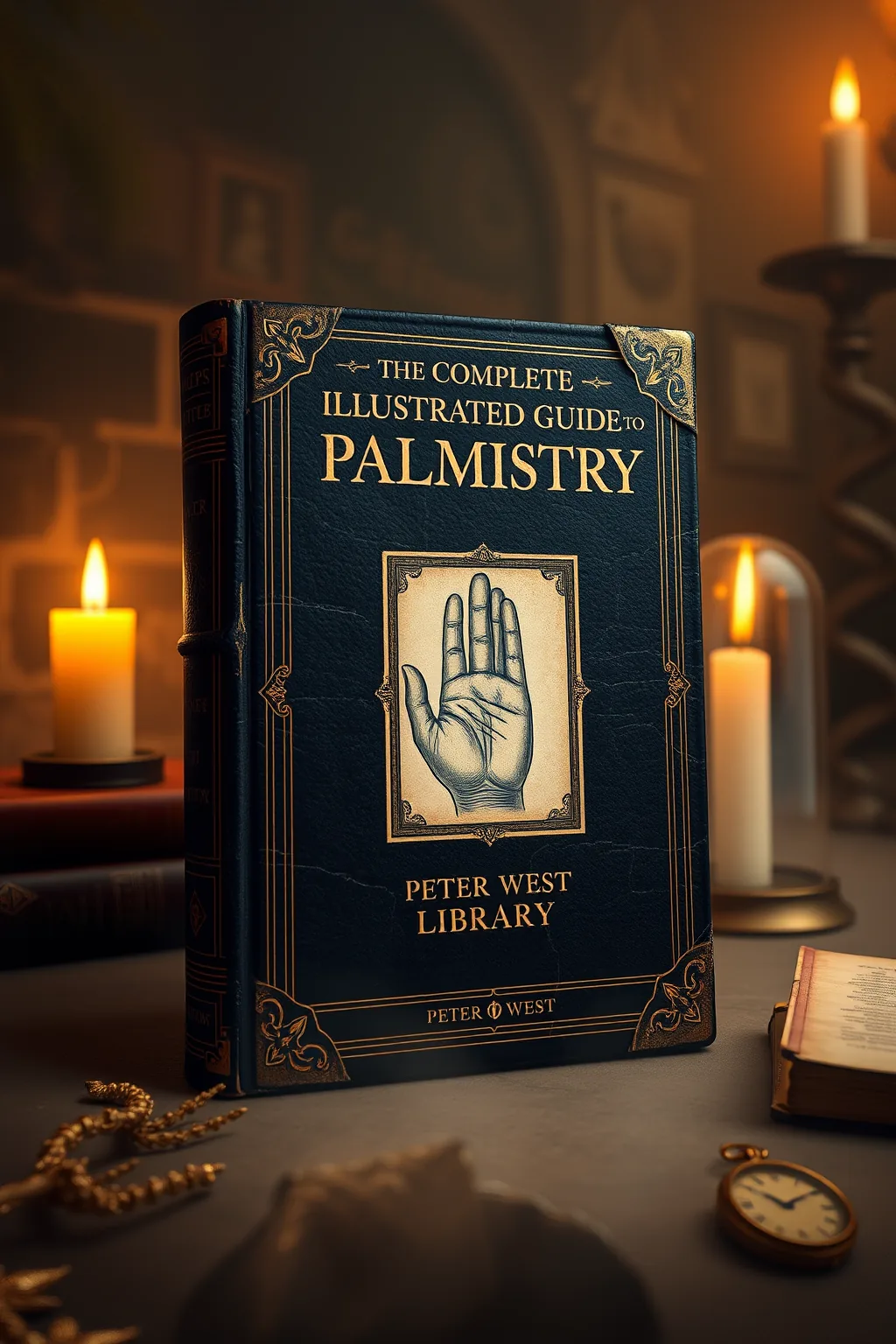
The complete illustrated guide to palmistry
 74
74

The complete illustrated guide to palmistry
Peter West’s "The Complete Illustrated Guide to Palmistry" presents a refreshingly thorough approach to a practice often relegated to parlor tricks. Its strength lies in the clarity of its illustrations and the systematic breakdown of complex palm features. The book avoids the sensationalism that plagues much contemporary occult literature, focusing instead on a methodical exposition of chiromantic principles. One particularly effective section details the subtle variations in the Mount of Luna and its correlation with intuition and emotional expression. However, the work sometimes leans heavily on established interpretations without deeply exploring alternative viewpoints or the psychological underpinnings that modern practitioners might seek. Despite this, for anyone seeking a well-organized introduction to the mechanics of palmistry, West provides a solid foundation.
📝 Description
74
Peter West's 2011 guide offers a complete visual and textual account of palmistry.
The Complete Illustrated Guide to Palmistry details cheiromancy, the practice of reading palms. Published in 2011, the book explains hand analysis, covering interpretations of palm lines, mounts, fingers, and overall hand shape. It functions as a practical manual for understanding both the diagnostic and predictive elements of palmistry, drawing on centuries of tradition.
The guide is arranged for individuals new to palmistry, supplying basic knowledge and clear illustrations to simplify the subject. It also accommodates those with some experience who wish to advance their grasp of specific interpretations and methods. Students of esoteric arts, comparative divination, and personal growth will find its organized approach useful.
The book systematically divides the complex art of palmistry into digestible parts. A core aspect of its method is linking specific palm features to character traits or life potentials. This involves interpreting major lines like the Life Line, Head Line, and Heart Line, alongside minor lines and their specific meanings. Hand shapes, finger lengths, and the prominence of mounts such as Venus, Jupiter, and Saturn are presented as important components for constructing a full reading.
Palmistry's lineage traces to ancient India, Greece, and Rome, with notable development in the Renaissance through figures like Johannes Indagine. Peter West's 2011 work engages this long history. It appears in an era where esoteric practices are often viewed through historical and psychological lenses, a contrast to earlier, purely divinatory traditions. The book connects contemporary study to this extensive lineage of chiromantic texts.
💡 Why Read This Book?
• You will learn to differentiate between the major and minor lines of the palm, understanding the specific divinatory meanings attributed to each, such as the Head Line's relationship to intellect, as detailed in the chapter on 'The Major Lines'. • Gain insight into the seven hand shapes described by the author, recognizing how each shape, like the 'Square' or 'Spatulate' hand, offers a fundamental key to personality archetypes. • Discover the significance of the mounts on the palm, understanding how their prominence, like that of the Mount of Venus, is interpreted to reflect vitality and emotional capacity.
⭐ Reader Reviews
Honest opinions from readers who have explored this book.
❓ Frequently Asked Questions
When was 'The Complete Illustrated Guide to Palmistry' first published?
The book was first published in 2011, offering a modern compendium of chiromantic knowledge to contemporary readers interested in palmistry.
What are the main components of palm reading discussed in the book?
The guide covers hand shapes, palm lines (major and minor), finger characteristics, and the mounts on the palm, each analyzed for interpretative value.
Does the book explain how to interpret different hand shapes?
Yes, it provides detailed explanations and illustrations for various hand shapes, such as the square, spatulate, conic, and philosophical hands, linking them to personality traits.
Are the illustrations in the book helpful for beginners?
Absolutely. The 'illustrated' aspect is key; the book features numerous clear diagrams and images that aid in identifying and understanding the various lines, mounts, and markings on the palm.
What is the historical lineage of the palmistry covered in West's book?
The book draws upon a tradition of palmistry that has ancient roots, evolving through various historical periods, including significant contributions during the Renaissance and subsequent centuries.
Can this guide be used for predictive palmistry?
While focusing on character analysis, the interpretation of lines and markings in the book can be applied to understand potential life paths and future tendencies, aligning with traditional predictive aspects of palmistry.
🔮 Key Themes & Symbolism
Line Interpretation Nuances
The work meticulously details the major palm lines—Life, Head, and Heart—and their numerous variations. It goes beyond simplistic definitions, exploring how subtle breaks, chains, or islands on these lines modify their core meaning, offering a sophisticated approach to reading an individual's vitality, intellect, and emotional landscape. The book emphasizes that no single line exists in isolation, encouraging holistic analysis.
Hand Shape Archetypes
West categorizes hands into distinct shapes, such as the elemental (Earth, Air, Fire, Water) or descriptive types (Square, Spatulate). Each shape is presented as a foundational blueprint for personality, providing an immediate framework for understanding a person's inherent tendencies, strengths, and potential challenges before even examining the palm's intricacies.
Mount Analysis
The book dedicates significant attention to the mounts—fleshy pads at the base of the fingers and palm. It explains how the development and markings on mounts like Jupiter, Saturn, Apollo, and Venus offer insights into ambition, creativity, happiness, and sensuality, adding another layer of interpretative depth to the chiromantic reading.
Fingers and Thumbs
Beyond lines and mounts, the guide analyzes the significance of finger length, shape, and spacing, as well as the thumb's flexibility and angle. These features are correlated with specific psychological traits and behavioral patterns, providing further detail to the portrait sketched by the palm's other elements.
💬 Memorable Quotes
“The hand is a map of the individual.”
— This central tenet highlights the book's perspective that the palm is not merely a passive surface but an active record reflecting a person's innate character, life experiences, and potential.
“A clear Life Line indicates vitality, but its length is less important than its condition.”
— This emphasizes the book's focus on the quality of expression over mere superficial measurement, suggesting that the state and integrity of a line offer more profound insight than its simple presence or perceived length.
“The thumb's angle reveals the degree of will power.”
— This concisely captures the book's approach to analyzing secondary features, linking a specific physical attribute—the thumb's splay—to a core psychological attribute: willpower and determination.
“Markings on the Mount of Saturn require careful consideration.”
— This points to the book's nuanced approach, acknowledging that certain areas, like the Mount of Saturn, are associated with more complex or potentially challenging energies that demand detailed interpretation.
“The Head Line's separation from the Life Line suggests independence.”
— This illustrates the book's method of correlating specific configurations of major lines, such as the space between the Life and Head Lines, with distinct personality traits like independence and self-reliance.
🌙 Esoteric Significance
Tradition
This work sits within the Western esoteric tradition, specifically drawing from the lineage of chiromancy that evolved from ancient Hellenistic and Roman practices, later codified during the Renaissance and Victorian eras. It aligns with a practical, divinatory, and characterological approach to reading the hand, distinct from purely Kabbalistic or Gnostic systems, though it can be seen as complementary to broader occult studies.
Symbolism
Key symbols include the major palm lines (Life, Head, Heart) which represent fundamental aspects of existence: vitality, intellect, and emotion. The mounts, such as the Mount of Jupiter symbolizing ambition and leadership, or the Mount of Luna representing imagination and intuition, act as localized centers of planetary influence and psychic energy, each imbued with specific meanings.
Modern Relevance
Contemporary practitioners of embodied spirituality, psychological astrology, and self-help modalities often reference chiromancy as a tool for self-understanding. While not always explicitly citing West, modern readers and esotericists utilize the principles of hand analysis, including line and mount interpretation, to explore personal development and intuition in ways that echo the foundational knowledge presented in his guide.
👥 Who Should Read This Book
• Aspiring practitioners of divination seeking a clear, illustrated introduction to the art of palmistry, providing foundational knowledge of lines, mounts, and hand shapes. • Students of Western Esotericism interested in the historical development and practical application of chiromancy as a symbolic language for understanding human nature. • Individuals curious about self-discovery and personal growth who wish to explore the diagnostic potential of palm reading as a tool for self-awareness.
📜 Historical Context
Peter West's "The Complete Illustrated Guide to Palmistry" (2011) emerges in an era of resurgent interest in esoteric practices, a trend that gained momentum throughout the late 20th century. While palmistry itself boasts ancient origins, tracing back to Vedic India and classical Greece, its modern form was significantly shaped during the European Renaissance. Figures like Johannes Indagine published influential treatises in the 16th century, codifying much of what became standard chiromantic interpretation. West's work builds upon this historical foundation, but it also implicitly engages with a broader Western esoteric tradition that includes Hermeticism and Theosophy, movements that re-popularized divination and occult studies. Unlike the more purely predictive texts of the Victorian era, contemporary guides like West's often seek to integrate psychological interpretations, a shift influenced by figures such as Carl Jung and his exploration of archetypes, which resonates with the symbolic language of palmistry.
📔 Journal Prompts
The Life Line's connection to vitality and the Mount of Venus's influence on personal magnetism.
Variations in the Head Line and their implications for cognitive style.
The significance of finger lengths relative to palm width.
Interpreting the prominence and markings of the Mount of Saturn.
How the overall hand shape, such as 'Square', provides an archetypal foundation.
🗂️ Glossary
Chiromancy
The practice of reading fortunes or character from the patterns of lines and features on the palm of the hand; also known as palmistry.
Life Line
The semi-circular line around the base of the thumb, traditionally interpreted as indicating vitality, physical health, and major life events.
Head Line
The line running horizontally across the palm, generally interpreted as relating to intellect, learning, and communication style.
Heart Line
The line running horizontally across the upper palm, typically associated with emotional nature, romantic relationships, and heart health.
Mounts
The fleshy, raised pads on the palm, named after mythological figures (e.g., Mount of Jupiter, Venus), believed to influence specific personality traits and potentials.
Spatulate Hand
A hand shape characterized by a broad palm and fingers that widen towards the tips, often associated with dynamism, restlessness, and practicality.
Trifurcation
A line that splits into three distinct branches, often indicating a complex or multifaceted expression of the line's core meaning.