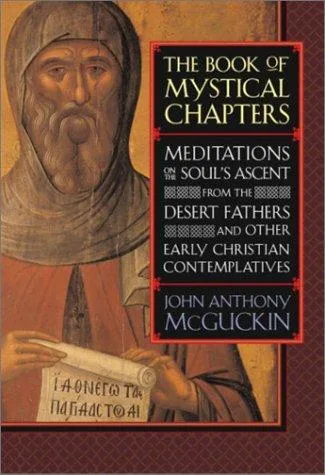
The book of mystical chapters
 79
79

The book of mystical chapters
McGuckin’s ‘The Book of Mystical Chapters’ offers a welcome, if occasionally dense, exploration of esoteric philosophy. The strength lies in its scholarly approach to often-eschewed subjects, particularly its detailed unpacking of Gnostic concepts, a departure from more popular esoteric interpretations. McGuckin’s analysis of the concept of ‘pleroma’ and its implications for understanding divine emanation is particularly well-executed, providing a clear lens through which to view complex cosmological frameworks. However, the book's primary limitation is its lack of a consistent narrative flow; readers accustomed to more structured esoteric guides might find the chapter-by-chapter approach somewhat disjointed. The section discussing the symbolism of the serpent, while informative, could benefit from more direct connections to contemporary practices. Despite these structural challenges, McGuckin provides substantial intellectual sustenance for the dedicated seeker.
📝 Description
79
<p>### What It Is</p><p></p><p>The Book of Mystical Chapters, first published in 2002 by John Anthony McGuckin, presents a collection of essays and contemplations on esoteric themes. It does not follow a linear narrative but rather explores distinct spiritual and philosophical concepts through a series of thematically linked chapters. The work draws from various mystical traditions, offering interpretations of ancient wisdom for a modern audience seeking deeper understanding of the unseen.</p><p></p><p>### Who It's For</p><p></p><p>This volume is intended for individuals engaged in serious spiritual study, particularly those interested in comparative mysticism and the history of occult thought. It appeals to readers who appreciate scholarly yet accessible explorations of complex metaphysical ideas. Those seeking to expand their knowledge beyond common spiritual doctrines will find value in its detailed examinations of less-discussed esoteric currents.</p><p></p><p>### Historical Context</p><p></p><p>Emerging in the early 21st century, the book arrived during a period of renewed popular interest in spirituality and esotericism, often termed the 'New Age' movement, though McGuckin's approach is more academically grounded. It followed decades where occult studies were often relegated to niche academic departments or underground circles. The work contributed to the growing academic and public discourse on esoteric traditions, offering a synthesis that acknowledged both historical lineage and contemporary relevance.</p><p></p><p>### Key Concepts</p><p></p><p>Central to the book are explorations of symbolic language, the nature of consciousness, and the archetypal forces that shape human experience. McGuckin examines the concept of 'gnosis' as a direct, intuitive knowing, distinct from empirical or rational knowledge. The text also frequently touches upon the cyclical nature of time and the human soul's journey through various spiritual planes, often referencing Gnostic cosmologies and the Neoplatonic philosophical framework that influenced many later esoteric schools.</p>
⭐ Reader Reviews
Honest opinions from readers who have explored this book.
❓ Frequently Asked Questions
What is the primary focus of John Anthony McGuckin's 'The Book of Mystical Chapters'?
The book focuses on esoteric themes, exploring symbolic language, consciousness, and archetypal forces. It examines concepts like gnosis and cyclical time, drawing from Gnostic and Neoplatonic traditions for a modern audience.
When was 'The Book of Mystical Chapters' first published?
John Anthony McGuckin's 'The Book of Mystical Chapters' was first published in 2002.
Who is John Anthony McGuckin?
John Anthony McGuckin is the author of 'The Book of Mystical Chapters,' known for his scholarly work on esoteric and mystical traditions. His academic background informs his detailed explorations of complex spiritual concepts.
Does the book require prior knowledge of esoteric subjects?
While prior knowledge is helpful, McGuckin's work aims for accessibility. It provides context for complex ideas like gnosis and Pleroma, making it suitable for serious students of spirituality, even those new to these specific traditions.
What kind of esoteric traditions does the book reference?
The book references Gnostic cosmologies and Neoplatonic philosophical frameworks extensively. It also touches upon broader mystical traditions and their symbolic languages.
Is 'The Book of Mystical Chapters' a practical guide for rituals?
No, it is primarily an intellectual and philosophical exploration of esoteric concepts rather than a practical guide for performing rituals. It focuses on understanding the theoretical underpinnings of mystical thought.
🔮 Key Themes & Symbolism
Gnostic Cosmology and Emanation
The work extensively explores the intricate cosmologies of Gnosticism, particularly the concept of the Pleroma as the totality of divine emanations. McGuckin details the descent of divine sparks into material existence and the subsequent quest for spiritual liberation. This theme offers a framework for understanding creation myths and the nature of the divine within a specific, influential esoteric lineage.
The Nature of Gnosis
A central focus is the exploration of gnosis – direct, intuitive spiritual knowledge – as distinct from empirical or rational understanding. McGuckin examines how this form of knowing is central to salvation in many esoteric paths, emphasizing its role in awakening consciousness to its divine origin and purpose within the cosmic order.
Symbolic Language of the Soul
The book interprets various symbols and archetypes as expressions of the soul's journey and its relationship with the divine. McGuckin analyzes motifs such as the serpent, light, and darkness not merely as literary devices but as profound signifiers of spiritual states, cosmic principles, and the hidden architecture of reality.
Cyclical Time and Spiritual Return
McGuckin discusses the esoteric understanding of time as cyclical rather than strictly linear. This perspective highlights themes of spiritual evolution, reincarnation, and the soul's eventual return to its divine source. The concept provides a framework for understanding historical patterns and personal spiritual development across lifetimes.
💬 Memorable Quotes
“The Pleroma represents the fullness of the Godhead from which all existence emanates.”
— This statement encapsulates the Gnostic concept of a perfect, primordial divine realm. McGuckin uses it to frame the origin of the cosmos and the subsequent spiritual fragmentation that necessitates a path of return to this original state of unity.
“Gnosis is the light that dispels the darkness of ignorance.”
— This highlights the salvific aspect of direct spiritual knowledge in Gnostic thought. It suggests that true enlightenment comes not from external dogma but from an internal awakening to one's divine nature.
“Archetypal forms pre-exist and inform the manifest world.”
— This paraphrase points to the Neoplatonic influence, suggesting that the patterns and essences we perceive in the material world are reflections of eternal, unchanging spiritual blueprints.
“The serpent symbolizes both primal knowledge and the potential for transformation.”
— McGuckin explores the dual nature of potent symbols. The serpent here represents not just temptation or danger, but also the deep, often hidden, wisdom that can lead to spiritual rebirth.
“Consciousness is the bridge between the material and the divine.”
— This suggests that our awareness is the key faculty for spiritual perception and connection. It implies that expanding consciousness is fundamental to accessing higher realities and understanding our place within them.
🌙 Esoteric Significance
Tradition
The work is firmly rooted in the Gnostic and Neoplatonic traditions, which form the bedrock of much Western esotericism. McGuckin's scholarship positions the book as a bridge between ancient philosophical inquiries into the nature of reality and contemporary spiritual seeking. It aligns with traditions that emphasize direct spiritual experience (gnosis) and complex cosmological systems over dogma.
Symbolism
Key symbols explored include the Pleroma, representing the divine totality and source of emanation, signifying the ultimate spiritual reality. The serpent is interpreted as a potent, often ambivalent, symbol of primordial knowledge and transformative power. Light and darkness are presented as fundamental cosmic principles, delineating spiritual clarity versus material illusion or ignorance.
Modern Relevance
Contemporary thinkers and practitioners in fields like depth psychology, comparative mythology, and integral spirituality draw on McGuckin's rigorous examination of Gnostic and Neoplatonic ideas. His work provides a valuable resource for those seeking to understand the historical roots of concepts like consciousness expansion, archetypal psychology, and the pursuit of direct spiritual knowing in modern spiritual movements.
👥 Who Should Read This Book
['• Students of Gnosticism and Neoplatonism: Those seeking a scholarly yet accessible overview of these foundational esoteric systems will find detailed explanations of cosmology and core philosophical tenets.', "• Comparative Religion Scholars: Individuals interested in exploring the intersections between different mystical traditions and understanding the historical development of esoteric thought will benefit from the book's analytical approach.", '• Seekers of Deeper Metaphysical Understanding: Readers looking to move beyond superficial spiritual concepts and engage with complex ideas about consciousness, reality, and the nature of the divine will find ample material for contemplation.']
📜 Historical Context
Published in 2002, John Anthony McGuckin's 'The Book of Mystical Chapters' emerged during a period of significant academic and popular engagement with esoteric traditions. While the 'New Age' movement had peaked, interest in comparative religion, mysticism, and occult history continued to grow in both scholarly and public spheres. McGuckin's work offered a more academically rigorous approach compared to many contemporary popular spiritual texts. It contributed to a broader discourse that included scholars like Ioan P. Couliano, whose work on Gnosticism and magic was influential. The book navigated the complex landscape of Western esotericism, drawing heavily on Gnostic and Neoplatonic thought, which had seen resurgent interest since the mid-20th century, partly due to figures like Carl Jung and esoteric scholars exploring Hermeticism and Kabbalah.
📔 Journal Prompts
The concept of Pleroma as the divine totality: how does this contrast with other creation narratives you know?
Reflecting on the nature of gnosis: what personal experiences might align with this direct knowing?
The symbolism of the serpent: explore its potential for both hidden knowledge and transformation in your own life.
Contemplating cyclical time: how might this perspective alter your view of personal growth and history?
Archetypal forms and their influence: identify an archetype you frequently encounter and its potential source.
🗂️ Glossary
Pleroma
In Gnostic and related esoteric traditions, the Pleroma refers to the totality of divine powers and emanations, considered the perfect, primordial realm from which all existence originates.
Gnosis
Direct, intuitive spiritual knowledge or insight, often considered the key to salvation or enlightenment in Gnostic traditions. It is a knowing that transcends rational or empirical understanding.
Archetype
A primordial, universal pattern or model of a person, behavior, or symbol, believed to be present in the collective unconscious and to influence human thought and experience.
Neoplatonism
A philosophical system originating with Plotinus, which significantly influenced Christian, Jewish, and Islamic thought, as well as Western esotericism. It emphasizes emanation from a single, transcendent source ('The One').
Emanation
The process by which existence flows or is projected from a divine or primary source, as described in Neoplatonic and Gnostic cosmologies. It suggests a hierarchical outflow from the ultimate reality.
Esotericism
Belief systems and practices that focus on inner spiritual realization, often involving secret knowledge, symbolism, and direct experience, typically distinct from exoteric (outward) religious doctrines.
Cosmology
The study or theory of the origin, structure, and evolution of the universe. In an esoteric context, it often refers to the spiritual and metaphysical principles believed to govern the cosmos.