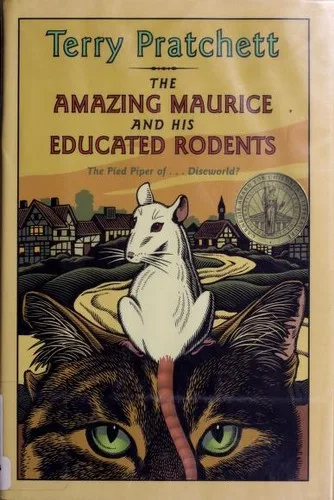
The Amazing Maurice and His Educated Rodents
 81
81

The Amazing Maurice and His Educated Rodents
Terry Pratchett’s *The Amazing Maurice and His Educated Rodents* presents a clever subversion of fairy tale tropes, focusing on a cat who orchestrates a rat-based scam. The strength of the book lies in its sharp wit and the sophisticated characterization of Maurice, whose cynical pragmatism drives the narrative. A particularly memorable sequence involves the town of Bad Ass, where the established order is built on a foundation of fear and misinformation, highlighting Pratchett's characteristic critique of authority. However, the pacing occasionally falters, with some sections feeling slightly drawn out as the central con is meticulously detailed. The resolution, while satisfying in its thematic resonance, could have benefited from a touch more narrative urgency.
Ultimately, this work stands as a prime example of Pratchett’s ability to imbue a seemingly simple story with layers of social commentary and engaging character arcs.
📝 Description
81
Terry Pratchett's 2018 novel, The Amazing Maurice and His Educated Rodents, uses a children's fantasy premise to examine societal control.
The story follows Maurice, a streetwise cat who can talk to rats, and his gang of intelligent rodents. Together, they pull off elaborate scams in various towns, convincing people there are rats and a rat catcher, when in reality it is all a setup. This narrative is aimed at readers who enjoy clever characters operating outside typical moral boundaries and appreciate stories with hidden meanings.
It is particularly suitable for those interested in how simple tales can carry deeper observations about human and rodent behavior. The book offers a lot for readers who like to consider power structures and how perceptions are manipulated. Pratchett published this work in 2018, continuing a career that began in the late 1970s. His writing style, known for mixing humor with social commentary, had already built a strong audience by then. The novel arrived during a time when fantasy literature was increasingly exploring complex social and philosophical ideas, a path Pratchett himself had long followed.
While framed as a children's fantasy, The Amazing Maurice and His Educated Rodents engages with ideas about collective belief and the construction of reality. The rodents' ability to create and maintain a shared illusion within a town mirrors how narratives, whether fictional or factual, shape societal understanding and behavior. This touches on concepts explored in philosophies that question the objective nature of truth and how consensus reality is formed, often through the strategic use of language and storytelling.
💡 Why Read This Book?
• Gain insight into the mechanics of deception and collective manipulation, as exemplified by Maurice’s elaborate rat-based cons in the town of Bad Ass. • Explore the subversion of classic fairy tale archetypes, particularly how the narrative reframes the traditional hero-villain dynamic through characters like Maurice. • Appreciate Pratchett’s signature blend of humor and social critique, offering a unique perspective on societal structures and the power of narrative, evident in the clever dialogue.
⭐ Reader Reviews
Honest opinions from readers who have explored this book.
❓ Frequently Asked Questions
What is the primary scam orchestrated by Maurice and his rats?
Maurice, a cat who can talk to rats, leads a group of intelligent rodents in a scam where they clear a town of rats, only to demand payment for their services. The town of Bad Ass is a key location where this scheme is employed.
Who are the main characters in The Amazing Maurice and His Educated Rodents?
The central characters include Maurice, the cunning cat; Malicia, the human girl who discovers the rats' intelligence; and the educated rats themselves, such as Hamish, who play a crucial role in the narrative's unfolding events.
What is the significance of the name 'Bad Ass' in the book?
The town's name, Bad Ass, is a pun that reflects its grim reality and the desperate situation its inhabitants face, setting the stage for Maurice and his crew's arrival and the subsequent events.
Does this book connect to Terry Pratchett's Discworld series?
While sharing Pratchett's characteristic humor and thematic depth, The Amazing Maurice and His Educated Rodents is a standalone story and does not directly feature characters or locations from the Discworld universe.
What age group is this book recommended for?
Although often categorized for younger readers, its sophisticated themes, wit, and social commentary make it enjoyable and thought-provoking for adults as well, particularly those familiar with Pratchett's work.
What makes the rats 'educated' in the story?
The rats are 'educated' because they possess human-level intelligence, can communicate with Maurice, and understand complex concepts and strategies, enabling them to participate in Maurice's elaborate scams.
🔮 Key Themes & Symbolism
The Art of the Con
The narrative meticulously details the mechanics of elaborate scams, moving beyond simple trickery to explore social engineering. Maurice and his educated rodents operate on a grand scale, manipulating towns by first creating a problem (infestation) and then offering a solution for profit. This theme examines how perception, fear, and collective belief can be leveraged, turning a scam into a societal phenomenon. The town of Bad Ass serves as a prime example of a place ripe for such exploitation due to its own internal failings.
Intelligence and Communication
A central tenet is the concept of 'educated' rodents – beings possessing sapience and complex communication skills, notably between Maurice and his rat companions. This challenges conventional hierarchies and reveals intelligence in unexpected forms. Their ability to strategize, plan, and execute complex operations underscores the power of shared knowledge and advanced communication, setting them apart from ordinary animals and positioning them as agents of change or disruption within their environment.
Critique of Authority and Society
Pratchett uses the story to satirize societal structures and the figures who hold power. The adults in the towns are often portrayed as gullible, fearful, or corrupt, easily manipulated by Maurice's schemes. This reflects a broader commentary on how societies can be controlled through misinformation, tradition, or the suppression of inconvenient truths. The narrative questions the legitimacy of established orders and highlights the vulnerabilities inherent in human communities.
The Nature of Storytelling
The book subtly explores how stories shape reality. Maurice's success relies not just on his intelligence but on his ability to craft narratives that people will believe. The rats' intelligence allows them to participate in this, understanding the power of a well-told tale. This theme touches upon the esoteric idea that reality itself can be influenced by collective agreement and the power of myth-making, a concept explored through the characters' interactions and the towns' reactions.
💬 Memorable Quotes
Direct passages from the work, attributed to the author.
“The rats were intelligent. They were educated. They could read and write.”
— This statement is foundational to the novel's premise, immediately establishing the extraordinary nature of Maurice’s companions. It signals a departure from typical animal stories, introducing a world where non-human intelligence operates on a sophisticated, almost human level.
“‘Everyone’s got to make a living.’”
— A recurring sentiment that serves as Maurice’s justification for his actions. It presents a justification rooted in necessity, framing his elaborate scams as a form of survival in a world that doesn't necessarily reward honesty or offer fair opportunities.
💡 Key Ideas
Editorial paraphrase of the work's core concepts — not direct quotes.
‘It’s not what you know, it’s what you can prove.’
This line captures the pragmatic, almost legalistic approach Maurice takes to his schemes. It highlights the importance of evidence and presentation in convincing others, suggesting that even a fabricated reality can gain traction if it appears demonstrably true.
‘We’re rats,’ said Hamish. ‘We’re supposed to be stupid.’
This quote reveals the rats' awareness of their societal perception versus their actual capabilities. It underscores the theme of intelligence existing where it's not expected and the inherent conflict between innate ability and imposed identity.
‘I don’t like the way you talk about the mayor.’
This line, likely spoken by Malicia, indicates a budding moral compass or an early challenge to Maurice's cynical worldview. It suggests a tension between the pragmatic, amoral nature of the con and a developing sense of justice or empathy.
🌙 Esoteric Significance
Tradition
While not explicitly tied to a single esoteric lineage, *The Amazing Maurice* engages with themes common in philosophical and allegorical traditions. Its focus on illusion, manipulation, and the uncovering of hidden truths speaks to Gnostic and Hermetic thought, which often explore the idea of a false reality or a demiurgic creator. The narrative presents a world where conventional understanding is flawed, and true insight comes from an 'outsider' perspective, mirroring the Gnostic concept of gnosis as a path to liberation from ignorance.
Symbolism
The most potent symbol is the 'educated' rodent itself, representing hidden intelligence and the subversion of expectations. Rats, often seen as pests and symbols of decay or disease, are here elevated to sentient strategists, challenging ingrained societal perceptions. Maurice, the cat, can be interpreted as a liminal figure, bridging the mundane and the extraordinary, a common archetype in folklore and esoteric narratives, often associated with cunning and hidden knowledge.
Modern Relevance
Contemporary thinkers exploring the psychology of belief, the spread of misinformation, and the dynamics of power in the digital age can find parallels in Maurice's methods. His ability to orchestrate a town-wide scam by manipulating perceptions is remarkably relevant in an era of 'fake news' and social media echo chambers. The novel serves as a cautionary, yet humorous, reminder of how easily societies can be swayed and the importance of critical discernment.
👥 Who Should Read This Book
• Readers interested in social commentary disguised as children's fantasy, particularly those who enjoy dissecting narratives for underlying critiques of authority and societal norms. • Students of folklore and comparative mythology seeking examples of how classic archetypes (like the clever trickster) are reinterpreted in modern literature. • Fans of Terry Pratchett’s distinctive humor and narrative style, who appreciate works that blend wit with profound observations on human nature and community.
📜 Historical Context
Terry Pratchett’s *The Amazing Maurice and His Educated Rodents*, published in 2018, arrived decades after his career began, yet it carries the hallmarks of his distinctive, socially aware comedic fantasy. The late 20th and early 21st centuries saw a growing trend in children's and young adult literature to tackle complex themes such as social injustice, corruption, and the nature of power, a space Pratchett had long occupied with his Discworld series. This novel fits within that tradition, offering a sharp critique of societal gullibility and manipulation. While not directly engaging with specific esoteric movements, its exploration of how belief systems are constructed and exploited echoes certain Gnostic ideas about illusion and hidden knowledge. Pratchett’s work often found itself in dialogue with contemporary thinkers concerned with societal structures, and this book, with its focus on deception and collective action, continues that critical examination. Its reception was positive, fitting into a literary landscape where authors like Neil Gaiman were also blending fantasy with profound social commentary.
📔 Journal Prompts
The societal constructs within the town of Bad Ass and their role in enabling Maurice's scam.
The concept of 'educated' rodents and its implications for understanding intelligence.
Maurice's justifications for his actions versus the ethical considerations presented.
The narrative's commentary on how communities respond to perceived threats and solutions.
Malicia's evolving perspective on Maurice and the rats throughout the story.
🗂️ Glossary
Educated Rodents
Rats possessing human-level intelligence, capable of complex thought, communication, and strategic planning, as depicted in the novel. They are central to Maurice's scams.
Maurice
The protagonist, a cunning and articulate cat who can communicate with rats and orchestrates elaborate scams for profit.
Bad Ass
A town featured in the novel that is plagued by rats, setting the stage for Maurice and his crew's deceptive operation.
The Con
The central scheme employed by Maurice and his rat companions, involving creating a problem and then demanding payment for its resolution.
Sapience
The quality of being wise or intelligent; the state of being sentient. In the context of the book, it refers to the rats' advanced mental capabilities.
Liminal Figure
A character or entity that exists on the threshold between two states or worlds, often possessing unique insights or abilities. Maurice can be seen as such a figure.
Social Engineering
The use of psychological manipulation to influence people into performing actions or divulging confidential information. Maurice employs this on a large scale.
🔮 Readers Also Liked
Browse all →








More by Terry Pratchett
All books →





More Free Occult Philosophy Books
View all →