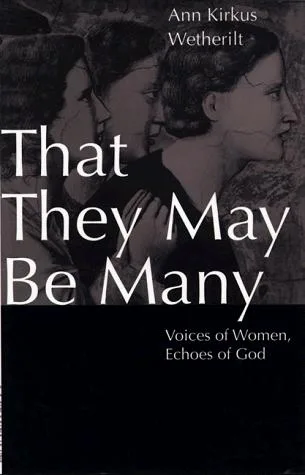
That they may be many
 83
83

That they may be many
Ann Kirkus Wetherilt’s "That They May Be Many" offers a dense, philosophical exploration of consciousness that eschews easy answers. The book’s strength lies in its rigorous intellectual approach, dissecting the concept of the individual within a larger cosmic framework. Wetherilt avoids the common pitfalls of New Age platitudes, instead building a case for a complex, multi-layered unity. A particular passage that stands out is the discussion on "energetic coherence," which posits that shared intention can create palpable, unified fields of awareness. However, the work’s abstract nature can also be its primary limitation. Without a more grounded narrative or illustrative examples beyond conceptual frameworks, readers may struggle to fully grasp the practical implications of Wetherilt’s theories. The text demands significant reader engagement and a pre-existing familiarity with esoteric thought. It is a challenging but rewarding read for those prepared to undertake the mental labor.
📝 Description
83
Ann Kirkus Wetherilt published 'That They May Be Many' in 2016.
Ann Kirkus Wetherilt's 2016 book, "That They May Be Many," examines the connection between individual awareness and group identity. It moves past simple ideas of oneness, looking at the self's fractal structure and how it can grow in a spiritual or energetic sense. The work presents ideas for thought rather than a story, asking readers to consider its concepts personally. Wetherilt's writing is for those studying occult philosophy, consciousness, or comparative mysticism. It suits readers familiar with basic texts on individuality, shared consciousness, or existence. The book is for people who prefer detailed philosophical examination over spiritual directions. It is especially useful for individuals wanting to grasp how shared experiences work or how ego boundaries can lessen without dogma.
The book breaks down the idea of the 'self' into its energetic and psychic parts. It discusses the formation of collective identity and the different ways consciousness can be shared. Wetherilt uses a speculative approach to explore how group dynamics might operate on a psychic level. The text invites contemplation on the nature of boundaries, both personal and communal.
Published in 2016, "That They May Be Many" arrived during a time of renewed interest in non-dual philosophies and the use of contemplative methods for modern psychological and social issues. While not directly referencing Carl Jung's earlier work on the collective unconscious, Wetherilt's book touches on similar ideas. The growth of online groups and global connection in the early 21st century framed discussions on shared awareness. This context made Wetherilt's look at the 'many' within the 'one' particularly relevant, offering a complex, analytical view in contrast to simpler New Age ideas of unity.
💡 Why Read This Book?
• Gain a nuanced understanding of "unity" beyond simplistic concepts, exploring how "energetic coherence" functions as a practical mechanism for shared consciousness, as detailed in the book's core arguments. • Discover a framework for reconciling individual identity with collective experience, learning how the "fractal nature of selfhood" can be integrated rather than dissolved. • Engage with a sophisticated esoteric perspective that emerged in 2016, offering a counterpoint to more superficial discussions of consciousness prevalent at the time.
⭐ Reader Reviews
Honest opinions from readers who have explored this book.
❓ Frequently Asked Questions
What is the central thesis of Ann Kirkus Wetherilt's "That They May Be Many"?
The book's central thesis explores how individual consciousness can expand into collective awareness without losing its distinct identity, proposing a model of "energetic coherence" where multiplicity is harmonized, not erased.
When was "That They May Be Many" originally published?
The book was first published in 2016, positioning it within contemporary discussions on consciousness and interconnectedness.
Is "That They May Be Many" suitable for beginners in esoteric studies?
While accessible, the book is best suited for those with some prior exposure to esoteric philosophy or consciousness studies due to its abstract and analytical approach.
What does the book mean by the 'fractal nature of selfhood'?
This concept suggests that the individual self is not a monolithic entity but is composed of many interconnected parts, mirroring the structure of a fractal, and that this complexity extends into collective consciousness.
Does the book offer practical exercises for readers?
The book focuses primarily on conceptual exploration rather than providing a set of prescriptive exercises. Its practical application lies in the reader's intellectual and contemplative engagement with its ideas.
How does "That They May Be Many" relate to ideas like the collective unconscious?
While not directly referencing Carl Jung's "collective unconscious," Wetherilt's work explores similar territory by examining the underlying structures and dynamics that connect individual minds into a larger whole.
🔮 Key Themes & Symbolism
The Fractal Self
Wetherilt posits that the individual consciousness is not a singular point but possesses a "fractal nature," meaning it is composed of infinite, self-similar patterns within patterns. This concept challenges the notion of a fixed ego and suggests that the self is a dynamic, multi-dimensional construct. This intricate structure, the book argues, is the very mechanism that allows for participation in and understanding of larger, collective fields of awareness without dissolution. The exploration of this fractal geometry of the psyche is central to grasping how one can be both distinct and part of a greater whole.
Energetic Coherence
A core concept introduced is "energetic coherence," describing the phenomenon where multiple individual consciousnesses can align and synchronize their energetic frequencies. This alignment, Wetherilt suggests, creates a unified field of awareness that possesses properties distinct from the sum of its parts. It’s not about merging into an undifferentiated mass, but about achieving a state of resonant harmony. This principle is presented as the underlying mechanism for phenomena often described as group intuition, collective intent, or shared spiritual experiences.
Multiplicity as Foundation
Instead of viewing the "many" as something to be transcended in pursuit of a singular "one," Wetherilt argues that multiplicity is the fundamental reality upon which unity is built. The book examines how recognizing and harmonizing the diverse elements within oneself and within groups is essential for authentic collective existence. This perspective reframes the common esoteric goal of unity, suggesting that true oneness emerges from the conscious integration of difference and the acknowledgment of the inherent complexity of being.
Consciousness Fields
The work explores the idea of "consciousness fields" – emergent properties of interconnected minds. These fields are not merely abstract concepts but are presented as tangible, though subtle, energetic realities that influence perception, experience, and action. By understanding the dynamics of these fields, readers can gain insight into how collective beliefs, emotions, and intentions shape reality on both individual and global scales. The book offers a framework for perceiving and potentially interacting with these subtle energetic structures.
💬 Memorable Quotes
“The self is not a solitary point, but a universe echoing itself.”
— This statement captures Wetherilt's idea of the fractal nature of selfhood, suggesting that the individual consciousness contains within it patterns and structures that are mirrored on larger scales, both internally and externally.
“Unity arises not from erasure, but from resonant alignment.”
— This paraphrase highlights the concept of energetic coherence, emphasizing that true collective consciousness is achieved through harmonious synchronization of individual energies, rather than the loss of individual distinctiveness.
“Each point of awareness contributes to the collective field.”
— This interpretation points to the idea of consciousness fields, illustrating how every individual consciousness plays a role in shaping the larger energetic and perceptual realities experienced by groups.
“The many are the grammar of the one.”
— This metaphorical statement suggests that the diversity and multiplicity of individual experiences and perspectives are the fundamental building blocks that create and define any larger sense of unity.
“To be many is to perceive the universe from infinite perspectives.”
— This phrase encapsulates the benefit of understanding multiplicity, suggesting that embracing the many facets of existence, both within oneself and in the collective, leads to a richer and more comprehensive perception of reality.
🌙 Esoteric Significance
Tradition
Wetherilt's work can be situated within the broader Hermetic and Gnostic traditions, which emphasize the intricate architecture of consciousness and the potential for individual gnosis (knowledge) to unlock participation in higher realities. It departs from some mystical traditions by focusing on the inherent value of multiplicity as a foundational principle, rather than solely on transcendence or dissolution into a singular divine essence. The book's analytical approach to consciousness aligns with Hermeticism's focus on understanding the principles governing the cosmos and the self.
Symbolism
The primary symbolic motif is the "fractal," representing the self-similar patterns that constitute both individual and collective consciousness. This symbol suggests infinite complexity within finite forms, mirroring esoteric ideas of the microcosm reflecting the macrocosm. Another implicit symbol is "resonance" or "coherence," representing the harmonious interaction of distinct energetic points, akin to musical harmony or crystalline structure, which facilitates the formation of unified fields of awareness.
Modern Relevance
Contemporary thinkers and practitioners in fields like consciousness studies, integral theory, and even certain branches of quantum mysticism find Wetherilt's framework for understanding collective phenomena highly relevant. Her ideas on "energetic coherence" can be applied to understanding the dynamics of online communities, collaborative projects, and the cultivation of group intention. Thinkers exploring non-dualism without positing the annihilation of the individual often draw upon such nuanced explorations of unity through multiplicity.
👥 Who Should Read This Book
• Students of esoteric philosophy seeking a rigorous, non-dogmatic exploration of consciousness and identity, particularly those interested in the interplay between individual and collective awareness. • Practitioners of contemplative or meditative arts who wish to understand the energetic mechanics behind shared experiences and the nature of unified consciousness. • Researchers and thinkers in consciousness studies interested in 21st-century esoteric perspectives that offer alternatives to simplistic models of unity, providing a complex framework for "energetic coherence."
📜 Historical Context
Ann Kirkus Wetherilt's "That They May Be Many," published in 2016, emerged at a time when discussions on consciousness were increasingly influenced by both scientific advancements and a renewed interest in ancient esoteric traditions. The early 21st century saw a proliferation of concepts related to interconnectedness, amplified by digital communication, yet often lacking rigorous philosophical grounding. Wetherilt’s work offered a more analytical and structured approach, diverging from the more simplistic notions of "oneness" prevalent in some New Age circles. While not directly engaging with the psychoanalytic theories of Carl Jung, her exploration of collective consciousness and the individual's place within it resonates with Jung's concept of the collective unconscious, albeit from a different philosophical lineage. The book provided a sophisticated counterpoint to more diffuse spiritual philosophies, offering a framework for understanding unity through complexity and multiplicity, a perspective less common in the immediate post-millennial spiritual landscape.
📔 Journal Prompts
The fractal nature of selfhood: how do its patterns manifest in your daily life?
Reflect on moments of "energetic coherence" you have experienced within groups.
Consider the "grammar" of "the many" in your personal relationships.
How can recognizing multiplicity enhance your understanding of unity?
Explore the concept of "consciousness fields" and your participation within them.
🗂️ Glossary
Fractal Nature of Selfhood
The concept that individual consciousness is structured in self-similar patterns across different scales, suggesting an inherent complexity and interconnectedness within the individual psyche.
Energetic Coherence
A state where multiple individual consciousnesses align their energetic frequencies, creating a unified field of awareness with distinct properties, facilitating shared experience.
Consciousness Fields
Emergent, subtle energetic realities formed by the interaction and synchronization of multiple individual minds, influencing collective perception and experience.
Multiplicity
The principle that diversity and distinctness are fundamental aspects of existence, serving as the basis for any form of true unity or collective being.
Resonant Alignment
A state of harmonious interaction between individual consciousnesses, where their energetic vibrations synchronize to form a cohesive, unified field.
Gnosis
Spiritual or esoteric knowledge, particularly direct experiential insight into the divine or the fundamental nature of reality, often associated with Gnostic traditions.
Hermeticism
A philosophical and religious tradition based on writings attributed to Hermes Trismegistus, emphasizing the interconnectedness of all things and the pursuit of knowledge through understanding cosmic principles.